‘It could be any town, but it is better that it was Trenton. That’s unique,” says Erik N. Pyontek about his emerging series of novels based on the true life experiences of his family in Trenton.
Called the Cavell Avenue Memoirs, the story is also about the times of a city and a nation. It appears in two installments published in 2015 by Twining Press, a small press in Minneapolis, Minnesota.
The first is the nearly 500-page “When the World Was Young.” The second is “Scattered Dreams,” shorter at 196 pages. But no matter the size, they both chronicle the personal and social lives of a family living in a specific Trenton house during the era bookended by the start of World War I and the Atomic Age. A third installment is in the works.
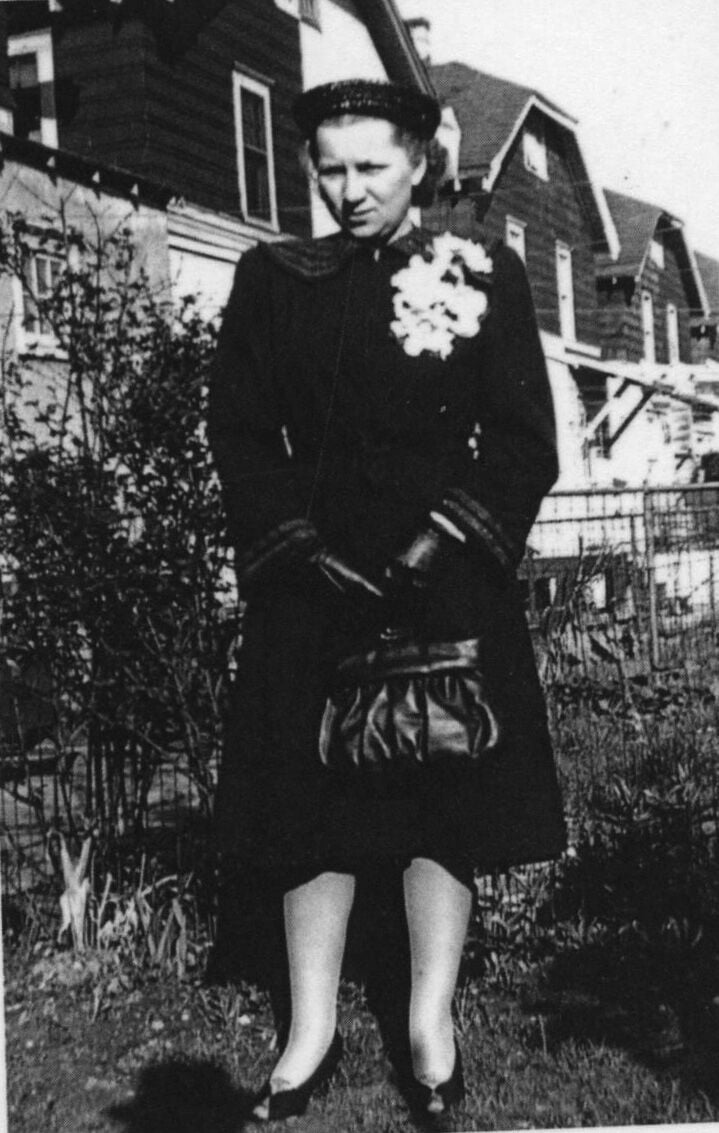
The works are unified by the Ewing-based author’s grandmother, Anne Lewis. The daughter of Eastern European immigrants, she chronicles the stories and preserves the memories of a Trenton that no longer is.
“My grandmother was a great story teller, and I was a great listener,” says Pyontek during a recent interview.
“I spent a lot of time with her. She was in her 80s and belonged to a generation of people who were very private. But as a teenager I asked a lot of questions and she opened up to me more than others. I pretty much saw her every day and loved to listen to the stories. So after she died I wrote them down and that led to the book.”
A high school history teacher in Florence Township, Pyontek says, “My family’s roots are in Trenton. I grew up in Moutainview section of Ewing, went to Ewing High School, and in 1986 went to Rider.” He has a master’s degree in history and English.
In the 1950s, he continues, his father “opened up a stereo store in Trenton, House of High Fi. He was an engineer and he was living away from home and discovered high fidelity stereo and that the only place to get high fi components and parts (near Trenton) was in New York and Philadelphia. It was the only game in town.” The store was originally on Princeton Avenue but moved to Olden Avenue in the 1960s.
His mother, in addition to raising her two sons, worked as a secretary for the Ewing school system.
Looking at his family’s history, Pyontek says they felt the repercussions of an America that transformed them from “intercity urban people to suburban people” and transformed Trenton.
“A lot of changes came about at the same time, and it didn’t bode well for the city,” says Pyontek.
“After the Second World War ends, there is an economic boom that is unprecedented in the U.S. and that led to the development of a car culture, so everyone was mobile and everyone was moving outside the city limits. It became trendy to live outside the city. They felt like it was moving up. The economic changes after the war did something to the younger generation — there wasn’t a cohesion. There was an interest in exclusion. But others didn’t want to leave, like my grandparents; they liked living in the city.”
He adds that during the war, people from the Midwest, called “Okies,” and blacks from the South came in to fill a labor shortage. “People thought they would move back after the war, but they didn’t and more moved into the city. It was big demographic change and people were less educated.”
Pyontek says that was followed by a business-orchestrated panic using race and class to scare people into selling and moving. “What happened in the Cavell Avenue neighborhood was a lot of realtors seized on the idea of blockbusting. They would move in a family that would make the neighbors feel uncomfortable and capitalize on it. They contributed a big part to what my family would call a panic — make people want to move.”
Alluding to his series’ depiction of tensions between various races and ethnic groups, Pyontek asks, “How much does anything have to do with race and how much does it have to do with class? It’s a question that Americans are uncomfortable with.”
The writer’s interest in the economic impact on communities and society comes from his work before teaching.
“I worked at Bloomberg Financial News when it literally just started. I was a writer and did editing and analysis. The internet was brand new, and Bloomberg was on the ground floor of the financial news industry.
“I was an English and history major at college. But it was a good experience. I learned a lot about economics and finance and the dynamics of change regarding economies — how it impacts change on social conditions. When I started writing in financial news it was the ’90s and I was becoming aware from a professional standpoint how big economic change was taking place in the country. It’s something that comes across in the books because it’s about economic change.”
He also learned something important for his literary work. “I learned how to edit writing, taking 500 words down to 50. It is a craft that you have to learn and it takes a while to figure that out.”
Yet Pyontek says his English and history background was at odds with the general culture of economic professionals and he decided to make a change and turned to teaching, first at Notre Dame High School in Lawrence and then in Florence.
About his interest in Trenton, he says, “I grew up in the suburb and the conditions I lived with were completely different. My mother used to take me into the city a lot and go to the neighborhood they lived in. But it was gone. I remember the battle monument area when I was kid, it was all boarded up. There was a world that existed before that. I was frustrated that it wasn’t around anymore.”
He then says, “I once made a big mistake. My grandmother was dying and I took her back to that neighborhood. She said it was hard to believe that ‘it’ was all gone. In a way, the book was written for her.”
It is also written through her. “It was her story,” says Pyontek. “She was the most grounded. Around her are all these family members and neighbors who are little more chaotic. Most of the people were immigrants. And they had nothing.
“My grandmother and my grandfather represented the noble figures. They’re trying to keep everyone together. They knew they could lose it all. From their experience growing up, it was rough. My grandmother is trying to control everyone while they’re going out in different directions. The house, the street, the city represent a human story. A story of change and trying to hold onto something but it isn’t going to necessarily happen. That was something that I found fascinating. A house and a lot of people passing in and out of life, and it all vanishes.”
He says it was in the summer of summer 1992 that he started recording the stories and put it away. Then his childhood friend Jerilyn Veldof — now an author, academic librarian at the University of Minnesota, and writing and a publishing consultant who has published with Twining Press —- encouraged him to shape the memories into a narrative and the process took over.
“There were times when I was writing and I was pulled into that world. And it was like time travel and I’d expect it to be there when I stopped writing.”
As the book began to take shape so did its needs. “I had to invent the dialogue. That was coming out of the stories that I was told. I was looking for anything that I could get my hands on from that neighborhood, documentation. I had to double check to make sure (my grandmother’s accounts) weren’t from faulty memory.”
He says he is gratified by the growing interest in the books through local book groups and online exposure and says that a reader from Vancouver, Canada, had contacted him and said that while she knew little about Trenton she saw her own hometown in the story.
“I think there is a universal appeal,” says Pyontek of his series. “You could have set the story in Camden or Rochester or any town that you may have heard of and don’t know much about. It’s a history of the country that maybe people don’t know anything about.”

Author Erik N. Pyontek,