As the director of the Princeton String Academy, Paul Manulik is accustomed to teaching students from many different backgrounds. He isn’t, however, accustomed to working with students who must make do with partially broken instruments with fraying strings.
Like a Haitian man Manulik met this summer, a viola student in his early 20s, who had been playing such an instrument for four years. Despite his desire, he felt like he wasn’t improving because he hadn’t received enough instruction.
“He wanted more, but he just didn’t have it,” Manulik said.
Manulik and his wife, Lindsay Diehl, encountered many students with similar stories this summer during a two-week volunteer trip in Haiti. The West Windsor couple visited the Circle of Christian Musicians of Cap Haitian Music Camp in Terrier Rouge from June 20 to July 2 to help both students and teachers hone their skills.
The camp is held on the grounds of Saint Barthelemy School—40 minutes outside of the nearest city, Cap-Haïtien—and draws about 200 students from around the country. The school was founded by Rev. Jean Bruno, an Episcopal priest, in an effort to improve the lives of northern Haiti residents through education, healthcare and development projects.
About half of the teachers are Haitian. The other half are volunteers from the United States and other countries. While he was in Haiti, Manulik taught private violin and viola lessons to students and also gave a teacher-training course in the Suzuki method of music education. The Suzuki method focuses on creating the ideal, positive environment for learning music.
Diehl, who is fluent in French, went primarily to translate Haitian creole—a French-based language.
“I was just fascinated by the language,” she said. “It’s a very good language. They love it, and they’re very proud of it.”
The Haitian students also took pride in their work. Despite playing on old, battered instruments, Manulik said, the students matched the enthusiasm American students have note for note.
“The kids and the students just love being in a group making music together,” Manulik said, adding that they never wanted to stop learning.
The classes each had about 25 students, ranging in age from 7 to 15. A few adults spent time studying at the camp as well. Manulik said the weather was about 95 degrees and humid each day they were there, so many of the classes took place outside.
The open air class therefore created an open atmosphere style of learning. Even during private lessons, Manulik said if a student was playing something wrong, another student would walk over, take his finger and move it to the right spot. It didn’t take long for the couple to realize the relaxed classes and enthusiasm are a big part of Haiti’s culture.
“It is a close and spirited community,” Diehl said. “The students were really helping each other, engaging with each other, actively interacting.”
The day would start at 5:30 in the morning and rehearsals would often go until 9 p.m. In between, however, Manulik and Diehl said, the posted schedule for the day was more of a guideline than a set standard.
Practices would be moved around and meals would be served hours late. Some students knew the loose schedule meant that things would often change at the last moment, and they would try to fit additional lessons into their own schedule.
“Kids that were scheduled for a lesson didn’t show up, but then another group of students knew they weren’t going to show up and would be constantly asking, ‘Can I have a lesson, can I have a lesson?’” Manulik said. “That group of students got several lessons during the day because they wanted to have that extra attention.”
Manulik said this reflected the overall attitude of the students during the camp. They took advantage of every opportunity to learn more from the instructors.
“I was just excited about being able to give something back to the world,” he said.
The couple knew they wanted to spend their summer vacation teaching. Diehl, a devotee of Haitian art, has always been interested in traveling to the country, and began researching places that would allow them to volunteer.
When she discovered the music camp, she and Manulik and felt like it would offer an opportunity to quench their passions for music and volunteering. The couple volunteers for a few local organizations, including the Threads of Hope Clothing Closet in Trenton, but this was the first time they’ve traveled out of the country for volunteer work.
Both Manulik and Diehl are well traveled. Manulik grew up in Wisconsin and moved to the Princeton area roughly 15 years ago. Diehl’s father was an international banker and she frequently traveled to new countries as a child, which is how she discovered her passion for both the Caribbean and learning languages.
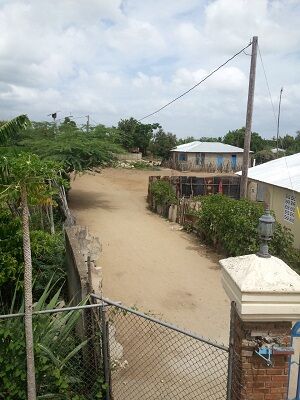
Manulik and Diehl knew Haiti was a poor country, but they were still shocked by the conditions they saw once they arrived. As they were traveling to the camp, they drove on dirt roads littered with potholes and passed houses that were nothing more than tiny structures with tin roofs. The locals didn’t have running water — just a central water pump in town.
It costs $100 to send a student to the three-week camp, and $300 to send them to the school for an entire year. Most families in Haiti can’t afford those prices, so the majority of the students rely on scholarships. According to Business Insider, Haiti is the 20th poorest country in the world, with a GDP per capita of $1,846. The United States, meanwhile, has a GDP per capita of $57,045.
Things that many Americans could easily take for granted are things students and teachers in Haiti cherish. During the camp, a Haitian teacher asked Manulik if he could keep his Suzuki workbook because he couldn’t afford to buy his own. The book cost $10.
“At the end of the camp, we gave a donation,” Diehl said. “They didn’t ask us for one, and it wasn’t huge, but the director was stunned.” The director told her that their funds were running so low, they didn’t know how they were going to buy food for the third week.
Understanding that their donation went directly toward the students’ food and education hit home for the couple.
“We have wonderful students here [in West Windsor], and they enjoy playing and they’re working hard,” Manulik said. “But they don’t always realize—and maybe the parents don’t realize—how incredibly fortunate they are to be in this country where, okay, things can cost a little bit of money, but you can get a wonderful instrument for your child and wonderful teachers.”
Since returning home, the couple often thinks back to the people people they met in Haiti. They’re planning additional ways to help—donations, sending books, Skype lessons and possibly a trip back.
“The trip also tugged at your heartstrings because we know things about some of those students and we’d like to help them out more because they need help,” Diehl said.
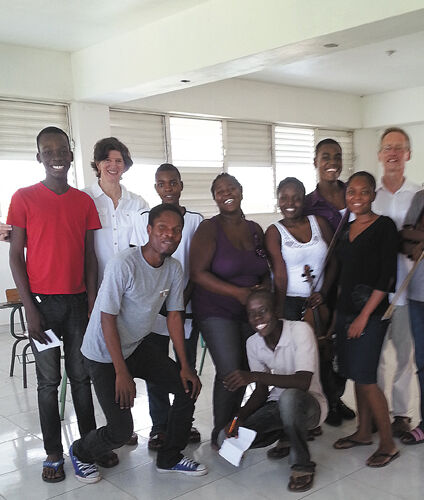
Paul Manulik, far right, and wife Lindsay Diehl, second from left, with students they taught music to in Haiti this summer.,