Trenton Water Works announced this week that it has resumed supplying millions of gallons of finished drinking water each day to Aqua New Jersey.
The utility said the move demonstrates the strength and flexibility of its regional water system following recent winter-related disruptions.
But regulatory records and internal correspondence obtained and published by From the Mains of Trenton, an independently run watchdog site, show the interconnection had been shut off earlier this winter after frazil ice crippled the system’s raw water intake and pushed storage levels toward critically low thresholds.
The Substack-based site is published by Marc Leckington, a Trenton resident and former city official with extensive experience in regulatory compliance and municipal operations.
The situation traces back to Dec. 12, when frazil ice — a slushy accumulation of ice crystals that forms in supercooled, turbulent river water — clogged the raw water intake at Trenton Water Works’ filtration plant along the Delaware River, forcing a temporary shutdown of the facility.
According to a letter sent the same day by the New Jersey Department of Environmental Protection, the shutdown, combined with ongoing water main breaks and planned intake cleaning, caused water levels at the Pennington Avenue Reservoir to fall below normal operating ranges.
DEP described the intake as a critical point of failure and directed the utility to notify customers to conserve water, postpone nonessential intake work until warmer months, and provide daily operational updates to the state through March.
Despite those directives, residents and officials in the five municipalities served by the system — Trenton, Hamilton, Ewing, Lawrence and Hopewell — were not immediately informed of the shutdown.
Trenton Water Works did not issue a public water conservation advisory until Dec. 18, nearly a week later, and that notice did not disclose that the filtration plant had been taken offline.
Internal DEP emails later obtained through public records requests and published by From the Mains of Trenton show that as reservoir levels continued to drop, regulators ordered the utility to shut down its interconnection supplying water to Aqua New Jersey in order to preserve remaining storage for its primary service area.
In one email dated Dec. 15, DEP staff described the reservoir as having roughly one day of storage remaining. Regulators instructed the utility to close the Aqua interconnection, open an interconnection with New Jersey American Water to bring water into the system, and continue conservation measures until conditions stabilized.
Trenton Water Works did not publicly acknowledge that the Aqua connection had been shut off or explain the reason for the interruption at the time.
In a press release issued this week, the utility announced that it had resumed supplying water to Aqua New Jersey and emphasized the capacity of its infrastructure.
“The TWW system is well-engineered with six interconnections with other water systems and is more than capable of helping Aqua New Jersey meet their customers’ water demands,” said Sean Semple, director of the city’s Department of Water and Sewer, which operates Trenton Water Works. “We regularly supply water to Aqua.”
Semple said the utility’s filtration plant on Route 29 South produces about 33 million gallons of drinking water daily for its five-municipality service area and has the capacity to supply up to 60 million gallons per day.
“The water filtration plant is operating normally, and our licensed operators continue to monitor Pennington Avenue Reservoir levels, system demand, performance, and we are grateful for Mother Nature’s cooperation,” he said.
The press release did not reference the earlier shutdown of the Aqua interconnection or the DEP directives that prompted it.
The frazil ice incident and delayed public notification prompted sharp criticism from suburban leaders, who said the episode underscored longstanding concerns about transparency, system reliability and public health.
In a joint statement, Ewing Mayor Bert Steinmann, Hopewell Township Mayor Courtney Peters-Manning and Hamilton Mayor Jeff Martin said the utility had ample warning following a similar frazil ice shutdown nearly one year earlier.
“If it did not have real world impacts, we would think this is a bad comedy show,” the mayors said. “Under their current leadership, TWW has failed time and time again.”
They said the shutdown compounded broader concerns about water quality and reliability.
“If we weren’t already worried about brown water or Legionella; now we again must worry if we even have any water,” the statement said.
They called on state legislators in Legislative Districts 14 and 15 to amend the Water Infrastructure Protection Act to allow DEP — rather than local officials — to determine when a water system faces emergent conditions and to initiate public reformation hearings.
The frazil ice episode unfolded as litigation involving Trenton Water Works continues in state Superior Court, with all suburban municipalities now party to a lawsuit alleging longstanding operational failures, governance problems and risks to public health tied to the regional water system.
Earlier this year, a judge lifted a stay and allowed discovery to proceed after determining that the city had not complied with state administrative orders related to the system.
The discovery phase is expected to continue into late 2026.
As winter conditions persist, regulators and suburban officials have warned that the system’s narrow operating margins, aging infrastructure and communication failures leave little room for error should another prolonged shutdown occur.
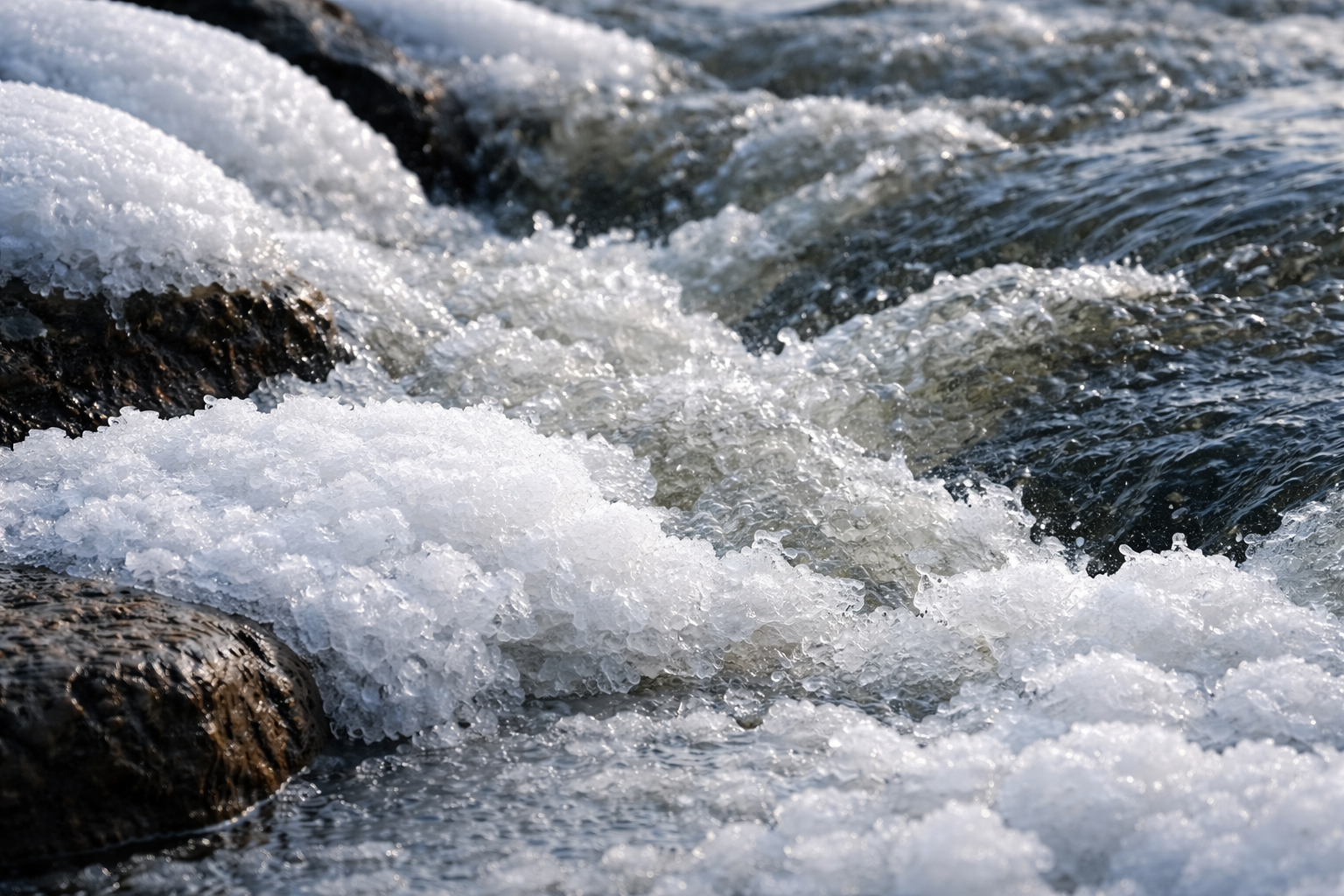
Frazil ice forming in a river.,

