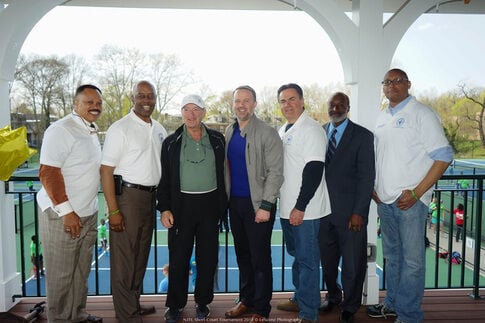
Tennis, Everyone? Trenton business administrator Terry McEwen, left, Mayor Eric Jackson, NJTL board president Albert Stark, NJTL executive director Rob Howland, police director Ernest Parrey Jr., fire director Qareeb Bashir, and city public information officer Michael Walker.
By Wendy Greenberg
It’s about whole-child development, lifelong friends, and even college opportunities. The National Junior Tennis and Learning of Trenton (NJTLT) offers all that and more.
The NJTL’s Trenton chapter is by all accounts a bright success story. Boasting a new $1 million flagship Cadwalader Park Junior Champions Tennis Center, it is one of more than 500 United States Tennis Association Foundation (USTA) nonprofit youth development organizations nationally. The Trenton chapter was twice named the USTA Chapter of the Year and its original ACE program is a national model.
Yet, despite the accolades and validation of excellence, the hard-working staff in modest offices on the corner of State and Parkside in West Trenton are somewhat puzzled that the courts at Cadwalader were not completely packed over the summer. They are concerned that individuals who can benefit from the program are missing out.
A Sunday, September 27, fundraiser — Capital Cup at Trenton Country Club and honoring tennis writer Ann Loprinzi — will bring some awareness, and some needed funds. But to reach the neighborhood parents who can encourage their children to try tennis, the staff is taking their case to local church leaders and continuing to recruit in city schools, says executive director Robert Howland.
The Trenton chapter has grown, but has room to grow more. It started in 1975 with 30 participants and has grown to over 2,500, 95 percent of whom are from the city of Trenton. In its 40th anniversary year, the organization that is based on the ideals of tennis great Arthur Ashe (who co-founded the National NJTL and played several exhibition matches at Cadwalader Park in the 1960s), the Trenton chapter has a stunning new facility.
The renovated center at Cadwalader Park was named as the national public facility of the year by the USTA. The Daniel L. Haggerty Jr. Pavilion dedication last year, featured U.S. tennis stars Todd Martin and Jim Courier for an exhibition match, and a gala anniversary party attended by celebrities such as former New York City Mayor and Trenton native David Dinkins, Trenton Mayor Eric Jackson, and Katrina Adams, the first African American chairman, CEO, and president of the USTA.
The Trenton chapter is close to the hearts of many who would like to see it continue to thrive, perhaps because of their hopes for Trenton itself, which has seen many after school and summer programs cut from budgets. The NJTL has helped fill the void.
NJTL Board President Albert Stark, a Mercer County attorney, grew up near the park on South Westfield Avenue and was a tennis champion at Trenton High. Stark, who has a love for his old neighborhood, feels that the NJTL “is really an anchor to the future improvement of the whole western section of the city.” He refers to it as an “education program,” having impacted 5,000 to 6,000 youths, and looks forward to upcoming improvements in Villa Park and programs starting in other sections of the city.
Trenton has had a troubled image, he says, but NJTL has made a huge impression outside of Trenton. “The project is a model … tennis at the park took me to where I am.” The key to its future, he says, is “parents seeing that their kids are getting something they never had, tutoring, mentoring, college.”
What began as summer clinics has indeed grown into a tennis and mentoring program. A tutoring aspect evolved into the Academic Creative Engagement (ACE) program, a way to make education fun, teaching math, literacy, and nutrition through tennis. Instructors teach geometry through angles on the tennis court, for example. That program was adopted by the USTA and is being used by more than 50 other chapters across the country.
Howland visualizes the programs as a pyramid, with the foundation as the students in the summer outreach programs for ages 5 to 17. This program teaches not only tennis fundamentals, but development of hand eye coordination and social skills. NJTL pairs with other organizations such as the Boys and Girls Clubs and other nonprofits that dot the after-school landscape.
Outreach continues during the school year at all Trenton elementary and middle schools as well as some city charter schools and Trenton Catholic Academy. At each school the staff identifies students with positive attitudes and consistent program attendance to represent their schools on “all-star” teams in the Trenton Short Court Championships. Now in its sixth year, the event is well attended with more than 240 students representing 22 schools across Trenton, Hamilton, and Ewing.
NJTL has been a hit within schools, and played “such a huge part in helping our students develop many of the necessary traits needed to be successful in the classroom,” says Sharron Grady, director of athletics, health, physical education and family life for the Trenton School district.
“NJTL of Trenton has been an awesome partner and program for the children/students of the Trenton School District,” she says. “NJTL has provided another opportunity for students to become engaged in a sport to learn early in life. Students have developed great social skills through interaction and communication while learning the sport of tennis. I have found that our middle school and high school programs are having great success as many of these students also participate in NJTL and our number of participants has increase,” she says. “NJTL has played such a huge part in helping our students develop many of the necessary traits needed to be successful in the classroom and has been a great assistance in helping students move on to the next level.”
The middle of the pyramid is the ACE program, co-developed in Trenton by Steve Duncan, Pat O’Brien, and former NJTL executive director Dan Faber for children in grades three to five. It emphasizes health and wellness, academic achievement, decision-making, problem solving, and collaboration. The curriculum consists of 50 activities to motivate and prepare students for success. Literacy activities are coupled with children’s literature, poetry, and texts. Both ACE and the clinics are run on site and the youths get field trips one day a week, where they experience other programs like a performing arts activity led by Passage Theater.
“We’re proud that what we have developed here is used elsewhere,” says Howland. “The goal is to make learning fun and build the confidence of our students, not to identify a weakness, drill and kill, and then memorize for the next test or state assessment exam.”
On a recent summer day in Cadwalader Park, about 27 youngsters socialized at picnic table. They played board games to improve literacy skills under the watchful eye of Duncan, a creator of the ACE program, who taught for 37 years before becoming an administrator of an elementary math program. He says a third of the campers are repeat campers. Developing players play on 14 mini-courts with foam balls. There are seven regulation courts.
Mason, one of the campers, says he likes the people in the program. His friend Edrese adds that “it gets your brain working.” The ACE camp is 8:30 to 11:30 a.m. Monday through Friday except in rain.
The park, with its shiny new blue-colored hard courts, was dedicated in 2011. The pavilion, dedicated last year, capped a million-dollar refurbishing project that replaced clay courts that were known for their weeds. At the time of the ceremony, hopes were high that the center would revitalize Trenton and be a mecca for youth. That it has, but more is possible, says Howland.
Howland says that the USTA Foundation hired statisticians from the University of North Carolina who concluded that ACE is shown to have a statistically significant, positive impact on attitudes about learning while increasing math and reading levels.
The top of the pyramid is the Ashe Program, which is for youths identified as high achievers with an eye toward college.
Many in Trenton take pride in Trenton Central High School graduate, and 2014 Senior Class president, Nu-Kermeni Kermah, who is attending Fairleigh Dickinson University on a full tennis and academic scholarship. Others are attending Elmira College, Goucher College, and other selective schools.
Michelle Gbelama, NJTLT program director, was a participant at Trenton Central High and played at Drew University, where she was captain of the Drew women’s team and led the team to a conference championship. Participant Axe Owens, a senior at Chestnut Hill College, is another who works each summer on the courts and in the office. And, Kallah Masudi of Trenton, a long-time Ashe participant and current junior instructor, was keynote speaker at the opening night gala at the US Open and started her freshman year at Rutgers the next day.
The staff can personally relate to the excitement of playing college tennis. Howland himself was an all-American tennis player at the College of New Jersey, and started with NJTL as an instructor 17 years ago on the Trenton High School courts. He became executive director in 2013. Development coordinator Chris Hoeland played tennis at Washington University in St. Louis, and was the assistant men’s tennis coach at Princeton University until joining NJTL in 2013. Through his connections with the university he helped to nurture a Princeton Universitystudent group “College Counseling Project” with the NJTL.
“They adopted us about two years ago,” says Hoeland. “They help our Ashe high school participants navigate the college application process through one-on-one mentoring.” They help juniors identify schools they want to apply to, and support them on college essays, financial aid forms, housing, and in some cases advice on areas in which to major. The program started with five mentors and mentees in 2014 and will grow to 15 during this year. The pairs keep in touch through the summer.
The three programs and many satellite activities are run by five full-time staff, with additional part-time seasonal staff, half of them former and current participants. ACE staff needs to be certified teachers. Expenses are funded through two major events, and 30 to 40 percent comes from grants and donors. The program is free but asks for donations.
For Howland, it’s a no-brainer. “Any parent or child in the city of Trenton, if they can start with us in third grade, and if they stick with it, their child will receive a host of benefits, physically, academically, and emotionally. They have a good chance of college enrollment. We can only do so much, but the opportunities are there.”
“Tennis is the hook with which to engage youth,” he says. “Tennis is lifelong and social. It can be a family activity. It presents a unique set of development opportunities. It’s an individual sport and a learning tool. I don’t know of any other sport that offers that package.”
For further information on the Capital Cup, visit www.njtloftrenton.com-capital-cup or contact Claire Shevlin, event manager at 609-977-8277, or Chris Hoeland, development coordinator, (609) 468-4273.
,

