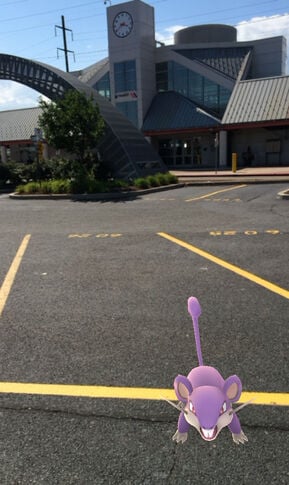
The Hamilton train station has a Rattata problem. Kelly Yaede has superpowers. Goose poop makes me cranky.
These are just a few of the discoveries I made last month while playing Pokemon Go, the augmented reality smartphone app that took the world by storm in July. For those who don’t know, Pokemon Go recreates, in real life, the hit Game Boy video games of the late 1990s. As players walk around the real world, an avatar in the game navigates a virtual world full of creatures. The game’s goal is to capture all 150 types of Pokemon.
A player can capture a Pokemon—such as the rodent Rattata—once it appears on the map by “throwing” a virtual Poke Ball at the creature. The Pokemon appears on your phone’s screen, superimposed into whichever environment happens to be in front of your phone’s camera. Players can collect Poke Balls and other in-game items at locations designated as Pokestops, usually a point of interest in town.
Millions of people have decided this sounds like fun. In the game’s first week, it already had been installed on 10.8 percent of all phones in the United States. By late July, the game averaged 7-million downloads and $15.6-million in revenue daily. It has overtaken Candy Crush as the most-played mobile game in history, and has more active daily users on mobile than Twitter, Pandora Radio, Spotify and Netflix.
The game has encouraged its players to get outside, explore their surroundings and socialize with other players. But, there have been complications, too.
In Auburn, New York, a man crashed his car into a tree because he was playing Pokemon Go while driving. People in Wyoming, New Hampshire and Demark have discovered dead bodies while hunting for Pokemon. A Florida man fired his handgun at two teens after he discovered them playing Pokemon Go in front of his house at 1:30 a.m., mistaking them for burglars. Police in Texas arrested a man after he wrote on social media that he and some friends were going to use their modified paintball guns to “purge” their area of Pokemon Go players. A woman in South Jersey got stuck in a tree chasing Pokemon.
It all sounded a bit anarchic, so I left a message with the Hamilton Police asking if they had heard of any problems in town due to Pokemon Go. I never heard back. Interpreting this as a silent “go ahead” from HPD, I hopped in my car, plugged in my phone and set out to find some Pokemon.
My first scheduled stop was the township municipal building, but en route, I saw five teenagers walking in circles around Tulip, the sculpture at the intersection of Klockner Road and Nottingham Way. I had heard reports of Pokemon Go causing odd behavior, and these young men seemed so oblivious to their surroundings they had to be either zombies or Pokemon Go players.
Sure enough, the sculpture was a “gym,” a place where players can train and battle their Pokemon. I considered speaking to the congregated youth, but a grown man approaching a group of children to talk about Pokemon seemed, at best, sad. I continued on to town hall.
The municipal building, by all appearances, should be a wonderful Pokemon Go location. There’s a Pokestop there, and rustling leaves—a signal there are Pokemon in that location—appeared on my in-game map in at least three locations near town hall. But, within a minute, I felt creepy, walking in circles, staring at my phone, mumbling to myself about Pidgeys. Even worse, no Pokemon ever appeared, and the harder I looked, the more it became clear that nothing of substance was occurring around the municipal building. So I moved on.
Driving on to the Hamilton train station, I passed Grounds For Sculpture, which has about 50 Pokestops both inside its gates and along the roads around it. (GFS capitalized on this July 17 by offering tours of the park geared specifically toward Pokemon Go players.) Although the game allegedly disables some features at driving speeds, Pokestops along roadways are still accessible. This clearly presents an opportunity for players who value Poke Balls more than their own well-being. In other words, I could see how someone could crash into a tree—or a police car, like one man in Baltimore did. I kept my phone stowed away.
Once safely parked at the train station, I turned on the game, and immediately found myself surrounded by Rattata and Weedles, roughly the Pokemon version of rats and worms. Pokemon Go has a weird sense of humor that makes me think the whole rats-at-a-train-station thing isn’t a coincidence. During an earlier playing of the game, I had a Koffing—a Pokemon that spews dark, toxic fumes—appear at a gas station.
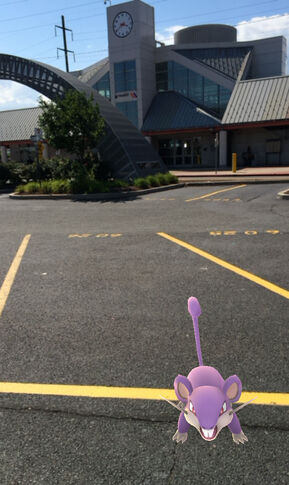
I clicked on one of the Rattata around me, and my phone showed an angry purple rat in the parking space just in front of me, snapping its jaws. The Rattata had me pinned against my car, and while I could have wasted a Poke Ball trying to catch it, I opted instead to take a photo that made it look like the train station had a Rattata infestation. Satisfied with my yellow journalism, I left the Rattata where it could torment weary commuters, and proceeded to my next stop: the library.
On the way, I noticed Mercerville Fire Company, which is a Pokestop located at one of Hamilton’s most dangerous intersections, had changed its roadside sign to remind people to not drive while playing Pokemon Go. Later, I called Chief Christopher Tozzi, who said he hasn’t seen any incidents, but the staff wanted to ensure residents keep safety in mind while playing the game. Tozzi said he has noticed an influx of pedestrians coming to the front of the firehouse, glued to their phones, but “nothing to the detriment of the operation.” This is our world: a fire chief had to clarify that a bunch of people hunting imaginary monsters had not prevented public safety staff from doing their jobs.
Once at the library, I had a revelation: Pokemon Go really has a thing for sculpture. The library itself was not a Pokestop, but nearly every piece of artwork on the grounds was. I’m sure artist Seward Johnson delights knowing—between Grounds For Sculpture and his work at the library—he has made an immeasurable contribution to the lives of Hamilton-area Pokemon Go players.
Next door, the Hamilton Golf Center also had two Pokestops, so I took the short drive to check them out. One, “the Hole-In-One Hut,” requires players to actually go onto the mini golf course. Another, at the far end, is a memorial plaque. You can reach this Pokestop without ever leaving your car, if you have the guts to park in Mayor Kelly Yaede’s reserved parking space at the facility. I’m not going to say I am this brave/stupid, but I will tell you that my game crashed at this point of my journey and refused to load again until I left the general vicinity of the mayor’s space. Yaede has told me several times in her years as mayor that she knows everything that happens in Hamilton Township. I never believed her until now.
Sufficiently spooked by the possibility Yaede could control my phone, I needed to find somewhere to soothe my anxious soul. I decided a lakeside stroll at Veterans Park should do the trick. By most accounts, Veterans Park is the place in Hamilton to play Pokemon Go, with plenty of Pokestops, gyms, Pokemon to catch and other Pokemon Go players to share the experience. But on the lakeside path, I only found several Scyther, a vicious-looking bug Pokemon. Oh, and goose poop. Lots of goose poop.
That’s a bit of an exaggeration because at the far end of the path, near a gazebo, I did happen to find a Pokestop, a gym and three Pokemon Go players who each resembled Seth, actor Jonah Hill’s character in the movie Superbad. As they walked by me on the path, they spotted I was also playing Pokemon Go. One whispered to the others, and they quickly slipped off into the woods, down what didn’t appear to be a path.
Having reached the end of the road—and my work day—I turned around, only to have two more young men zoom by me on bikes. They both paid no heed to the path in front of them, eyes firmly on their phone screens. Something good must have been in that direction. I left it to the Pokemon Go pros.
As I got in my car to leave, three more teens, again all males, took to the path with skateboards. One of them, wearing a Hawaiian shirt and riding a larger skateboard, sped ahead.
“I found it!” he shouted.
I looked to my map. Nothing.
Eh, no problem. If my experience held true, it only could’ve been two things anyway: Scyther or goose poop.
And I had enough of both for one day.
,