This article has been updated to include reporting on the Oct. 21, 2025 Trenton City Council meeting.
The bad news continues to flow out of Trenton Water Works.
A sweeping report released in October by the New Jersey Department of Environmental Protection warns that persistent staffing shortages, bureaucratic delays and infrastructure failures continue to threaten the safety and reliability of the regional water utility — with even greater risk looming once its Pennington Avenue Reservoir is taken offline.
The 164-page Comprehensive Performance Evaluation, completed in May 2025 by engineering firm H2M Associates of Parsippany, concludes that TWW remains plagued by “chronic deterioration” and a host of operational, administrative and physical vulnerabilities that “pose the most consistent and predictable threats to the efficiency and effectiveness of the TWW system.”
The utility serves approximately 225,000 residents across Trenton, Hamilton, Ewing, Lawrence and Hopewell, and has been under state DEP oversight since 2022.
According to the report, “the worst of the limiting factors stem from staffing and communication issues.”
H2M found that “TWW is short-staffed in both the operational and maintenance departments” and that Trenton’s system of public service contracts and state-imposed hiring restrictions has left the plant with too few licensed professionals and a workforce that is stretched thin.
“This leaves the current licensed operators spread very thin, giving behavioral evidence and overtime labor records indicating a status of being overworked and burnt out,” the report states.
Interviews with plant staff described a maintenance team with “a significant lack of training and relevant knowledge.”
The report states that “almost no maintenance staff was observed around the plant despite equipment needing calibration, routine maintenance or repair being abundant.”
The absence of a scheduling or task-tracking system has allowed even basic service needs to be overlooked.
“Without a designated person to track and schedule repairs and required routine maintenance, important servicing is often missed,” the report states.
The findings were part of a broader evaluation ordered by the DEP under a 2022 Unilateral Administrative Order, issued after years of repeated Notices of Violation, missed compliance milestones, and failed agreements between the state and the City of Trenton.
Under the order, the DEP gained expanded authority over daily operations at Trenton Water Works, which operates as a city department.
H2M reviewed operating records, process data, treatment plant performance, and administrative procedures as part of the assessment. It found signs of progress in some technical areas but stressed that core issues involving staffing, communication and infrastructure remain unresolved. “The entire Trenton and TWW entity would likely benefit from organizational and managerial optimization, as well as enhanced training.”
The evaluation describes a system burdened by “underqualified and unmotivated individuals,” procedural delays and physical limitations.
Staff reported that the plant’s laboratory roof “leaks in several places,” forcing technicians to move equipment and place bowls on the floor during rainstorms to catch dripping water.
“Sunlight can be seen through holes in the roof when looking through sections of missing ceiling tiles,” the report notes, adding that “this issue poses a safety hazard and distracts staff from completing their testing, not to mention the probability of contamination of samples.”
Elsewhere in the plant, H2M documented mechanical breakdowns, corrosion and inaccessible equipment. It warned that the HVAC system is “well beyond its useful life” and that some areas near the filters have suffered “significant corrosion.”
According to the report, the high-service pump room lacks space for routine maintenance and has been identified as “a poorly designed space which lacks accessibility for repairs of equipment.”
The report states that two of the plant’s three raw water pumps were offline at the time of the site visit. “This operating condition does not provide any redundancy or firm capacity and presents a risk to the continued operation of the plant.”
One pump was out of service due to a failed bearing, and another had a damaged impeller and a broken variable frequency drive.
The intake system in the Delaware River, which draws in raw water for the plant, has no automated feedback to indicate blockages and must be manually monitored by operators. In the winter of 2024, the intake became clogged with frazil ice, forcing TWW to shut down the plant and issue a limited-use advisory to customers.
“Given TWW’s complete reliance on 24/7 supply of water through this single intake structure, any outage has the potential to be detrimental to the operation of the plant and the overall water system,” states the report.
That risk is compounded by the imminent decommissioning of the Pennington Avenue Reservoir — the 78-million-gallon water storage facility that has long acted as a buffer during shutdowns.
The reservoir is being taken out of service in Phase 3 of TWW’s Pennington Avenue Reservoir Replacement Project, which involves constructing new tanks to replace the aging, open-air reservoir.
H2M calls the reservoir “a safety net,” adding that once it is taken out of service, “fairly frequent outages and shutdowns at the treatment plant… may potentially lead to loss of service to customers.”
H2M found additional vulnerabilities in the way chemical treatment is handled at the facility. TWW continues to rely heavily on manual jar testing to adjust dosing of chlorine and coagulants, a process the report describes as “inefficient.”
Operators collect and test samples every one to four hours, resulting in delayed dosing adjustments during rapid changes in raw water quality.
“Newer technologies may resolve this,” the report says, but it recommends a follow-up Comprehensive Technical Assessment to determine the most optimal approach.
The chlorine disinfection process, known as CT, occurs before filtration, rather than after, due to physical constraints at the facility. While this method allows TWW to meet regulatory standards, the early introduction of chlorine may increase the formation of disinfection byproducts.
“There is likely room for optimization in how TWW doses chlorine for achieving CT while reducing the potential for DBP formation,” the report states.
Much of the plant’s design and equipment have not been updated in decades. For example, a sand separator built in 2008 has never functioned as intended and remains offline.
Even the electrical system is unreliable. According to the report, “In general, the plant suffers from somewhat frequent electrical brown outs. These brown outs cause complete plant shutdowns.”
The report also criticizes the utility’s purchasing and hiring procedures, which require multiple levels of city and state review.
According to H2M, “significant delays could potentially cause serious shortfalls of critical supplies at the plant, such as chemicals or replacement equipment.”
In some cases, TWW staff believed that the state was holding up procurement, only to discover “that the request had never been sent by TWW to DCA [the state Department of Community Affairs] for their review.”
Within the city structure, H2M found a lack of written procedures, slow communication, and a pattern of lost institutional knowledge due to high turnover.
“With each person that leaves, there are bits of knowledge that gets lost. With each new hire, there are inefficiencies as standard operating procedures are being taught and learned,” the report says.
The report concludes with a clear warning: “Without proper care and leadership needed to run a successful surface water treatment plant,” Trenton Water Works will remain at risk of failure.
The findings come at a time of renewed pressure on Trenton officials to commit to long-term governance changes. In a letter dated July 29, DEP Commissioner Shawn LaTourette urged city leaders to formally commit to a regionalization study — an effort to consider whether the utility should remain under sole control of the City of Trenton.
“For years, the Department has been urging TWW to improve governance and transparency,” LaTourette wrote. “Yet progress has remained inconsistent.”
* * *
On Oct. 21, Trenton City Council, in a split vote, authorized the creation of an ad-hoc committee to “address issues relating to the Trenton Water Works.”
It also passed a resolution supporting an independent assessment of TWW. In this case, the study would be awarded to a company chosen by the city and paid for by the state.
Also at the meeting, the council rejected a measure that supported a study looking into the creation of a regional Trenton Water Utility.
The towns that rely on TWW have long expressed frustration with the city’s control of the utility, voicing concerns about water quality, rate increases, service disruptions, poor communication and a lack of accountability.
Officials at the state and local level have proposed the creation of an independent regional board composed of representatives from all municipalities served by Trenton Water Works.
This regional board would be tasked with overseeing the utility’s long-term management, budgeting, capital projects and compliance — while preserving Trenton’s ownership of the utility.
Some city officials have resisted regionalization, citing the city’s ownership of the plant and the need to retain water revenues.
Supporters of regionalization argued that the approach could give suburban customers a voice in how the system is run and reduce the risk of future mismanagement.
For now, discussions remain preliminary, but momentum is growing among stakeholders who say shared governance could help stabilize a system that has been under pressure for too long.
At the same time, TWW has been estimated to need more than $1 billion in improvements over the next 15 years.
A significant portion of this comes from a pending $600 million capital improvement plan and an estimated $570 million in capital needs highlighted by the state in August 2025.
Recent smaller-scale projects have included a $230 million, five-year capital improvement plan for regulatory needs and various upgrades, such as a $150 million lead service line replacement program.
To pay for those improvements, TWW is proposing five straight years of rate hikes — 14% in 2024, 2025 and 2026, and 4% in 2027 and 2028.
H2M’s report recommends that Trenton Water Works immediately begin a Comprehensive Technical Assessment, the next step in the EPA’s Composite Correction Program.
The goal would be to implement corrective actions based on the CPE findings, including automation of chemical analysis, development of formal maintenance procedures, enhanced staff training, and modernization of communication and procurement systems.
The report notes that many of these changes are time-sensitive, particularly as the reservoir is removed from service.
“These recommendations are not just technical fixes,” the report states. “They are organizational imperatives.”
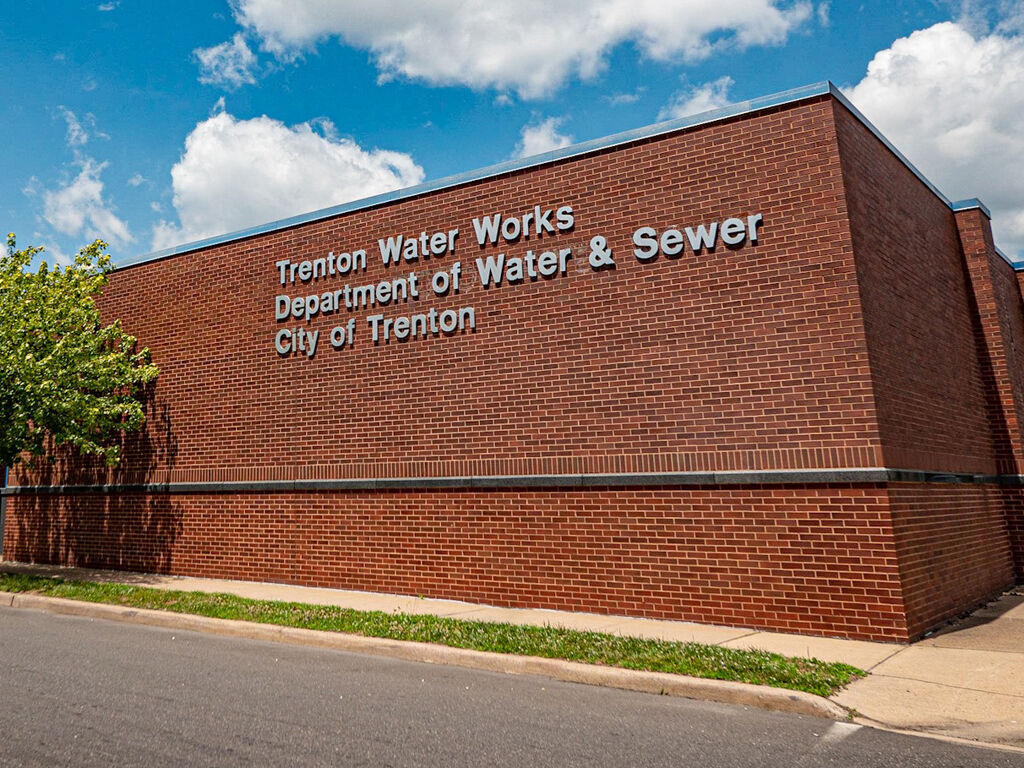
Trenton Water Works administrative building at 333 Cortland St., Trenton.,

