Some people would prepare for a trip to Seoul by researching the best places to stay and eat and the best historic sites to visit while there. Alan Kesselhaut prepared for his recent visit by researching the South Korean metropolis’s most promising photo opportunities.
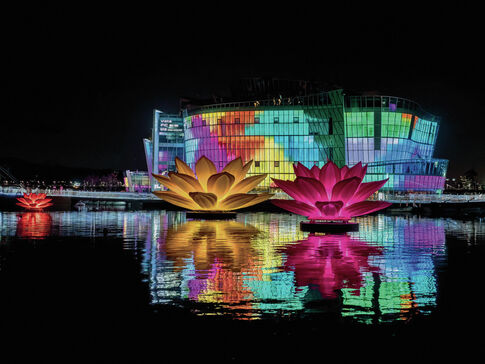
He was excited when he learned about a nighttime lantern exhibit on the river. He realized that he might have a perfect opportunity to combine several images to create a single photograph, using a technique he had perfected in the years since he discovered and learned the techniques of high-dynamic range photography. Lights on a nearby building and flower structures on the lake fronting on it would be counterposed to the surrounding darkness.
Ordinarily it would be “almost impossible to capture all of that in one image,” Kesselhaut says, but he knew that in processing, he could indeed create a single image and one with intensified colors and reflections that would be a piece of art.
In 2010, after Kesselhaut and his wife, Barbara Cuneo, ended the 30-year run of their construction company, Herrontown Builders, a friend invited him to lecture at the Sedona Camera Club of Arizona on HDR photography. The successful talk and demo revealed to the couple an untapped strength: Kesselhaut’s talent for making the complexities of photography accessible to others. Combining this with Cuneo’s experience in marketing, the two created Princeton Photo Workshop. As Kesselhaut started to teach more, the development of the business they would call Princeton Photo Workshop was a “natural progression,” he says.
“I call it ‘our inadvertent retirement business,’” Cuneo says. “It wasn’t like ‘Oh we have to have a business.’ We both are very entrepreneurial, and it sort of evolved.”
Today Princeton Photo Workshop employs six professional photographers in addition to Kesselhaut, has a mailing list of 2,500, and draws old and new students to an array of classes and workshops in different venues for photographers of different ages and skill levels.
Kesselhaut got interested in the technique of HDR, in which he modestly admits he is now a world expert, when he saw travel photographer Trey Ratcliff’s photo of the Taj Mahal taken at dusk. “You look at this photo and say, ‘I can’t do this,’” Kesselhaut says. His next thought was, “How is it done?’”
The technique of HDR solves a common photography problem: how to overcome the limitations of digital cameras when shooting a scene with strong contrasts between light and dark, like Christmas lights in New York, a situation he will face with students in his upcoming workshop, “The Holiday Lights of New York,” on Dec. 6 (they will take photos of Rockefeller Center, Times Square, Radio City, and the lit-up buildings on Sixth Avenue). More information is online at princetondigitalphotoworkshop.com.
The issue, he says, is that camera sensors can’t see the total range of light. The solution is easy to state, but harder to implement: “You take multiple pictures at different exposures and merge them together in a final image,” Kesselhaut says, noting that at least one photo focuses on the brightest elements in the scene, one the darkest, and one the middle range. He then uses Photomatix to merge the photos.
Starting with Ratcliff’s website, he learned what he could about HDR photography, but it took him a while to get the hang of it. Cuneo notes that his early efforts were “garish, cartoonish, unsubtle.” But he was not deterred. “As in all photography, it is just practice,” Kesselhaut says.
Once he finessed the technique, he began teaching it in a variety of venues, one of them B&H Photo in New York, where he recorded a video that has had over 346,000 views on YouTube.
But the question of whether HDR photos like these are authentic representations of what the eye sees gets into a bit of philosophy.
Kesselhaut explains that no camera sensor is good enough to see what the human eye sees. “There is an algorithm in your camera that some software engineer has put in there that processes your image. It has made the decision for you—it puts in contrast, sharpening, saturation, so immediately it doesn’t look like what you shot,” he says.
His resolution of the authenticity question balances the demands of photography and art: “When I go out shooting, I think of myself as a photographer and I want to come back with an image that is well composed, has a subject, and has a good exposure. When I put that into my computer, I think of myself as an artist. I’m not necessarily trying to make a realistic image, I am trying to make an artistic interpretation. Whatever that entails for me personally, that is what I am going to do.”
The teachers at Princeton Photo Workshop often combine “classroom” work with practice shooting photos, much like the research and hand-on practice that enabled Kesselhaut to become an expert in HDR photography. Kesselhaut offers several tips to Princeton Echo readers who may be traveling or taking photos during the holiday season:
Take note of the distinction between “looking around” and “really seeing what is going on” and be ready to act. While walking down the street during a trip to Nepal, Kesselhaut saw a sign featuring a large tooth and, looking inside, saw a barber’s chair, a dirt floor, and a dentist. So he snapped some photos. “You have to be able to process immediately, lift up your camera, and photograph,” he says.
Photographs should have a definite subject and be well composed. Viewers should know immediately what you, the photographer, is trying to impart. Suppose you are in Europe and see an interesting scene. “If you are just taking a picture of the whole thing, then it’s a snapshot—nobody knows exactly what you want them to see,” Kesselhaut says. “If in that image is a church and you can make that the most important part of your image, then the person viewing the image knows exactly what you had in mind.”
When taking pictures of family or other people, don’t ever ask them to smile. “What you do is say something really stupid so you get a natural smile,” Kesselhaut says. It’s important to tell people that the camera can’t see them if they can’t see the camera.
When shooting photos of children or animals, shoot them eye to eye, not from above, and snap them from different angles, higher or lower, to the left or right. “By moving a few feet or inches it might become a really different photograph,” Kesselhaut says.
You don’t need a $3,000 camera. The considerations are budget, what you like to shoot, and how the camera feels in your hand. “There’s no magic button on any camera that allows you to take a good picture,” Kesselhaut says.
Don’t stay inside when it is raining. Street reflections can make some of the best photographs; just make sure to protect your equipment.
Learn from other visual artists. When you are at the movies, notice how the cinematographer focuses your eye on what he or she wants you to see. Or at a museum observe how painters handle patterns, light-to-dark combinations, and contrast.
And perhaps most important: if you’re not making mistakes, you’re not trying hard enough.
As Princeton Photo Workshop has expanded, Kesselhaut and Cuneo have envisioned new ways to make students better photographers; they decide what to offer through a combination of staying on top of the trends, listening to their students, making their best guesses, and getting ideas from their instructors.
One great success was their camp for teenagers, which this summer drew 32 budding photographers. The first week focused on photography basics, interspersed with lots of shooting. The second added the basics of using Photoshop and Adobe Lightroom, which enable users to process photos and “make them into artwork.”
“Every day there was something fun about it,” Kesselhaut says, including bringing in models, photographing food then eating it, or shooting trips to the campus, weekly farmer’s market, and to Morven to shoot flowers.
Each student chose their best image, which Princeton Photo Workshop printed and framed, and the show and reception was so large that they may look for a larger venue next year.
Kesselhaut and Cuneo are also bringing in renowned international photographers for weekend workshops. In October, German photographer Chris Marquardt, who attracted students from Austria, Switzerland, Luxembourg, Portugal, California, and Colorado, spent the weekend with 15 students sharing photographic techniques, offering constructive criticism, and sharing meals. They shot photos of Grand Central Terminal and the flow of humanity passing through it, the subway, Times Square, and Central Park.
“The whole time we’re teaching. We are always looking to see what they are doing, and if we see something they should be doing differently, we will talk to them,” Kesselhaut says. He adds that the weekend includes eating because “photography can be a lonely hobby,” and the social aspects of photography can be important.
While in the southeast corner of Central Park, standing on a bridge, they had an over-the-top experience. Cuneo tells the story: “Alan glanced down, and a young man was on his knee in front of a girl… they told the couple, ‘Believe it or not you have a group of professional photographers here to photograph you.’ Everyone took pictures and sent them to Alan, and he sent them to the couple.”
All photographers who teach classes for Princeton Photo Workshop are working professionals, offering classes in areas where they work professionally, as well as more basic classes. Sports photographer Ron Wyatt has covered the Olympics, the Giants, and the Jets, and this summer did a class for Princeton Photo Workshop teaching Rutgers University photographers to do sports photography. He will also be leading photo fieldtrips in Philadelphia. Frank Veronsky, a fashion photographer, teaches beginners as well as flash, portrait, model and fashion photography.
Jennifer Pierce, Veronsky’s wife and artist’s representative or agent, teaches the business of photography, such as how to price a photo shoot. Frank is the fashion photographer, not Jennifer, who is not a photographer at all. And David Hartz, a video photographer and recent graduate in photography, led a four-part seminar for yearbook students at Princeton High.
Richard Sherman has taught how to use available light, and in the spring the former naval officer will lead a workshop on the Intrepid in New York., while Derek Fahsbender, a New York street photographer, teaches classes in his craft.
A native of Newark, Kesselhaut started clicking photos at age 13, when his dad gave him a Brownie Hawkeye camera. While he was in high school, the two built a darkroom in their basement. “I loved the process,” he says.
When the time came for college, he chose to go to the school of design at the University of Cincinnati, where his senior thesis was a photographic essay on the decline of the railroad. After college he was in the military in the United States, where he fixed airplanes. He also worked in advertising for J. Walter Thompson.
Kesselhaut and a partner started a graphic arts company, which did model and product photography in the advertising arena, working with companies like Warner Lambert and Mennen Products. His partner, an excellent musician who loved bluegrass and old-time country music, wanted to start a magazine devoted to these passions. Because they had everything they needed in house, they published “Pickin’” successfully for six or seven years.
After selling the design business, Kesselhaut started working with real estate people who were involved in building and found he really liked the business, in part because it allowed him to use his design skills.
Kesselhaut and Cuneo then started Herrontown Builders. They did everything from buying land through working with architects, where Kesselhaut used his design background to help translate what people said they wanted. “He really sees three-dimensionally,” Cuneo says, “and his management skills were critical, because he ran the jobs.” In 2010 they closed the business. As Cuneo explained in an email, “We decided to retire after 30 years in the building business. Time for something new and for more travel time!”
Cuneo has a master of science in psychology from City University of New York, but also wide experience in marketing as director of market research and planning for Saks Fifth Avenue, director of merchandising for Lenox China and Crystal, and director of all marketing activities for Herrontown Builders. She is currently on the advisory board of The Bank of Princeton.
For Kesselhaut, shooting in Princeton is often about light and people. “I enjoy the lake early in the morning on days when the sun is coming up; some days the sky is just gorgeous red,” he says. “I like to photgraph around the campus, the people, the light on some of the buildings, … and I like to photograph people; in the streets around Princeton there is always something going on.”
Twice a year, he leads a “Composition-on-Location” workshop on the Princeton University campus. In it, he teaches students how to make use of diverse photo opportunities — people, architecture, flowers — to make interesting images. He also likes to shoots at Carnegie Lake, on the Delaware and Raritan Canal towpath, and to do street all around town, including at the Thursday farmers’ market in Hinds Plaza.
Kesselhaut and Cuneo love to travel, and he of course takes photos wherever they go. He advises people to do some pre-trip research to get an idea of what kinds of visual images will be available, whether they are animals, particular venues, or landscapes, and to understand the culture of a place.
Just in the last year they have visited the Azores and Australia, New Zealand, and Seoul. Next year, they plan to visit Indochina. Cuneo lamented that their bucket list just seems to get longer.
The couple’s post-retirement business has been satisfying to both Kesselhaut and Cuneo. “It really makes us feel good to see that our students are really making progress,” he says.
More information can be found online at princetondigitalphotoworkshop.com.
web1_untitled-364-HDR-Edit.jpg,

