This article was originally published in the April 2018 Princeton Echo.
There are six candidates for the two open seats on Princeton Council, but only two have earned the coveted endorsement of the Princeton Community Democratic Organization (PCDO).
Incumbent council members Heather Howard and Lance Liverman have both announced that they are not seeking re-election, leaving newcomers Dwaine Williamson, Eve Niedergang, Adam Bierman, Michelle Pirone Lambros, Surinder Sharma, and Alvin McGowen— all Democrats — vying to fill their spots.
Niedergang, the volunteer coordinator for the Stonybrook-Millstone Association, and Williamson, an attorney with a practice in Trenton, were endorsed by the PCDO. They were also the top vote-getters at the Princeton Municipal Democratic Committee meeting to determine recommended ballot placement.
The Princeton bubble
Last spring, as she prepared to graduate from Princeton University, Lara Norgaard reflected on the undergraduate life of luxury inside the university’s “orange bubble.” In her story, “The Pampered Princetonian” (The Echo, June, 2017) she wondered “why Princeton chooses to consistently spend on the steady stream of small luxuries for its undergraduate community. What role have these luxuries played in my life as an undergraduate student? Are they worth it?”
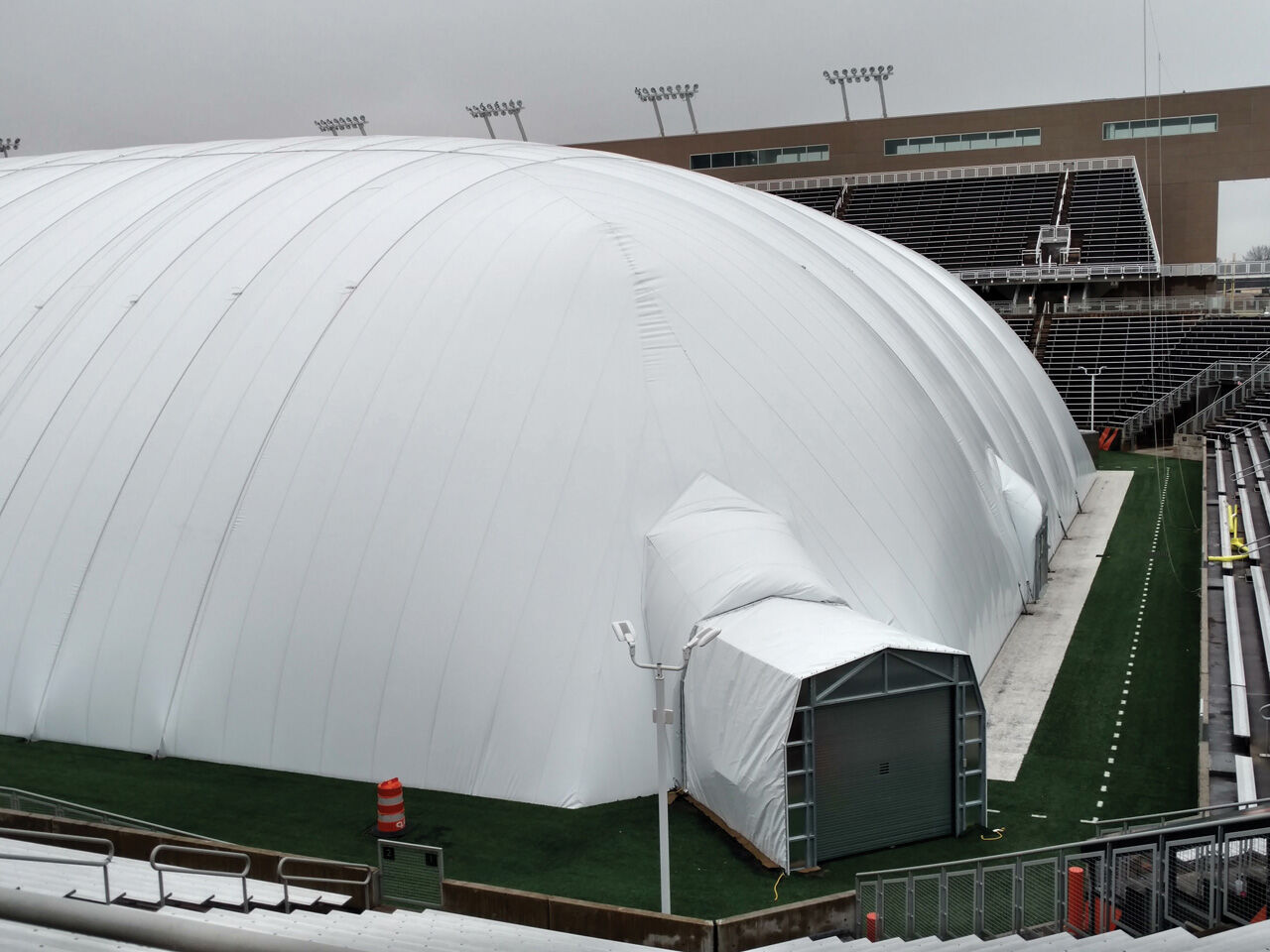
The metaphorical orange bubble is alive and well, and during a winter that has extended well into the first days of spring, it has been augmented by a physical bubble. A “seasonal air structure” can now be seen covering the football stadium’s Powers Field provides ample space for varsity as well as club and intramural teams to practice in a climate-controlled structure. The bubble, courtesy of an anonymous $3.5 million donation — tuition, room, and board for more than 50 students, for anyone keeping score at home — will be placed on the field at the conclusion of each football season.
Schools seek $137 million bond referendum
A price tag has been placed on the Princeton Public Schools’ October construction referendum: $137 million. The bonds, to be paid back from 2020 to 2050, would fund the upgrades to all district schools as well as an expansion of the high school and new buildings for administration and an upper elementary school serving grades five and six.
It’s not the price tag alone that could prove controversial: as letter writers Sheila Siderman and Naomi Vilko noted in the March Echo, construction plans include changes to the school structure to include more open spaces and fewer interior walls, closely resembling failed open space schools from 50 years ago.
The school board plans to purchase the former SAVE animal shelter at 900 Herrontown Road for $1.75 million. Additionally, its proposed budget includes a 3.63 percent increase — a $159 property tax increase for the owner of an average Princeton home valued at $837,000.
Russian attack has Princeton connection
There is a Princeton connection to the Russian poison attack that hospitalized a former Russian spy, his daughter, and a British police officer, and potentially exposed hundreds of other residents of Salisbury, England, to a toxin on March 15.
“Novichok was invented and studied and experimented and many tons were produced only in Russia,” said Russian chemist Vil Mirzayanov, 83, in an interview with Reuters from his home on Cherry Hill Road. “Nobody knew in this world,” he said.
The Russian defector worked at the secret military chemical weapons laboratory that developed Novichok, which is thought to be many times more deadly than other nerve agents. He went public about the program in 1992 and was subsequently arrested on charges of treason. He was eventually released and allowed to move to New Jersey, where he took a job teaching at Rutgers.
,

