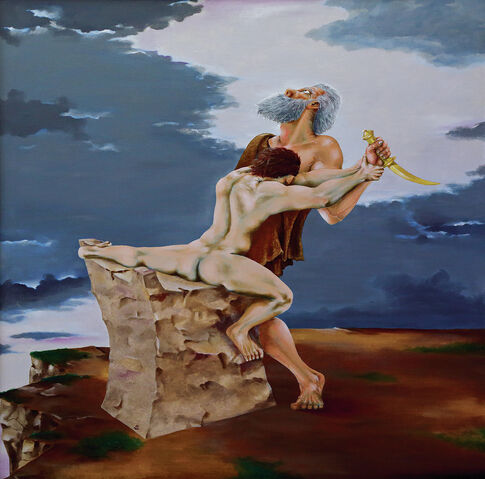
“Abraham and Isaac,” a painting by artist Marc Malberg, will be on display at Rider University Nov. 5–Dec. 6 as part of the exhibition titled, “Biblical Inspiration in a Secular Time,” curated by Judith Brodsky.
By Michele Alperin
Marc Malberg, by day an orthopedic surgeon in New Brunswick specializing in spine surgery and hip replacement, is an avid painter, creating huge paintings of biblical images from the Old Testament.
Malberg and four other artists will be showing their work in the exhibit “Biblical Inspiration in a Secular Time,” running from Thursday, Nov. 5 through Sunday, Dec. 6, at the Rider University Art Gallery. Judith Brodsky, the show’s curator, says of Malberg’s work, “The iconography of Christ has been developed for centuries. His idea was to create major works that would have the same kind of impact as paintings based on New Testament themes.”
One of Malberg’s five paintings in the show is “Abraham and Isaac.” The biblical account has Isaac bound to the altar, with Abraham about to slaughter his son as God commanded, stopped at the last minute by an angel. Malberg, a Princetonian, says of this scene, “I couldn’t imagine Isaac being passive.”
In his painting, Abraham, knife in hand, looks desperately toward the sky, seemingly for some advice from God. A very muscular Isaac, unbound, presses the knife away from himself. Looking at his artistic interpretation of this scene, Malberg asks, “Is Isaac the angel who communicates that we don’t do human sacrifice anymore?”
Malberg grew up in Hillsborough on what became an egg farm with 100,000 laying hens. His chores and, later, his college-prep courses left him little time to focus on the drawing he was always good at. But the largely self-taught artist used every possible opportunity to learn from painters he loved: Rembrandt, Dali, Leonardo, Titian, Caravaggio and Delacroix, through art books and later museums and galleries in New York City and beyond.
As a young man, he said, he tried to emulate the technique of the Old Masters, but an exhibit of the work of Salvador Dali in the 1960s pushed him toward surrealism. “The kind of paintings I wanted to do were things that needed to be momentous subjects rather than genre paintings or landscape or things of that nature,” he says.
What followed were several paintings with mythological subjects. Then he started to focus on biblical subjects.
The other artists in the Rider show include Siona Benjamin, who combines Indian and Jewish themes in her work; Helène Aylon, whose work reinserts women into the Five Books of Moses; Hanan Harchol, who creates animations of biblical scenes without overtly religious references; and Archie Rand, who has recreated Bible stories as a comic book series. The opening reception is Thursday, Nov. 5, and an artists talk will take place Thursday Nov. 12, 7 p.m. Gallery hours are Tuesdays through Thursdays, 11 a.m. to 7 p.m.; Sundays, noon to 4 p.m. For more information, call (609) 896-5168.
Placing the show within its broader cultural context, Brodsky says, “This is kind of a developing direction within art at the moment—the return of interest in the spiritual.”
,

