By Dan Aubrey
Passage Theater opens its 2014 season with “Little Rock,” a new work that uses a painful American moment to spotlight courage and spirit.
Written and directed by guest artist Rajendra Ramoon Maharaj, the work uses music and memory to tell the story of the nine black students who in 1957 endured hate to help end segregation and injustice in both Little Rock and the nation.
Maharaj is the founder and artistic director of Rebel Theater Company in New York City and known for diverse, social, and political theater about American history. His work has also been seen at Syracuse Stage, Arkansas Rep, and Crossroads Theater (in New Brunswick).
“I think that those who do not learn from history are doomed to repeat it,” says Maharaj in a statement. “And if you look at our country today, from Sanford, Florida, to Ferguson, Missouri, the need for racial equality and tolerance is as vital as it was during the Civil Rights Movement. Education is, and will always be, the key to opportunity, access, happiness, and freedom in the United States of America. And ‘Little Rock’ illuminates that through the eyes of nine children whose simple desire to go to school and follow the law changed the trajectory of our country forever. ‘Little Rock,’ at its heart, reminds me of one of my favorite quotes from (American writer Henry David) Thoreau, ‘Go confidently in the direction of your dreams and live the life you imagined.’”
In a recent interview for U.S. 1 newspaper (a sister paper of the Downtowner), Maharaj told writer Neal Zorn that the play’s spirit is rooted in “sankofa” — a term that derives of the Akan language of Ghana and means “to reach back” and to feel “the presence of your ancestors and to be in spiritual touch with your heritage.”
The 42-year-old American director of Indo-Caribbean and African descent says he was inspired by a 2004 visit to the Little Rock, Arkansas, school where the nine students embodied the rights gleaned from the 1954 landmark U.S. Supreme Court decision in Brown vs. The Board of Education – a unanimous ruling that segregation was a violation of the 14th Amendment’s equal protection clause.
It was at Central High School that the students found themselves cast in a national drama — one that reached a fever pitch when Arkansas governor Orval Faubus deployed the National Guard to stop the students from entering the school and United States president Dwight Eisenhower responded by ordering the 101st Airborne Division to escort the students into the building and enforce the law. That moment has been recorded in the nation’s memory through the news photographs of soldier flanked Elizabeth Eckford passing through crowds of angry and shouting whites to go to school.
The playwright, whose background includes theater training and a degree in criminal justice, reports that it was during his visit to the Little Rock school that he could feel the essence of both his ancestors and Elizabeth and her classmates, and his journey to create the work began.
Maharaj says (in U.S. 1) that the work “is a memory play with the documentary elements you’ll find in pieces by Anna Deavere Smith (an American performer and playwright who blends theater and journalism). It was very important to me that the voices and memories of the nine people who entered Central High School be heard, and that we saw the story through their eyes. Lots of people are familiar with the picture of Elizabeth (Eckford) being led into the school. What you don’t see is that the soldiers — called in to keep the approach and entrance to the school orderly — were not permitted into the building. Once Elizabeth and the others passed the crowd, who were yelling all kind of threats at them, they were on their own to face the classmates and teachers at Central.
“Minnijean (Brown) did not make it through that first year at Central because she retaliated to the taunts she received from other students. Melba (Patillo) was trapped by a group of girls and had acid thrown in her eye. The Nine had to show a lot of restraint and fortitude to endure their roles as the first to do something. My play chronicles a lot of the experiences the Nine had while inside and unprotected. I divide the show into four parts that represent the seasons from the time Elizabeth entered the building to the time Ernest (Green) is graduated from Central in June 1958.”
Maharaj — who was born in Brooklyn but spent his early life in the Caribbean with working class parents — says this new piece is consistent with his other work, “A lot of the focus of the plays I’ve written and directed comes directly from my interest in civil rights, past and present. As a person of color and of unusual background, I have curiosity about minorities and underdogs that go beyond the black or South Asian experience to the Native Americans and the Trail of Tears.”
Then there is the art of discussion such topics. “I continue to believe art should entertain, but ‘Little Rock’ and some other plays have shown me art can also educate. It can entertainingly acquaint people in history and culture that are part of the American, and the human, experience. I look to include a sense of harmony and enlightenment in what I write. ‘Little Rock’ is an example of that.”
The play is also an example of Passage’s mission to create and produce socially relevant new plays and community-devised arts programming to transform the lives of individuals and community. Passage Theater artistic director June Ballinger notes in a statement the connection between “Little Rock” and Trenton: “What set the course for the stand that the Little Rock students took was a law that had been in existence for over ten years but was being ignored – Hedgepeth and Williams vs. Board of Education, Trenton, New Jersey. The 1944 New Jersey Supreme Court case was brought to the court by two (Trenton) mothers, Gladys Hedgepeth and Berline Williams, who sued the Trenton Board of Education over racial discrimination against their children, and won. It was a precursor to the Brown vs. Brown decision that prohibited racial segregation of school systems throughout the United States. But Little Rock Arkansas in 1957, regardless of federal law, did not adhere.”
Ballinger also notes that “Trenton actually has a community member living amongst us who was one of the students from the original group who started out for school that first day in 1957: Delois Harris, wife of The Reverend Harris of Galilee Baptist Church.”
While Maharaj notes his commitment to sankofa (or reaching back), he is committed to looking forward and says, “’Little Rock’ is not only a story about nine people. It’s about America coming to a next stage in its development.”
“Little Rock,” Passage Theatre, Mill Hill Playhouse, 205 E. Front Street, Trenton, Thursday, October 2, through Sunday, October 26, 8 Thursday through Saturday, 8 p.m., and Sunday, 3 p.m.. $30 to $35. For information, call 609-392-0766 or visit passagetheatre.org.
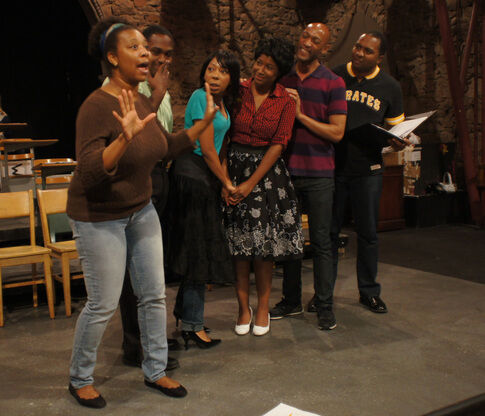
Passage cast, left to right, Adiagha Faizah, Shabazz Green, Bliss Griffin, Gia; McGlone, Damian Norfleet, and Brandon Rubin in rehearsal for “Little Rock.”,

