You can’t help it: you step off the plane and the colors slap you right in the face.
“These colors are not gentle, subtle pastel,” says Samuel Vovsi, a mathematician and photographic chronicler of his world travels. “They are blinding, overwhelming, and sometimes simply crazy. Your eyes hurt from these colors, but you can’t stop looking.”
But then a curious thing happens. Those colors, even the colors inside the colors, become secondary to the people. As many types of people as there are shades and hues in the palette of Latin America.
“Young and old, children and adults, poor and rich,” he says. “Poor much more often than rich.”
Vovsi, 69, chronicled nearly half a decade’s worth of travel in Mexico, Guatemala, and Peru, and the results will be showcased in “People and Colors of Latin America,” a photographic exhibit opening on Friday, Jan. 8 at Gallery 14 in Hopewell. The opening reception will run from 6 to 8 p.m. The gallery is also set to host a reception with Vovsi on Sunday, Jan. 10, from 1 to 3 p.m. Both are free to attend. The exhibit will run through Feb. 7. More information is online at photogallery14.com.
Gallery artist or not, Vovsi is not the type to weave lofty artistic statements about his work. The pictures should do their own talking, he says. If he has to tell you what to think about them, they’re not working.
Still, he does want visitors to the show to see the juxtaposition between the cheerful color wash of Latin America and the often equally glaring poverty and hard life on display. Vovsi’s only real theory on the meaning of the Latin America’s Crayola box, where sometimes every wall of a building is a different color, is that maybe the bright colors are meant to make life look better than it is. “But maybe not,” he laughs. “I don’t know.”
The important thing here is not to get lost in the vibrancy of the architecture and the sky and the markets where vendors peddle their goods. You need to see the people. Because even with the sparkling palette, “without the people it would get a little monotonous.”
“The colors play a minor role,” he says. “I want to give people a feeling of the life. How people live, how they struggle, how they’re able to exist.”
Vovsi’s exhibition will feature a blend of life-on-the-street stills, day-in-the-life action, and individual portraits spanning the age spectrum. It’s in these faces that Vovsi sees the richness of life and all its choices and realities.
“The difference between adults and children,” he says, “is that in adults, I see in their faces that life is tough. And children, their faces are happy, innocent. They still don’t know that life is tough.”
He doesn’t confuse this with seeing wisdom in the faces of adults. It’s not an abstract wisdom that Vovsi sees, it’s the hard realities of getting through life where life is hard. And maybe that harshness is best exampled by this observation:
“For Peru, Mexico is a rich country,” Vovsi says.
Still, life south of the equator is as vivid and bold as the color scheme that sets off the brilliant blue sky and deep green lands, and it shouldn’t be assumed that Vovsi’s documentation of Latin America is a commentary on poverty or pure contrast. It’s about life all around. Not just one thing, all things, because that’s what life is.
Last March, for example, Vovsi and his wife, Marina, spent a week in Guatemala, where he quite unexpectedly found that Mayan culture is very much alive and thriving.
“Until then, I somehow thought that the word Maya belongs to the same category as Aztec, Babylon, or Pharaoh,” Vovsi wrote on his blog. “Something from the distant past. But in fact there are 22 actively spoken Mayan languages in Guatemala, there are Mayan traditions, Mayan holidays, and even Mayan economy.”
You would think, perhaps, that a guy with such a humanistic perspective and keen eye for the spectrum of life might have evolved as an artist or philosopher who’s always sought the meaning of abstract concepts, but Vovsi’s background is pure mathematics, and his travel bug has its foundations in some of the most remote places Earth can throw at a person.
Vovsi today makes his home in Princeton and travels twice a year when he can. This freedom to travel abroad is something he doesn’t take for granted, mainly because he was born without it. He was born in Leningrad (St. Petersburg) but grew up in Latvia, in the former U.S.S.R., where travel to other lands was limited to eastern bloc countries like Bulgaria. Fine, he says, there’s beauty everywhere. But Bulgaria hardly differed from the Soviet Union in its look and feel.
And being Jewish in the U.S.S.R. didn’t win him any favor when looking to go places. Jewish in the Soviet Union was a race, not a religion. He could become a Christian at 20 and renounce all manner of Judaica, he says, but his passport would still have said his ethnicity was Jewish. And Jews in the U.S.S.R. weren’t exactly the favorite ethnicity.
Nevertheless, Vovsi sated his wanderlust inside the Soviet Union as much as he could. As a teenager, he and his friends would go into the woods to enjoy the outdoors and the remoteness. We’re not talking about a quiet ski lodge where you get to sip cocoa and make new friends here and there. We’re talking zero civilization, hide from the zombies kind of remote.
To give you the picture, imagine a forest the size of Texas. And when you get there, absolutely no one is around. “For 10 or 15 days, you don’t see people,” Vovsi says. “And it’s not just that you don’t see people, you don’t even see the trace of people ever being there.”
These weeks-long treks into the untamed were “sort of a sport” for Vovsi and his friends. The whole time, he took hundreds of photos, mostly black-and-white shots. From Vovsi’s current perspective, none of them was very good.
Still, at the time, he was not trying to be a photographer. By age 17 in the U.S.S.R., you had to declare a future that would remain your career path. Vovsi chose mathematics and went to college in Latvia, where he lived with his grandmother, Ella, one of the few survivors of the Nazi occupation that killed the members of his family who did not flee to Moscow during the invasion. Ella Vovsi managed to write her record of imprisonment, which her grandson has published as an e-book, A Document of Holocaust Survival, available on Amazon.
Latvia, Vovsi says, was more tolerant of Jews than other parts of the Soviet Union, but by the time he was closing in on age 50, was getting tired of the limitations of Soviet life. His first time traveling outside the U.S.S.R. to a non-eastern bloc ally was a mathematical conference in Japan.
“I was in absolute awe there,” he says. Everything was in spotless order. No litter blowing on the streets, not even a leaf on the grass outside the university. Doors inside the buildings were automatic, and not a single one didn’t work. It was perfect order, almost mathematical in its function. And yet, Japan had little in the way of mathematics programs at the time, in the 1980s.
He and Marina, a Latvia native, were married in 1975. They had two children, Mark and Dina. In 1989, with glasnost opening the doors to the west, Vovsi and Marina — who holds a degree in musicology and taught music in Riga —decided to leave the Soviet Union with their kids, then aged 11 and 2.
They weren’t the only ones. Every other academic, particularly in the engineering, science, and mathematics fields, it seemed, left Russia at the same time. Amid stiff competition, Vovsi had hoped to land a tenured professorship at an American university. That would have been a lateral move with more security.
The family lived in Boston for a time before moving to Highland Park, with Vovsi teaching math at Rutgers University. He has also taught at The College of New Jersey.
With prospects dim for a tenured position, Vovsi was convinced by a friend to take a job as an actuary, which he refers to as a “disgusting job.” After a year, he quit and got into computer programming, from which he retired and the semi-un-retired over the past couple years. The Vovsis moved to Princeton in 1993, and both kids graduated from Princeton High. They both live in New York today, where Mark is a computer programmer and Dina is trying to forge a career as a theater director.
Today, Vovsi does consulting work part-time for his old employer. The part-time work allows him to travel. Since leaving the Soviet Union, Vovsi has seen much of Europe, North America, and Central America. He’d love to see more of the Orient, and wants very much to see Brazil.
As he’s made his way around the globe, he’s taken acres of pictures, which, again, he doesn’t think are very good. At least not the ones he took before about a decade ago. After a trip to Norway, he compared his “tons of pictures” taken there to those of other traveling shutterbug friends. “Most of them were dreadful,” he says of his shots. He had liked to think of his photos as travel photography, but realized he wasn’t so good at making great images.
So he studied. Honed. Learned photo editing as much as photo capturing. Today, he says, making photos is his favorite part of photography. Taking photos is just the beginning.
So what in Vovsi’s globetrotting adventures qualifies as his favorite place? The short answer is, he doesn’t have one. Cities and countries are, he says, like colors. “They’re all beautiful and they’re all different,” he says.
He has high praise for Paris, which he says is beautiful not in one area but everywhere. In North America, he loves Vancouver, which surprised him. He fell in love with its unusual combination of mountains, city, ocean, and redwood forest.
As for American cities, he likes San Francisco best. Even though Russian Hill had absolutely nothing Russian about it.
Somewhat unusually for a serious photographer, Vovsi is not too concerned about his equipment. He shoots on a Canon DSLR with a couple standard lenses. He might upgrade to a better DSLR someday, but he’d sell the Canon first, he says.
“I will not have 40 cameras and 40 lenses. At most I will have two,” he says.
After all these travels and after all his perspective on what living a tough life under harsh realities is like, the question looms, does all this give Vovsi a more empathetic eye toward the human condition?
No, actually. At least, he doesn’t see it that way. Remember, he doesn’t go in for lofty philosophy. As he sees it, his life in the U.S.S.R. is nothing like the lives of those people he photographed in Central America. To try to place himself in their reality would be, what’s the word? Maybe condescending? Misguided? A stretch?
Whatever the word, his own life is not the point of his images. The point is not even the lives of the individuals in those images. The point is life. Just life. In all its forms and colors and faces. And it can speak for itself.
Scott Morgan is a multi-award-winning reporter and writer covering the Princeton area since 2001.
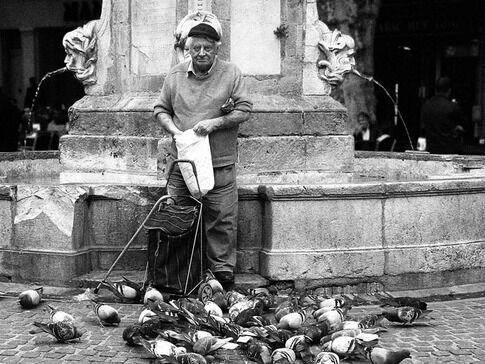
“Loneliness,” photograph by Samuel Vovsi taken in Aix-en-Provence, France.,

