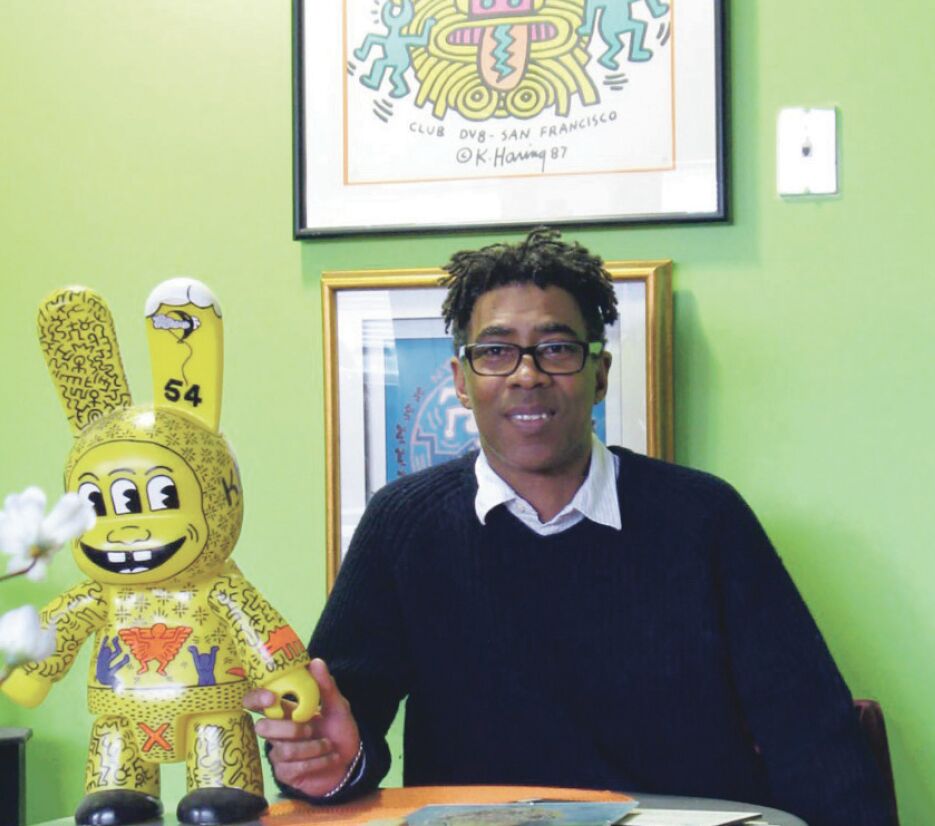
A big yellow bunny-man figure rests prominently in the apartment of multi-media artist Karey Maurice Counts, sometimes known as Karey Maurice or even just KaMo.
The figure is adorned with squiggly lines, purple creatures that seem to be dancing, and a cartoonish face that features three eyes and a gap-toothed mouth. In addition, on the one bunny ear is a big, black number “54.” (More about this mysterious number “54” later.)
Just above what would be the bunny-man’s navel, is an orange, winged humanoid figure that seems to be flying, rising toward the heavens. Counts calls this piece “Resurrection,” and the idea of reinvention and resurrection resonates strongly with him.
Counts is a native of Ewing and longtime fixture in the Trenton club and art scene, who bridged the sensibilities of the downtown New York art scene of the 1980s with his hometown.
It was there and then in NYC that he associated with neo-pop artist and ‘80s cultural icon Keith Haring, who influenced and encouraged his art, until his untimely death in 1990. Jean-Michel Basquiat (1960-1988), the New York street artist who rose to international art world fame, was also an influence, but less on Counts’ creations than on his personal style and appearance.
“We were dead ringers — I used to be tagged for Basquiat all the time, and got into a lot of clubs for free because of this,” Counts says with delight. He describes one elated woman running headlong across the dance floor at Danceteria Nightclub, and knocking him down, thinking he was Basquiat.
Although Counts is young looking, with a youthful and positive personality, he did hit the Big Five-Oh a couple years ago, and is experiencing the effects of age and gravity.
In addition, he lives with the pain, fatigue, and limited movement associated with the chronic condition of neuropathy.
“It’s like an electrical cord that’s been cut and is shooting sparks,” Counts says. “The pinched nerves shoot energy all over the place.”
It’s a condition that saps his energy and, for a while, threatened to extinguish his spirit. For some four years, Counts was living with his sister in South Brunswick, nearly “flat on my back — and you don’t want to lay on your back, you want to live,” he says, revealing his feelings of isolation and disconnection from the world of creativity.
Luck turned his way more recently, when an affordable apartment in Princeton opened up. Counts also connected with Patrick Henry Ryan, a 1968 graduate of Princeton University, who recently opened Gallery 353 on Nassau Street, a haven for contemporary art. Apparently, Counts read an article about the new space and its owner, picked up the phone, and made an appointment to show Ryan some of his latest artwork. As fortune would have it, the gallery is less than a mile from the artist’s apartment.
The meeting was quite productive, and now Gallery 353 is representing Counts, has already sold a couple of his works, including one work in his 2015 “Cream Cone” self-portrait series, mixed medium collage on paper.
When asked why he created a series of ice cream cone images as self-portraits, the artist lists several reasons, including the fact that “neuropathy makes me feel frozen, like an ice cream cone.”
In his artist’s statement, he writes that these works “are truly representational of the ‘Self’ and in this case the self is the artist open and vulnerable to everything that surrounds him. The lack of mobility keeps you frozen almost solid and stiff with the sun enriching you but also diminishing what keeps you beautiful!”
Furthermore, Counts reflects on the temporary quality of an ice cream cone, and how his “Cream Cone” series “indirectly addresses the ‘Pop Star’ or fifteen minutes of fame mentality of a person in today’s society gaining ‘Mass Appeal.’”
Coming up soon at Gallery 353 is a solo show for Counts, to include works in various media. The show runs from Saturday, May 7, through Sunday, May 22, with an opening on May 7 from 4 to 8 p.m., during the gallery’s regular Saturday evening salons.
In addition to his recent success in Princeton, Counts and his art have started to re-surface in Trenton. In 2015 his work was included in two shows at the Trenton City Museum at Ellarslie: “Of Color: the African-American Experience,” and “The Art of the Print.”
“Both of those shows helped me feel better about myself,” he says.
And Counts will also have a show in mid-May at Artworks ArtLab. Artworks education coordinator Jesse Vincent explains how the exhibit has been in discussion for about a year, and began when the artist approached Lynn Lemyre, Artworks former executive director.
“I’ve been working with Karey as a part of our first ever Print Studio Artist Residency,” she says in an e-mail. “Sometime last summer Karey had approached Lynn Lemyre and myself about working in collaboration with me on a series, which he’s titled ‘MIT: Made in Trenton.’ Karey is no stranger to Trenton as it has been hometown to him and his studio before becoming more involved in the New York scene.”
“That was something he wanted to touch on in this work, but, due to his condition, he was unable to perform some of the techniques he was interested in using, so we paired together and began to discuss his ideas,” Vincent continues. “(We eventually decided that) he would lay down the foundation of the pieces and then hand them over to me to print his images on top with the opportunity to incorporate some of my own judgment.”
“This exchange continued and the project soon developed into a body of work including such print mediums as screenprinting, linoleum blocks, collage, and even some notes of spray paint using stencils,” she adds. “Some of the linoleum blocks we have been using predate this residency and are ideas Karey has been mulling over for a decade or two.”
Counts was born September 2, 1963, and grew up in a section of Ewing he humorously calls “Dogpatch,” since it was adjacent to a landfill, and a favorite place for people to drop off unwanted pets, particularly cats and dogs.
His father worked as a reprographics specialist, and also did “darkroom stuff, re-touching film, enlargements, and whatnot,” Counts says. “I hung out with him in the darkroom, and he taught me some of the techniques.” His mother worked for the Mercer County Prosecutor’s Office, as office manager/lead clerk, training many younger colleagues, and working almost up to the end of her life.
Counts’ parents were not supportive of his artistic dreams and endeavors — although his mom took him to New York to see the circus, as well as the holiday show at Radio City Music Hall.
However, he did have a sympathetic godmother who understood his love for glamour and excitement, and took young Karey to the Playboy Club in Manhattan for his 16th birthday. Counts says the excursion was where he got his first taste of New York City nightlife.
He attended Mercer Community College briefly in the early 1980s, studying painting with Mel Leipzig, but left with the feeling that school was not going to teach what he desired to learn about art, the art business, and life in general.
Instead, Counts traveled to New York to absorb city life, to network, and develop his own urban aesthetic. “I didn’t go to college, I went to disco,” he says.
Counts was an integral part of the Trenton club and art scene, literally laying the floor down at the gone-but-not-forgotten City Gardens. “I brought New York City to Trenton through City Gardens, through the Thursday night dance parties,” he says. Naturally he was interviewed for the book, “No Slam Dancing, No Stage Diving, No Spikes: An Oral History of the Legendary City Gardens,” by Amy Yates Wuelfing and Steven Di Lodovico, and is quoted as telling “Tut” (City Gardens’ owner), “You need to put linoleum down so it’s easier to dance on. I was the one who got him to put money out, because Tut wouldn’t spend a penny. Then I said, ‘Let me paint the walls.’ So I painted the front of the stage with these Keith Haring-esque kind of characters.”
“After the stage was done, (Tut) allowed me to do the walls, and I painted these monstrous big feet, almost like a giant was walking up the walls, or dancing up the walls. It actually did a lot for the visual aspect of the club.”
Counts recently showed some works at Trenton Social, which is housed where the Urban Word Cafe used to be, one of his old haunts.
“It was bittersweet, because I helped create all this,” he says. “Nobody had a clue of my history, I practically had to re-introduce myself. It was an especially emotional experience, because I actually used to live near there: the Conduit nightclub was just across the alley, and I built my studio above the club.”
These days Counts is feeling re-energized and is looking forward to both shows in May. He is especially gratified to have found Ryan, and feels he has met someone who truly “gets” him.
“Patrick recognized (my style) immediately, understood this genre, recognized its origins from the early 1980s,” he says. “After I told him my story, Patrick understood where I was coming from, that I had been part of the 1980s downtown (New York) art scene.”
Indeed, it’s been almost 30 years since Counts met Haring and participated in a photo shoot in front of one of Haring’s signature works, the huge “Life is Fresh but Crack is Wack” mural in NYC. The photo was by Haring chronicler Tseng Kwon Chi.
Counts recently found two copies of the photo — and sure enough, there he is, sporting a mustache, wearing a pork pie hat and a jacket adorned with all kinds of buttons, and standing just in front of Haring’s orange mountain bike. When he brought copies of the Tseng Kwon Chi photo to Ryan at Gallery 353, it solidified his “cred” as a member of the NYC downtown art scene.
Further linking Haring and Counts is the aforementioned big yellow bunny-man that resides in the Princeton apartment. It was created for what would have been Haring’s 54th birthday, hence the number “54” on its ear. “I almost felt like I was channeling Keith when I was making this,” he says.
Counts describes himself as a “missing link” between such 1980s NYC artists as Haring and Basquiat. He explains a kind of artistic family tree with Andy Warhol as the pop-art patriarch, sprouting branches of street and neo-pop art progeny. Counts feels strongly that his work is the next historic branch.
“There was this gap from the 1990s to the present,” he says. “Historically speaking, my work is the bridge, and this work has not been seen.”
“I lost a lot of friends, but I kept working,” he adds, suggesting that his vast body of art is ready to be discovered, purchased, and maybe even exhibited in a museum.
He reflects that it was a real gamble for him to choose the life of a professional, working artist, and his family just never understood his passion, even from childhood. He also says that he heard the phrase “grow up” often, but it was advice that, happily, never completely sank in or jaded him.
“Even after we grow up, there’s still this need to play, and this need never left me,” Counts says. “I still want to play, but my body doesn’t allow me. However, I think my mental strength has increased. The illness has been kind of an epiphany, and my energies are now going into being who I really am.”
“MIT: Made In Trenton,” Artworks ArtLab, 19 Everett Alley. Reception Saturday, May 14, 6 to 8 p.m. Through June 11. 609-394-9436. www.artworkstrenton.org. For more on Counts visit www.redballoonstudio.com.
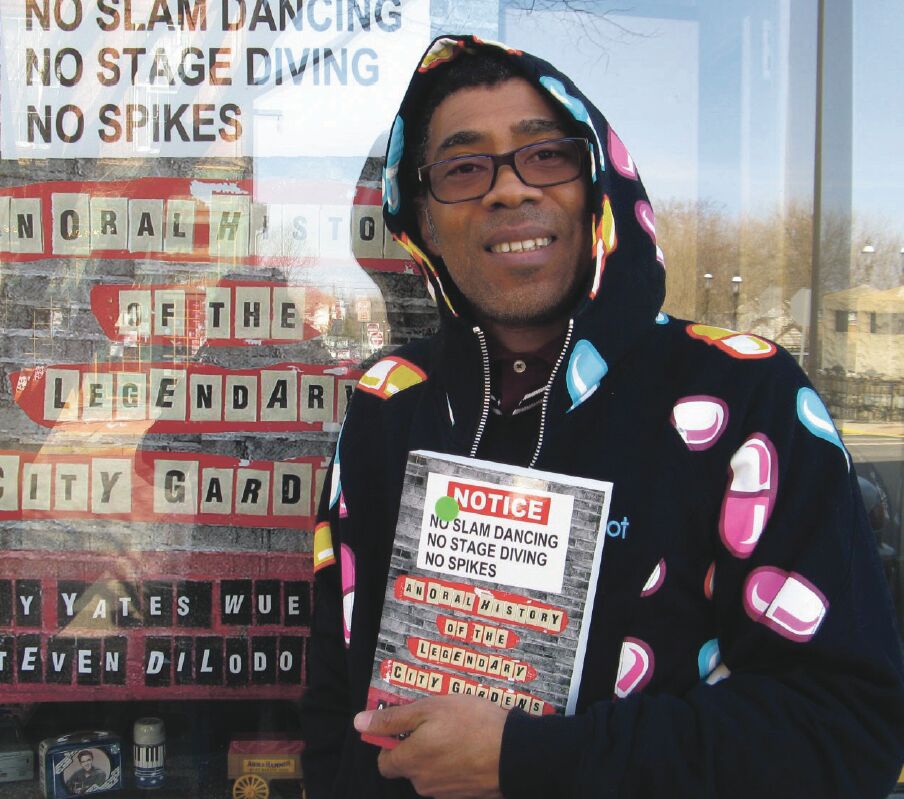
City Gardens Artist ‘KaMo’ returns to his Trenton roots with a new show opening at Artworks on May 14.,