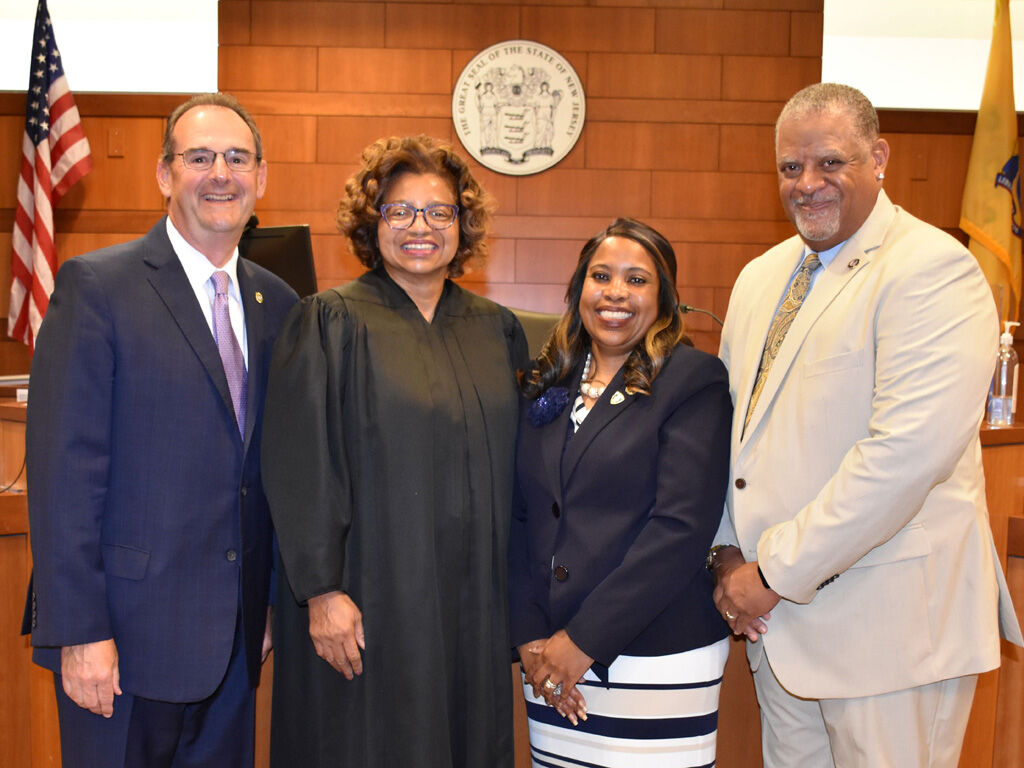
After working in the Mercer County prosecutor’s office for 25 years, Jennifer Downing-Mathis was recently promoted to first assistant prosecutor.
Having grown up in Lawrence township and now a resident of Ewing, the promotion has awarded Downing-Mathis substantial recognition for her decades of service to her community within the prosecutor’s office.
Before her promotion, Downing-Mathis served as the deputy first assistant prosecutor for Mercer County, a role that she says came with many of the same responsibilities, albeit with slightly less authority.
In her new role, Downing-Mathis will assist in formulating policy, overseeing investigations, and general oversight of several units in the office as well as the 210-member staff. She has served as deputy first assistant since September 2016.
“I look forward to working with Jennifer in her new role as this office strives to make Mercer County a safer community to live, work and visit,” said Mercer County Prosecutor Angelo Onofri.
“It’s the next logical step,” Downing-Mathis said of her promotion, which places her as second-in-command of the prosecutor’s office. “That’s just one level under what I am now, but being a part of the administration for those years, it’s doing some of the same things it’s just at a higher level.”
Downing-Mathis completed her undergraduate degree in business administration with a minor in Spanish at Rider University. Not long after, she went on to earn her law degree at Widener University School of Law.
Before her career at the Mercer County prosecutor’s office in 1998, Downing-Mathis worked as a law clerk for Judge Paulette Sapp-Peterson on the Appellate Division of the New Jersey Superior Court, as well as doing per diem work for an attorney.
As for why she chose the prosecutor’s office over other legal work, Downing-Mathis credits her father, Robert Downing.
“I come from a law enforcement family. My father, who’s deceased, was the first Black undersheriff for Mercer County, so I grew up my entire life around law enforcement, respecting law enforcement,” Downing-Mathis explained. “With my personal background, there’s really been no other type of law that I’ve been interested in.”
During her tenure as deputy first assistant prosecutor, Downing-Mathis oversaw both the Megan’s Law and special victims units. These specialized units handle crimes of a particularly sensitive nature, often involving investigations into child abuse and neglect.
Downing-Mathis said that assignments to units in prosecutor’s offices is often random, but opportunities for working in a certain unit do present themselves. The Megan’s Law and special
victims units are known as “major crimes units,” which, more often than not, are not units which people would start their career in.
“I actually did walk into the office starting out with [the] Megan’s Law [unit] because it was shortly after the law was enacted, when I started, and there was a grant that allowed prosecutor’s offices to hire people,” Downing-Mathis said.
Enacted in New Jersey 1994, Megan’s Law created a sex offender registry for the state of New Jersey after the rape and murder of the law’s namesake, Megan Kanka, in Hamilton Township. After first being adopted in New Jersey, it was signed into federal law in 1996.
On the question of whether her unit assignments were something that she felt drawn to or something she was assigned, she answered: “it’s a little bit of both, as far as me landing there.”
Outside of the prosecutor’s office, Downing-Mathis dedicates her time to both local and state-wide organizations, although she says it can be hard to separate her work with the community from her work inside the office. “I’m never not an assistant prosecutor, but yes I’ve been actively involved in the community in numerous organizations,” she said.
Growing up in Lawrence township, Downing-Mathis participated in the Eggerts Crossing Civic League, a neighborhood organization that holds community events and in recent years has advocated for improvements in city planning, such as better pedestrian access to local parks.
However, as Downing-Mathis said herself, most of the organizations with which she is involved are indeed enmeshed with her career.
“I was president of the Association of Black Women Lawyers in New Jersey, which is the oldest women’s legal organization in the state of New Jersey,” Downing-Mathis said.
She is a member of the New Jersey State Bar, serving as a trustee for the Criminal Law Section and interim secretary and a trustee for the Mercer County Bar Association. She is also a member of the National District Attorneys Association and the National Black Prosecutors Association.
Additionally, Downing-Mathis is significantly involved in the Mercer County Inns of Court, serves as chairperson of the Mercer County Commission on Abused, Neglected and Missing Children, is a Stigma Free Mercer Task Force member, and is a member of the Mercer Vicinage Superior Court Diversity and Inclusion Advisory Committee.
During her career, Downing-Mathis has been honored with awards from the Cherish the Child Foundation, the New Jersey Women’s Hall of Fame and the Association of Black Women Lawyers of New Jersey. She was recently inducted into the Marquis Who’s Who in America.
“Lots of my community outreach has been done with children, because I was chief of our special victims unit and out Meghan’s law unit,” Downing-Mathis said. “We do lots of outreach in the schools, or with community groups involving children, funneling information directly to the children or to the parents [about] different issues that involve our young people.”
Cases in the Megan’s Law and special victims units can often be complex and emotionally difficult. “It is heavy work, it is deep work,” said Downing-Mathis. “It is a lot of the icky, nasty things that people do to children.”
In order to prevent emotional and psychological burnout, as well as sustain morale, the office holds events on what are known as “resiliency days.” With the units she managed, Downing-Mathis would try to get everyone in the unit to gather outside of the office, whether it be a unit dinner or bowling, so that they could bond as a team, away from the office and the weight of their cases.
Downing-Mathis made a point to explain that everyone in the prosecutor’s office relies on one another for support. “We kind of keep an eye on each other if we think that, you know, we’re maybe noticing that something is affecting someone,” she said.
“I don’t think I’m much different than any other prosecutor in the state who’s handled sex crimes,” Downing-Mathis said, “we just somehow deal with it.”
The reality of working in a prosecutor’s office, Downing-Mathis emphasized, is quite different from TV shows like “Law & Order.”
“Well, as far as the cases being resolved in a nice, tidy package as instantaneously as it’s done on TV, it doesn’t happen that way,” she said, “there is a lot of work, a lot of investigation, a lot of time and resources that are dedicated to it.”
Another misconception, Downing-Mathis elaborated, is that prosecutors are solely agents of incarceration.
“Every single prosecutor is going to assess that file that they have before them and sometimes a program for the defendant is what’s appropriate. Incarceration is not always the answer,” Downing-Mathis said.
According to Downing-Mathis, part of what the role entails is deciding when not to charge a defendant.
“Sometimes we don’t have it right, or the local police department may not have it right, and a file needs to be downgraded to a lesser charge or even dismissed,” she said.
Downing-Mathis’ said her philosophy on the matter is that prosecutors must have a holistic view of a case, which means the outcome is not only considered with regard to the victim and the community, but the defendant as well.
Downing-Mathis says she is grateful for the opportunity to further serve the community she grew up in, but she is also triumphantly celebrating her promotion as a testament to her work ethic and dedication to her career.
“I mean, at 25 years you’re eligible to retire, so making it to this milestone this long in this profession, as a woman, as a woman of color, is no easy feat,” she said.
“I’m truly dedicated to making a difference in this community, working for this community,” she added. “It’s what I’ve done my entire life, and my entire work life has happened to be this job. But, focusing on the community and trying to make the community a better place has always been in the forefront of my mind.”