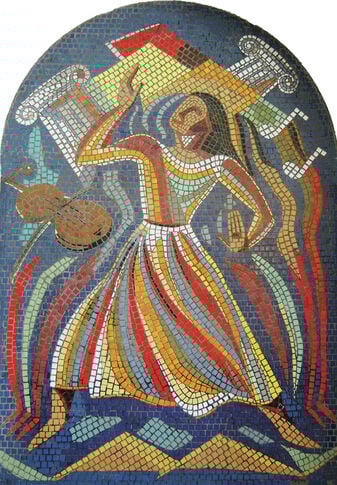
The 1941 WPA Mural, ‘Carrying the Heritage of Arts from the Past into the Future.’ The mural is divided into four sections: architecture and engineering, above left, science and research, and painting and sculpture.
The Trenton Museum Society continues its exhibition of the soon-to-be-demolished Trenton Central High School through Sunday, April 19.
“Trenton Central High School: A Remembrance” opened several months ago after the Trenton Public Schools Board of Education voted to demolish Trenton Central High School and, through the New Jersey Schools Development Authority (NJSDA), construct a new $130 million building.
The school opened in 1932 and “was an iconic structure that inspired and nurtured thousands of Trenton students over the past 82 years,” note museum materials.
According to Trenton-based writer and historian Glenn R. Modica, writing for the Trenton Historical Society, Trenton Central High School — hailed at the time as “an ornament to the city” and “one of the show places of Trenton” — was “one of the largest and most expensive high schools built in the country. The Chambers Street facade stretches broadly for almost 1,000 feet, nearly as long as the Empire State Building is tall. The cost of the building, including land and furniture, totaled $3.3 million. Most firms involved in the construction were based in Trenton, including John A. Roebling’s Sons who provided ‘Jersey’ wire lath to fireproof the ceilings and walls.”
The school’s architect was Ernest K. Sibley, of Palisades, New Jersey. His previous work in Trenton included the Gothic Revival Dunn Middle School on Dayton Street and the Colonial Revival Holland Middle School on West State Street. “For TCHS Sibley adapted his design of the Holland School and magnified it on a much grander scale. Overall, the school’s symmetrical proportions combined red brick and limestone in a monumental Georgian design,” writes Modica.
The exhibition features a variety of saved objects and highlights their significance. “Many of the features that contributed to the unique beauty of the school were made in Trenton. The porcelain shades in the light fixtures in the auditorium were made by Lenox in Trenton. The brown faience tile lining the hallways was made by the Mueller Mosaic Tile Company of Trenton. Even the sanitary ware, such as sinks and toilets, were made by the Trenton-based Maddock pottery company,” says a statement prepared by museum president Richard Willinger and Trenton Historical Society Member and TCHS alumnus Karl Flesch.
The exhibition also hones in on something that is represented only by photo reproduction: a grouping of four murals created and installed in the high school in 1941 by Works Progress Administration (WPA) Federal Arts Project artist Monty Lewis.
The mosaic-block work, “Youth Carrying the Heritage of Arts from the Past into the Future,” is divided into the following sections: painting and sculpture, architecture and engineering, science and research, and music, theater, and dance.
The Trenton Board of Education has noted that it intends to save the historic works, and a representative of the NJSDA said that a preservation company has been contracted to remove and store mosaics while planners examine ways to incorporate them into the new design. Calls to the Board of Education for more details were not returned.
While the murals are important to the city, they also represent an important part of American arts movement.
Artist Lewis, born in Cardiff, Wales, in 1907, came to New York City as a teenager, studied with several influential American artists at the Arts Students’ League in New York from 1924 to 1928, and then received a 1929 award from the Tiffany Foundation. In 1930 the artist received a Guggenheim Foundation fellowship to study traditional arts in Florence, Italy. When he returned to the United States, the nation was in the grip of the Great Depression.
In an Archives of American Art interview recorded in 1964, Lewis talked about the WPA and its importance to American art and mural painting. “By 1934 the Depression had gotten so bad that the government created the first federal project called the Public Works of Art Project, PWAP. Well-known painters were invited to participate,” Lewis said, adding that he was invited to join the original group.
Lewis, who later founded and directed the California-based Coronado School of Fine Arts until retirement in the 1980s, said that the public art of creating murals had become popular, citing Diego Rivera and Ben Shahn.
The interest heated up in 1939 “when the New York World’s Fair came along, we had two mural societies, the National Society of Mural Painters (for which I was on the board of directors at one time) and the Mural Artists’ Guild. We (also) had a group called the Artists, Painters, and Sculptors Collaborators. It was the first group of its kind. It was formed in an attempt to get the New York World’s Fair interested in developing art activity for painting, sculpture, and architecture.”
Lewis added that “the entire period of the projects themselves was unquestionably one of the most stimulating and inventive art movements this country has ever had, before or since. There was a great movement of works done all of the country and they still exist. It gave a tremendous interest to the younger painters, and it gave assistance to so many of the great talents. It preserved the abilities of many of the important people in the arts. No telling what might have happened without it. The stimulation it provided for real talent and real ability was probably greater than any other factor, from the point of view of the value for the country itself and for the artists.”
“The Project sprang up out of nowhere and lasted a comparatively short time. The difference between the Federal Arts Project and the great Renaissance development was of course that the Renaissance was a continuing development from the earliest medieval times all the way through the latter part of the 18th century: a continuity of tradition and background, of development and growth. The Federal Arts Project came entirely out of the blue, you might say, and ended just as quickly. So that continuity has been lost. If the interest nationally developed generation to generation then they might have something like a great Renaissance concept.”
Elsewhere in the interview, Lewis, who became head of the WPA mosaic division and created murals at other schools and libraries, said, “I don’t suppose they had any real mural painting in this country until the Federal Arts Project came along — at least vital mural painting.”
For “Youth Carrying the Heritage of the Arts of the Past into the Future,” Lewis used tiles that came from Perth Amboy to create works that touched both the past and present. And as a WPA pamphlet notes, “In his mosaic work Lewis endeavored to get away from the conventional association of this material with Byzantine Ecclesiastical mosaics. He recognized the visual opportunities in this country with its enormous tile industry and decided to take advantage of this situation. Instead of continuing the old flat, ornamental patterns, he adjusted his design to industrial possibilities and consulted industry to supply the desired material used for commercial bathroom tilting purposes. Lewis combined his search for new principles in design and mural approach with an appreciation of the extraordinary durability, and luminosity of this washable, bather-proof material, excellently fitted for outdoor mural decorations.”
In addition to the historical nature of the work, there is the artistic expression. As a writer for the San Diego Union newspaper noted in the 1960s, “Lewis’ art may be characterized as dynamic power controlled by thought. It had from the beginning a particularly unified character. Earliest sketches were already almost entirely concerned with figures in motion and their grouping. ‘If I had chosen then to become a musician, I would also have been mostly interested in composition,’ he says, thus indicating his distinction between interpretation and building creativeness.”
Lewis died in 1997. Yet like others who struggled through the Great Depression and World War II, he worked to inspire a better future.
Flesch, in a recent Times of Trenton interview, echoed that hope and the need to preserve artifacts important to region, saying, “These items represent the grandness of the past — that you just don’t want to throw away. You can teach the students of the future that there is more to going to school in a white box.”
Trenton Central High School: A Remembrance, Trenton City Museum at Ellarslie, Cadwalader Park, Parkside and Stuyvesant avenues, Trenton, Tuesdays through Saturdays 11 a.m. to 3 p.m., Sundays 1 to 4 p.m., through Sunday, April 19, Free. 609-989-1191. www.ellarslie.org.
,

