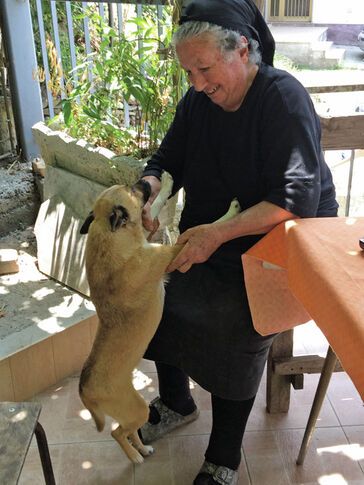
Lily the dog plays with Nonna at their home on the side of a mountain in Calabria last month.
For most of my life, Italy was a paper placemat at an Italian restaurant — the Leaning Tower of Pisa, the Colosseum, a heap of pasta and a boot-shaped land kicking Sicily firmly in the rear.
Not anymore.
Last month, I joined my family on a 15-day journey through Italy. We visited picturesque medieval villages like Orvieto and Assisi, saw priceless works of art in the Big Three of Florence, Rome and Venice, relaxed at the Tyrrhenian retreats of Capri and Positano. The food, the wine, the sights—they were all wonderful.
But when I think about Italy now, I think about a dog with half a nose, three-hour lunches on the side of a mountain and the generosity of people. I think about how a conversation is better appreciated when you find common ground—even if language isn’t one of the things that’s shared. I think about how everything’s just a shade more beautiful on four hours sleep and one cup of espresso.
In short, I think about family.
Italy isn’t at all what you expect—at least what I expected, and I read six books on the place before visiting. It pulls at you from both ends. It’s challenging, head-scratching, chaotic, hot, dusty and—yes—beautiful. Every day, Italy presents you with extremes. It never lets you relax.
In a 11-day loop with my parents, brother, sister and fiancée, we saw the Italy as told by The Placemat. “The Best of Italy,” our tour company called it—Rome, Florence, Pisa, Venice, Pompeii and more. If you ever get the chance, you should go see them. I still can’t believe I’ve seen them, and want to go again, just to be sure.
But, after a week-and-a-half in Italy, I had begun to think the country I expected did not exist. My experience with Italian-Americans has always been one of unconditional, come-as-you-are, you’re-too-skinny-eat-more hospitality. The Italians I encountered in Italy weren’t mean; they just weren’t warm like my friends with Italian heritage. Of course, it may have something to do with the fact that millions of shorts-wearing tourists aren’t invading my friends’ homes every year.
When the tour finished, my family returned home, having sufficiently seen the “Best of Italy.” My fiancée and I continued to Calabria, to visit her grandmother and uncles for four days. “A doctor’s visit,” Nonna called it beforehand, showing that guilt trips are alive and well in the Old Country.
For much of the tour, I had heard Italians describe Calabria in unflattering terms. It was “wild” and “uncivilized.” The people were “capo tosta“—hard-headed, stubborn. That may be true—the stubborn part certainly is. But it wasn’t until I travelled to Calabria that I felt I actually had arrived in Italy.
Nonna lives in a house on the side of a mountain, accessible only by taking a winding, paved road up to a more-winding dirt road. The dirt road is only wide enough for one Italian-sized car—think Fiat—and hugs the cliffside. You’re at least 500 feet off the ground at this point. There are no guardrails.
The dirt road ends at Nonna’s house. When we arrived, Nonna sat on the porch dressed all in black, walking stick in one hand. She smiled and waved.
Nonna lives here with her sons Franco and Mario, three German Shepherds, two pigs, a litter of cats, a half dozen chickens and a mutt with half a nose and a big heart named Lily. (The family found Lily in the trash, and adopted her; they aren’t sure how she lost that chunk of nose.) Things here are much the same as they were 50 years ago, although they do have WiFi in the house.
We spent much of our time with Nonna sitting on the grapevine-shaded porch, eating. Lunch would start around 1 p.m., with fresh bread, capicola and a cured, dry meat called soppressata. When Nonna says she made the capicola you’re eating, it’s with the between-the-lines suggestion that you’re sitting about 200 meters away from next year’s batch. She made it from start to finish.
After the bread and cold cuts, Mario and Franco would bring out a pasta dish. Then a meat dish, with homemade wine. Then cucumber salad. Then a shot of homemade limoncello to help make room for biscotti. Then white figs. Regular figs. Yellow peaches. Oranges.
This is more food than I’d eat in two days, and early in my time there, I made the mistake of telling Nonna I was full about halfway through the Parade of Fruits.
“Sono pieno, Nonna. Troppo cibo.”
She looked at me disapprovingly, and then shoved an orange in my hands.
“Eat the orange,” she said. “It’s Italian. It’s good.”
I ate the orange.
These meals stretched more than my stomach, though. With lunch taking three hours, there was plenty of time for discussion. Throughout the first part of our trip, I had attempted to speak Italian, only to receive a response in English. Here on the mountain, there was no English. Solo Italiano.
Zio Franco has published four books of poetry, logic and philosophy, and he embraced the opportunity to talk to an American newsman about the media, President Obama, foreign policy and more. I’m limited in my Italian to basically three phrases: “I’m full,” “I’m hot,” and “I’m tired,” and I stumbled over words to try to answer his questions. He strained to understand what I was saying. My fiancée often acted as translator.
I thought I fared miserably. It turns out, whenever my fiancée and I would leave to go sightseeing, Nonna would call her children on the phone to brag about Roberto. “He understands everything,” she would say.
I certainly did not understand everything. But I did grow to understand that there are more than just words in a dialogue, that comprehension sometimes means complacency. Not knowing all the words actually made me feel more connected to the conversation. We had to think to communicate, and that effort bred an appreciation between the people involved.
And, really, there was a lot to appreciate. Zio Mario rearranged his work schedule to serve as a tourguide, bringing us to beautiful seaside towns like Tropea and Le Castella. Zio Franco played chess with me, patiently, and shuttled us around the area. Nonna lives on about $5,200 a year, but she insisted on giving my fiancée and I $100 and €20 each. The €20 “to eat here,” and the $100 “to eat at home, in America.”
Of course, we never used the €40 because Mario and Franco refused to let us pay for anything. Between all the meals, the gas used driving us around, the bottles of water when the Calabrian sun started to melt me, I lost count of how much they spent on us. They’d give everything, even if they—by middle-class American standards—had little to give.
I had become family. And, so, when time came to leave, there wasn’t a dry Calabrese—or Calabrese-American—eye in the house. The teary Italian always had been a bit of a joke to me, but I, too, fought back tears when we pulled away from Nonna, standing on the porch, walking stick on one hand, waving her black head scarf with the other.
It seemed impossible when I arrived here a skinny, pale American, but I had finally understood what it means to be Italian. And that’s something I’ll never forget.
,

