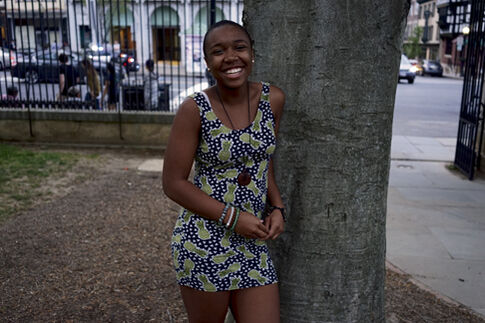
On a Wednesday evening early last month, Jamaica Ponder sat in her parents’ car, typing out the words to an entry for her blog, jamaicaponder.com. In the entry, titled “Drinking Games,” she wrote about how several Princeton High Schoolers had engaged in a ‘Jews vs. Nazis’ drinking game at a party the weekend prior. Included in the entry was a photo of five Princeton High School boys huddled around a pool table with a Star of David and a Swastika made from cups of alcohol.
Ponder, a Princeton High School junior, was not at the party, but took a screenshot of the original photo after one of the game’s participants posted it on Snapchat, a popular social media app.
On her blog, Ponder wrote, “…Perhaps [the game] is a joke. But then I guess the punch line would be: genocide. Pardon me if I don’t find that to be hilarious.”
As is sometimes the case with Internet content, Ponder’s blog post unexpectedly went viral. After being shared by countless Facebook and Twitter users, the story of the Princeton High School Nazi drinking game had attracted the attention of the Washington Post, The New York Times, and even the Times of Israel.
“The next day, [the picture] was everywhere,” Ponder recounted. “Within 48 hours, The New York Times was on my front stoop, and the day after that there were 12 news trucks at my house. By that time it had reached beyond the tri-state area into international news.”
After a month of seemingly nonstop coverage, Ponder, 17, can reflect on the incident and how it has changed her, as well as the Princeton community.
“Am I worried this will trail me? I hope it does!” Ponder said, declaring she has no regrets about her decision to write the blog entry.
While she never anticipated just how much the story would spread, she knew the blog post would be controversial at least, and she struggled initially with the decision to take the incident public. “It was something I really needed to think about, and it took a lot,” she said. “I spoke to a lot of people before I posted it, just considering all the outcomes.”
Ultimately, Ponder decided the drinking game was something she had to speak out about after talking to a close friend. “I spoke to one of my friends who had been at the party,” Ponder said. “She’s Jewish, and she told them to stop. She voiced how uncomfortable she was several times. She asked them to quit it, basically. And they, for lack of a better term, told her to shut up.”
While “Drinking Games” has become her most successful blog post by far, this is not the first time Ponder has addressed controversial topics through the online medium. “I’ve covered things from homophobia, to TSA searches and how ridiculously racist they are, to the socioeconomic divide in Princeton, to the education gap,” Ponder said. “I have a tendency to call people out, I guess.”
Many people across the country praised Ponder’s decision to blog about the drinking game, but she also faced a heavy backlash from several high school peers following the publicity.
“It was so crazy!” Ponder laughed. “It was like I had transitioned from being a person, to being someone who you can talk freely about, freely to.”
One of the many criticisms Ponder received, she said, was that her blog post had negatively affected the whole student body of Princeton High School, not just those who were in the picture.
“Somebody told me that I destroyed the reputation of Princeton High School and because of me they were no longer going to get into college. This is someone who wasn’t even in the picture!” Ponder said.
In addition to the face-to-face opposition received at school, Ponder is also heavily discussed online, through social media venues like Facebook.
“People post and tag me in things, who I don’t even know,” Ponder said. “It’s much more intense on Facebook, because even though it’s not anonymous, you still have a screen to protect you.”
These encounters were particularly difficult for Ponder, who prides herself as being outgoing. “I’ve always felt very confident in being able to walk through the halls and say ‘hi’ to everybody,” she said. “Or being able to go into any situation and feel 100 percent welcomed.” Since the blog entry, however, Ponder says that is no longer the case.
While she speaks openly about the issues that she has faced in light of “Drinking Games,” Ponder stresses that she does not want to be seen as a victim. “I think it’s a learning and a growing process,” she said. “You have to be OK with people disliking you. If you stand by what you did, and believe your actions are right and just, as I believe mine are, then it’s something you’re gonna have to be able to deal with.”
“People are always gonna be critics,” she added.
Despite this attitude, Ponder says she is troubled by certain comments made from the broader Princeton community. Following the blog post, some raised concern for the boys who were in the photo, questioning whether the international attention garnered by their actions was disproportionate to the magnitude of the offense. Others worried that the boys might be blacklisted by colleges because of the incident.
For Ponder, these responses reveal a deeper issue. “People who say this isn’t a big deal, you’re part of the problem,” Ponder said.
Ponder also suspects a racial double standard with such comments. “If there were a bunch of black or Hispanic boys doing the same thing, do you think I’d be getting the same reaction that I’m getting now? Absolutely not,” she said. “It’s because it’s a whole bunch of white boys in a Princeton basement, who think nothing bad will happen to them, that so many people are willing to support them. It’s disgusting.”
On the subject of the boys’ college prospects in light of the blog post, Ponder has little sympathy.
“There’s this convoluted ideology that’s so rampant in my school that you deserve college, that college is a right,” she said. “College isn’t a right. You have to earn that! If you do something bad, and you get caught, and you don’t get into school, it’s because you don’t deserve to get into school.”
Ponder clarifies, however, that little punishment has actually come to the boys in the photo. “Let me make that clear,” she said. “Nothing has happened to them besides their faces being all over the media,” she said. (Though the faces of the boys are visible in the photo, their names have not been released.)
In hindsight, Ponder says she is not surprised by the backlash she has faced. “People don’t like change, and they don’t like being told they’re wrong,” she said. “I guess I’m also not surprised when I get such negative feedback from my peers, just because so many people can see themselves being in that picture, and they think by me calling it out I’m threatening their way of life.”
In terms of the story reaching international audiences, Ponder has a theory for that too. “I think the reason it got so big is because Princeton is seen as this progressive, liberal Mecca,” she said. “We’re a very academic place, we’re supposed to be some of the smartest people in the country, and to see something that looks so ignorant and vile happen in Princeton is something that astounded people.”
Ponder is involved in various clubs and activities at Princeton High School, including Junior Statesmen of America, Feminism Club, Teen Pep, Presidential Youth Council, Just Wing It Improvisational Comedy, Varsity Field Hockey, and Varsity Basketball. Ponder says her aspirations is to have a career in politics, particularly foreign affairs.
“I haven’t decided if I’m going to run for president yet,” she said.
She is currently looking at colleges, including Princeton University. “I’m definitely applying,” she said. When asked if she had reservations of going to college so close to home, Ponder said, “Princeton University and the town of Princeton are two very different entities.”
Ponder’s mother, Michele, currently works at the University in career services, and her father, Rhinold, is a local attorney. Ponder also has one sibling, William, 9, who is in third grade.
Despite everything, Ponder, who has lived in Princeton her whole life, says the incident hasn’t really changed her overall opinion of the town.
“I’ve always loved my town. I still do,” she said. “I don’t know, I think they’ve got to grow, they’ve got to learn.”
,