D&R Greenway Land Trust will host “Poetry of the Senses: Listening, Tasting and Seeing” on Thursday, July 21, at the Johnson Education Center, 1 Preservation Place, Princeton.
Doors will open at 6:30 p.m. to experience the rich imagery of nature in Pablo Neruda’s poetry. Carlo Momo, co-owner, Terra Momo Restaurant Group, and Judith Robinson, actor/director, will present Neruda’s verse in Spanish and English. There will be a tasting of a sweet and a pungent drink.
Pablo Neruda (1904-1973) won the Nobel Prize for literature in 1971. His poetry is considered by many to be the soul of Chile, and he played an important role in his country’s history as a political icon and national hero. He wrote in a variety of styles, including surrealist poems, historical epics, overtly political manifestos, a prose autobiography, and passionate love poems. By examining common, ordinary, everyday things very closely, Neruda’s poems might meditate on a particular plant, a stone, a flower, a bird.
He wrote about the Black-chested Buzzard-Eagle, the Wandering Albatross and Peruvian Pelican, among many other birds, and his ode to a lemon invokes the senses with “lemon flowers/ loosed/ on the moonlight, love’s/ lashed and insatiable/ essences.”
“The earth’s glory was the portal to truth for Neruda, and his nature poems are as ravishing in the splendor of their brilliant metaphors and the eroticism of their luscious detail as his renowned love poems,” wrote Donna Seaman of the American Library Association.
“I have known of Neruda most of my life because my father is from Chile and my uncle, Fernando Gomez, was a friend of Neruda,” says Princeton-based restaurateur Carlo Momo who, with his wife, Leslie Dowling, owns a house next door to one that was once Neruda’s in the coastal town of Isla Negra, Chile, about one hour West of Santiago. “Tio Fernando, as we call him, owns a locally notorious bar called El Condor, where Neruda was a regular. It is located in the small agricultural town of Melipilla, along what was once the only route between Santiago and Neruda’s home, in Isla Negra. Neruda’s poetry gave voice to the most underrepresented and vulnerable people in society, in Chile and far beyond. It also celebrates the simple things we often take for granted, like bread, water or a steaming bowl of fish chowder. Neruda took time to study everything around him and his poetry is a vivid expression of those observations.”
Dowling collaborated with the Terra Momo Restaurant Group to create an homage to Neruda as part of Princeton’s 2004 Writers Block project that occurred during the centennial year and month of Neruda’s birth. Her architectural folly featured some of Neruda’s elemental odes to food and was a representation of Neruda’s “Ode to the Lemon,” featuring 11 other odes to food on the interior walls.
Neruda’s house is now a museum, overflowing with mementos and relics from Neruda’s life. During a trip there in 2008, Momo and Dowling discovered the beach house directly next door was for sale and bought it.
“Neruda had a great appreciation for nature,” continues Momo. “Whether it be the rain-soaked forests where he was born or the wild, unstructured coast where he spent his last days, he had a great love for nature’s creatures and gifts and much of his poetry expresses that love.”
“There is such richness to feed our senses from being in nature—breathing in the dense earthiness of the woods, the soft sun on our skin in an open field, the moist moss under our bare feet, the blueness of the sky that opens our eyes,” says Robinson. “All this refreshes our senses that might otherwise be starved by the technological focus of many of our days.”
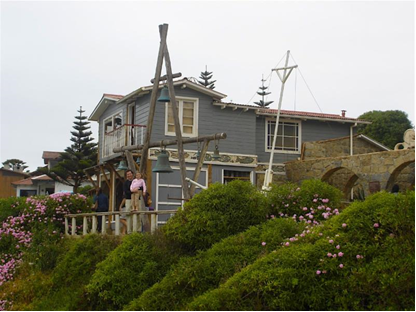
Carlo Momo with daughter, Anna, on porch of Pablo Neruda’s house, provided by Momo family.,

