Ewing Township Mayor Bert Steinmann is backing a plan to remove Trenton Water Works from sole control by the City of Trenton, saying the current structure is unsustainable.
He has agreed with a group of other community leaders that a regional public utility must be established to ensure reliable water service for more than 300,000 residents across five municipalities.
“This has to happen. It’s got to be regionalized,” Steinmann said in a recent interview with *The Observer*. “The city cannot sustain Trenton Water Works the way it is structured today, and for a lot of reasons.”
Steinmann joined the mayors of Trenton, Hamilton, Lawrence, and Hopewell townships in a public statement calling for the creation of an independent water authority.
The mayors’ proposal follows a sharply critical report from the New Jersey Department of Environmental Protection that identified persistent operational failures at Trenton Water Works, which serves all of Trenton and Ewing, and parts of Hamilton, Lawrence, and Hopewell townships.
The state DEP report recommends creating a new, independently governed utility to modernize operations, attract skilled professionals, and shield the system from political interference.
Steinmann said in the interview that Trenton Mayor Reed Gusciora supports the idea, but that Trenton’s city council has hampered past reform efforts.
“There was that period of about three or four years where his council really wasn’t cooperating,” Steinmann said.
He said he has already met with Gusciora and Hamilton Mayor Jeff Martin to begin mapping out a transition toward regional governance.
One key concern, he said, is how to fairly distribute the utility’s future capital improvement costs—estimated at up to $600 million over the next 10 to 15 years—across the participating municipalities.
“That’s the elephant in the room,” he said. “How much are we going to inherit in debt, and how do we accomplish that—spreading it amongst the municipalities moving forward?”
He added that the burden would fall heavily on Ewing and Trenton, the only two municipalities in the group that do not have any alternate water sources.
“Lawrence, Hamilton, and Hopewell—while still relying on TWW—have some alternatives,” Steinmann said. “Not great ones, but at least they have options.”
Despite lingering concerns from residents about water quality, Steinmann defended the safety of the water currently being delivered.
“At the end of the day, it’s drinkable water,” he said. “It’s not killing any plants.”
Under the plan supported by the five mayors, a new public utility would own and operate the system. Each member municipality would be represented on the governing board, with voting power proportional to water usage—a model similar to the Ewing-Lawrence Sewage Authority.
“Hopewell doesn’t have a whole lot of skin in the game,” Steinmann said. “But they’d still have a seat at the table. The larger consumers—Trenton, Ewing, Lawrence—would have more presence. It’s a fair system.”
The mayor said the group plans to reconvene to continue shaping the proposed utility’s structure and governance model. Though the process will require approval from each municipality, Steinmann said he is optimistic that the plan will move forward.
“I’d like to have it done within the next six months to a year,” he said. “I do think it’s going to get accomplished.”
North Olden Avenue water main project underway
Separately, Steinmann confirmed that work is finally underway on the long-delayed water main replacement along North Olden Avenue in Ewing.
The project was approved several years ago but stalled amid internal disagreements within Trenton’s city council.
“That’s how we got put on the back burner, even after money was approved to fix that water main,” he said.
Crews have now begun replacing the aging main, which serves as a critical section of TWW’s distribution system. Although not yet fully completed, Steinmann said the work marks a significant step forward in modernizing the township’s water infrastructure.
“It took far too long to get started, but we’re glad to see progress now,” he said.
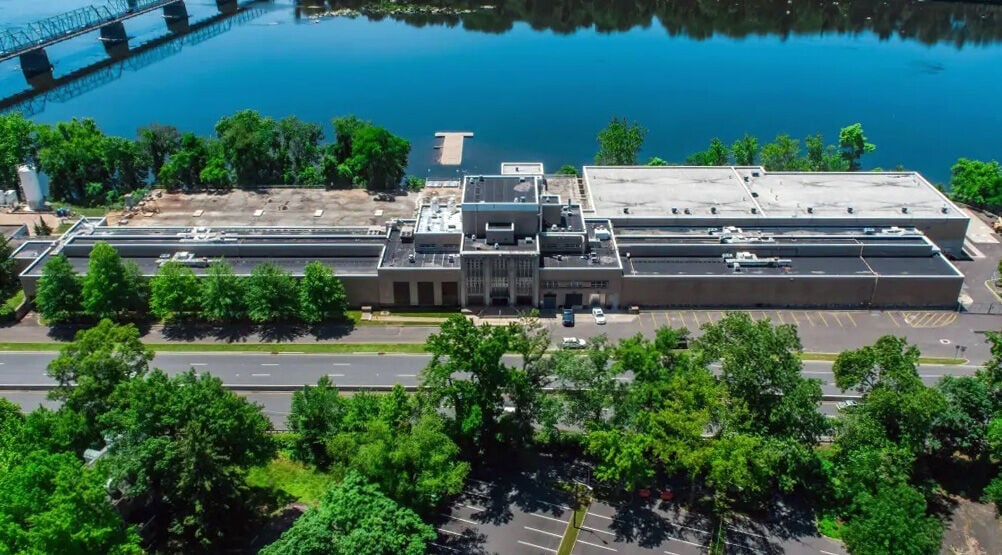
Trenton Water Works water filtration plant on the Delaware River. (Photo by Michael Walker courtesy of TWW.),

