When a very large bear decided to roam through a Hamilton neighborhood this past May, residents—who could easily see the lumbering mammal on their Ring cameras—called the Hamilton Township Police department.
“The bear sighting occurred on May 8th around 9:30 p.m.,” Hamilton Township Police Chief Kenneth DeBoskey said in an interview. “We received calls from several residents regarding the bear wandering around.”
The department had to strike a balance between keeping residents and property safe, while making sure the bear didn’t grow aggressive as it ambled across lawns and driveways. The officers also didn’t want to startle the bear, potentially becoming the object of its scorn.
And, thanks to what is rapidly becoming an important tool for law enforcement agencies and fire departments—a drone—Hamilton police officers were able to safely monitor the bear’s movement through the residential area.
“Officers tracked the bear on foot with the use of the drone,” the chief said, “and the bear eventually made its way south. The drone allowed the responding officers to keep their distance.”
DeBoskey, who stepped into the role of chief on June 1 of this year, credited his predecessor, former Chief James Stevens, with the idea of bringing drones to the force in 2019.
“Chief Stevens did his homework,” DeBoskey said. “And he convinced the administration that drones would be a positive asset for the police department.”
The department’s UAV Unit (UAV stands for Unmanned Aerial Vehicle) has three drones, and six officers licensed to use those drones. But it’s not just the police department that has the potential to put eyes in the sky. The Hamilton Township Fire Department has two drones and two licensed pilots — Hamilton Fire Chief Chris Tozzi being one of those pilots.
Drones have been available for hobbyists since 2010, according to a report from The Brookings Institution in Washington, DC, in 2016, when the Federal Aviation Administration established a drone licensing system, called Part 107, that change allowed people to secure drone pilot licenses in order to use the technology for commercial endeavors.
It was then drones became viable tools to assist police officers and firefighters in their jobs.
By May 31, 2022, the Federal Aviation Administration, the U.S. department which controls the nation’s airspace, issued a report noting that 865,505 drones had been registered in the U.S. Most of those drones, approximately seventy percent, are run and operated by law enforcement departments.
CJ Smith, a category marketing manager for drones with NYC-based Adorama Business Solutions, told a reporter for “Police Chief” magazine: “Drones are revolutionizing search and rescue, disaster response, crime scene mapping and modeling, [and] tactical overwatch.” Smith added, “in many cases, drone operators have found useful ways to increase public safety.”
And increased safety resulting from drone use has also been evident here in Hamilton.
Strict rules apply to the commercial flying of drones. There are altitude limits, usually 400 feet; but those limits can vary depending on location. There are restricted flying areas—for example, air space constraints exist for drone pilots around the Trenton-Robbinsville Airport on Sharon Road.
For safety reasons, the drone operator must always keep the drone within a line of sight. Drone pilots are assisted by apps; which, like flight instruments in a plane or helicopter, provide information about the location of the drone vis-a-vis the flight activity in an area.
Hamilton Police Sgt. Ed Lugo, the Supervisor of the police department’s Tech Services Unit, said the department’s drones played important roles at the scene of the May 18 warehouse fire on Whitehead Road. That fire, as described in a Hamilton Township Fire Department press release, was, “at its peak . . . operating at four alarms with 26 fire fighting units from 14 municipalities on scene.”
Lugo said the warehouse fire was the first time the township police drone unit had worked alongside the township fire department. ”We were out there together,” Lugo said. And his team launched drones to assist firefighters battling the blaze on rooftops.
Fire Chief Tozzi said having drone eyes in the sky was an amazing asset for all the units. One of Tozzi’s major concerns, he said, became the steel water tower on top of the former factory. His colleagues were battling flames under that tower, and Tozzi knew the intense heat from the flames could potentially bring the water tower crashing down. The cameras in the drones–one regular camera, and one which could monitor the heat intensity–were hovering over the roof.
Tozzi said, “once you put the drone up and see the video, it’s a different visual advantage.” And with that advantage, Tozzi said his crews could be directed where they were needed at any given moment. He could also continue to monitor the temperature of the water tower, and thus, keep tabs on its integrity. The drones, he said, enhanced the ability to fight that fire more carefully.
DeBoskey, Tozzi and Lugo agreed that using drones in many situations only enhances timely responses and increases safety measures for personnel.
For example, while drone officers watch unfolding incidents from the ground, the video can be live-streamed back to police department headquarters. According to Lugo, sending pictures back to shift commanders “allows them to make decisions on resource management.” Are there enough people on the scene? Does someone at headquarters see something on a larger monitor, in a well-lit room, that drone operators and colleagues might not see on smaller monitors in the dark?
Using drones, the three leaders indicated, requires good team work.
Sgt. Lugo talked about using drones to locate missing people, including children. He said in those cases, a drone saves valuable time. “If you get the drone operator there first,” Lugo said, “we can lock the [lost person] into a grid.” The drone pilot can then fly the drone back and forth to scan the gridded area where the missing person was last seen. The drone gives a big picture view from above. Putting the drone up instantly also allows other responding officers time to drive safely to a location.
Chief DeBoskey noted: “the drone gives us the same capability as calling in the State Police helicopter. Except, the drones are readily available and can be put up quickly.” He added that flying drones is economical compared to a helicopter; the drones run on rechargeable batteries.
The Hamilton UAV unit has also received mutual aid calls. Recently, Hamilton drone officers were called to assist in finding a missing kayaker. Drones have been used to monitor traffic flow on streets or highways while accidents are being cleared away.
But there are plenty of other uses for drones beyond emergencies. Tozzi said, the fire department, for example, as part of the township’s Emergency Management Team, will use drones to take photos of all the government buildings. This will allow the township to get a look at the condition of roofs, water towers, and other structures; but, the photos will also become a digital archive. Should these structures be damaged during a hurricane, for example, the township would have before photos to compare with after photos. Having that kind of photo evidence could speed up insurance or FEMA reimbursements.
Prior to drone technology, the township would have had to rent planes, or helicopters to accomplish that kind of documentation. Checking roofs has usually been done by people climbing ladders and walking around. Drones have changed that dynamic.
Mayor Jeff Martin fully supports this new technology and the opportunities it offers the township government, while providing increased security for township residents. “I think residents can see the investment the township has made to keep our community safe, thanks to former and current chiefs thinking outside of the box.”
DeBoskey, Tozzi and Lugo seem to know they probably haven’t yet figured out all the possible uses for drones. An online article in the eMagazine “SlateTech” noted: “Increasingly, drones will be able to operate autonomously, executing preplanned flight patterns without the control of operators.” Tozzi thinks it would be amazing to send a drone to the scene of an incident using geographic coordinates, allowing his emergency personnel to monitor and assess a potential fire, or other incident, while driving to get there.
“Drones,” Tozzi mused, “can cover so much area.”
If you want to get in on the drone buzz–and they do buzz–you can see them in action during Hamilton’s National Night Out, scheduled for Tuesday, August 1, 2023 from 5-8PM at Hamilton Township Veterans Park, South Side (2206 Kuser Rd, Hamilton NJ 08690). This event is Rain or Shine.
No bears allowed (Teddies are okay); but if the real ones show up, the drones will be ready.
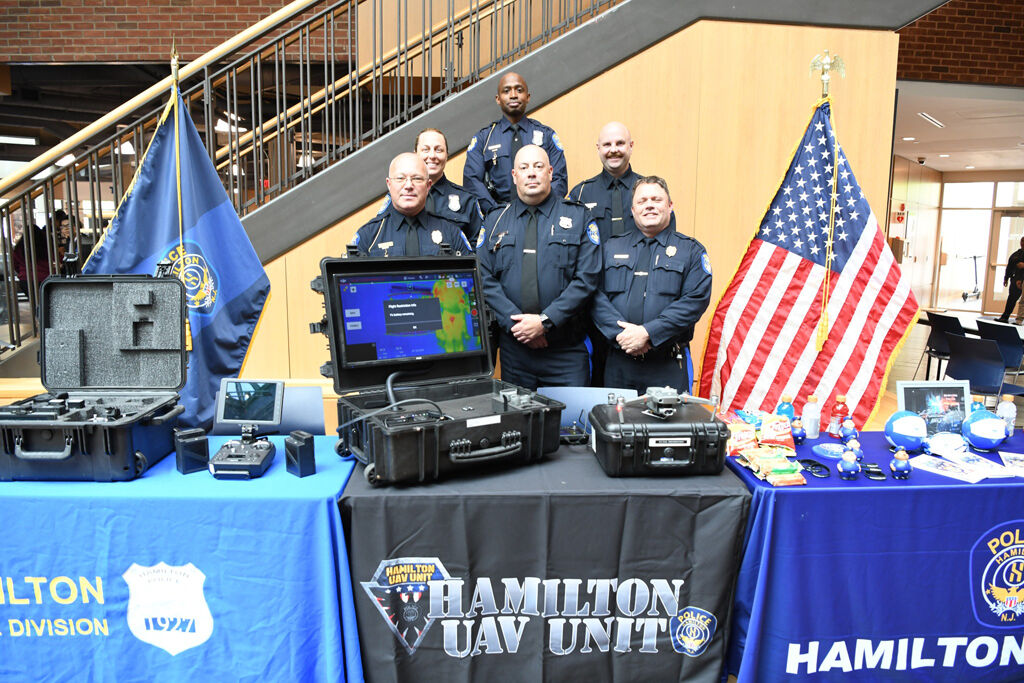
Hamilton Township Police officers at a law enforcement career job fair at The College of New Jersey, April 2023, with a drone. (Facebook photo.),

