This article was originally published in the October 2018 Princeton Echo.
Something new has been added to the Princeton Public Library, or more accurately, someone new has been added. For the first time since it opened its doors in 1909, the library boasts its very own poet-in-residence.
She is Dara-Lyn Shrager: Princeton resident, married, and a mother of two. She holds an MFA in poetry from Bennington College and a BA in English literature from Smith College.
A co-founder and editor of Radar Poetry, a quarterly electronic journal of poetry and artwork, her poems appear in an impressive roster of literary journals, and her articles have appeared in the New York Times, Philadelphia Inquirer, and Philadelphia Magazine, among others. Her chapbook (a paperback booklet) “The Boy From Egypt” (Finishing Line Press) was published in 2009. Her full-length manuscript “Whiskey, X-Ray, Yankee” (Barrow Street Press) was published in 2018.
And to think, it all began when her father submitted one of young Dara-Lyn’s poems to the New Yorker.
“This is an embarrassing story,” she says, chuckling. “I wrote poems when I was in grade school, and my proud father decided to surprise me and submit one to the New Yorker. It was called ‘Alone.’ It was your quintessential pre-teen lonely girl poem, and it was absolutely horrible.
“I was horrified and embarrassed when I was handed a printed rejection from them, because I had been reading the New Yorker ever since I could read. It was sweet that he had submitted a poem of mine, but even at that age I knew that there was no chance that a poem would make it out of the New Yorker slush pile unless you were represented by an agent. I haven’t sent them one since, but I continue to read it and love it.”
Early exposure to the harsh realities of the poetry world were not the only formative childhood experiences for Shrager. She was raised in Plymouth Meeting, Pennsylvania, where her father was an attorney and her mother an English teacher who stopped to raise her family and then became the administrator at her husband’s law firm. “I spent my summers on a sailboat with my family on the Chesapeake Bay,” Shrager says. “We all learned to sail and care for the boat as a family. We’d also go to the British Virgin Islands every year and charter a sailboat.
“So I spent a lot of time working on a boat, waking up on a boat, sleeping under the stars, and all those sensory experiences have become important to me. I started writing in earnest about that time. As an adult — I’m 51 — I haven’t spent a lot of time on the sea with my own family, but it’s starting to happen now.”
The calling to poetry also came later in life. “I started out as a reporter,” she says. “I graduated from Smith College with a degree in English literature and answered a want ad in the Philadelphia Enquirer for the position of editorial assistant at Philadelphia Magazine.”
Shrager was chosen from more than 1,500 applicants. “Over several years I worked as a freelance writer there while I was holding various administrative positions for the magazine,” she said. “I learned a lot about journalism from the business side and the creative side.”
She continued to work for the magazine while her husband — Daniel, a dermatologist with offices in New Hope and Sellersville, Pennsylvania — went to medical school at the University of Pennsylvania. “When he finished medical school we decided to strike out on our own,” she says. “We lived in Chicago and Boston, and I continued to freelance for some city magazines, but I also had two young children, so that fell by the wayside a bit.
“We moved to Princeton 15 years ago. At that time I landed a wonderful opportunity freelancing for the New Jersey section of the New York Times. I had a wonderful editor, complete freedom to choose my assignments, it was heaven.”
Then the regional sections were condensed to a single metropolitan section. “I decided to go to graduate school and get a masters of fine arts in poetry. It had always been an interest of mine, but I didn’t feel I had enough of a formal education in poetry. I went to Bennington College and I did a residency format masters because I had two little kids and a husband.
“I was the oldest person in my class, and I think I got the most out of it, because I was happier to be there than you could imagine. To get there was so hard, I had to craft my family life in such a way that I could leave for these two week periods, and I had to train my family that even when I was home I had to work on my studies.
“I worked with wonderful poets and left there with a chapbook that was accepted by the first publisher I sent it to. I’ve been writing poetry ever since.”
Shrager’s chapbook, “The Boy From Egypt,” is a poetic retelling of her father’s childhood. “My father was born and raised in Egypt,” she says. “His family was Austrian. They were Jews, but they lived in Cairo and Alexandria when he was a child. He came to this country at the age of 13 and had a fascinating story that had never been explored in our family lore. I talked to him a lot about that and tried to reconstruct some of his life in my book.”
Her latest book of poetry, “Whiskey, X-Ray, Yankee,” derives its title from her childhood boat. “The call letters of the boat I grew up on were WXY-9180,” Shrager says. “It was pre-cellphone, and to communicate with the Coast Guard or ship-to-shore or anyone, you had to use your call letters on the marine radio.”
The poems in “Whiskey, X-Ray, Yankee” belies the humor she finds in everyday life. “I’m very funny in real life,” she says, “and people can find the disconnect between their experience of me and their experience of my work jarring, but I find it completely normal that I express the darkness on the page and in life I choose to connect with people through laughter.”
“I’m considered a lyric poet and I think my poems tend to focus on my experience as a woman, as a child of people, and as a mother of people,” she says. “I don’t write about my husband explicitly, but he’s present in my work in the way I talk about myself. I see everything as a continuum where there’s this girl somewhere, these men — I have two sons, my husband is a man, my father — on either side of me and all around me.”
Given this perspective, it’s only fitting that Shrager cites as a favorite perhaps the most famous female poet. “I thought about not telling you this because it’s so trite,” she says, “but I have really always loved Emily Dickinson. If it’s not the oldest book of poetry I own, it’s one of two. I got a complete, annotated edition of Emily Dickinson in softback when I was 10, and I still read from it. I’m still utterly thrown and amazed by her; she’s one of my original loves in terms of poets.”
Dickinson is not alone among the titans of poetry Shrager admires. “I really loved Shakespeare and Chaucer when I studied them in college. I especially loved Chaucer. I must have had great professors, because I thought he was hysterical, and it’s fun to be able to think that I was able to connect with that work. I don’t know whether I would have been able to do that reading on my own.”
But while the old masters provide inspiration, Shrager’s work is steeped in the contemporary poetry scene. She is the founder and co-editor — along with Rachel Marie Patterson of Ewing — of the quarterly electronic poetry and art journal Rader, which publishes its annual awards issue in October. That issue will include the work of the winner of an endowed annual prize for women writing in English as well as the four finalists. A celebrity poet is chosen to judge the contest every year; this year’s judge is Martha Rhodes, author of numerous poetry collections, a member of the faculty at Sarah Lawrence College and the MFA Program for Writers at Warren Wilson College in North Carolina.
“I read a lot of contemporary poetry because we get a full range; established poets, undiscovered poets,” Shrager says. “We’ve had some exciting times when we’ve discovered poets who’ve gone on to do great things. Reading poetry of the here and now is probably the most helpful thing I do for myself as a poet, to continue my quest to be a better writer.”
“I’m currently reading the latest collection of Dorothea Lasky’s poetry, titled Thunderbird. I’ve met her; she’s a dynamic, powerful woman and a wonderful poet,” Shrager says. “I’m also rereading my book of John Clare collected poems. Clare was a poet in the 1800s in the English countryside and one of my absolute favorites.”
Would she care to name a poet that more people should know about? “Oh gosh, yeah,” she says. “I’d say one of my most loved poets is an Israeli poet named Yehuda Amichai. He died a few years ago, and he is such a gorgeous poet. He was published in The New Yorker many times, where I discovered him. I don’t think I’ve ever taken a class where his work was discussed, and I absolutely love his work.”
As for her own process, Shrager says, “It’s about visual cues for me; I’ll see something and literally a cartoon balloon will pop into my head that this will become part of a poem. Then it percolates, boils, simmers. It can take a long time, but usually the image that originally struck me will connect to ideas that live in my head, and then I get to where I’m possessed and I sit down and write.
“Then there’s the editing process, which can be excruciating until I get it right or even near to right. It helps me a lot to be able to talk with other writers, and the more time I spend talking about submissions to Radar with my co-editor, the more it stirs my own creative process.
“Social media allows me to stay in touch with other poets the world over. It also serves as a meeting place where poets and writers in every genre discuss literary topics that are often of interest to me. I think technology links people to ideas quite well. For that reason, the future of poetry is bright.”
Shrager admits to reading, and then mostly ignoring, reviews of her work. “If my son was not a musician and I didn’t have to see him deal with the press — (son Max is a singer with rock band the Shacks who released his first solo EP at age 20 in 2016) — I would feel differently, but I really don’t care. I’ve come to understand that any publicity is good publicity. I honestly am flattered by even a negative review; it helps me sharpen my teeth for next time. I find that so much more helpful than flattery. I’m not saying it doesn’t hurt, but I welcome it. I thirst for it, to be honest.
“I’m a joyful person; I want to connect with people,” Shrager says. “If I can do it through writing, that’s great.” So, when an email arrived asking her to be the library’s first poet-in-residence, she accepted immediately. “I got an email and I answered two seconds later and I said to myself, ‘You know what? That is absolutely perfect, because I wrote my master’s theses in this library, and nobody knew it; I would come and go for months, and to be able to come back here in this form makes so much sense to me.’”
Although Schrager’s one-year tenure officially begins in October, she has been hard at work preparing to hit the ground running. “I was invited in May, and (Public Programming Librarian) Janie Hermann and I have spent the summer meeting and developing events and activities. Janie is a bubbly whirling dervish, full of positivity and creativity. I would come up with ideas, run them by her, and we’d put things together. I’ve taught off and on at the Arts Council and I’ve done workshops in colleges, so I had a pretty good idea of what I wanted to offer.”
Events and activities will include a poetry walk on the D&R Greenway Poetry Trail, a three-part workshop for writers and many others. A complete listing can be found online at www.princetonlibrary.org.
Meanwhile, Shrager has some practical advice and words of encouragement for aspiring poets. “Don’t quit your day job,” she said. “Or marry rich! Take classes and talk to other writers; I stagnate when I spend too many months doing what I do alone. I can literally feel myself being nourished by the time I spend with other poets, other writers or even with people who just like to read.
“Don’t worry about how good you are,” she concluded. “Leave all that home and go out and just listen or participate in discussions about literature. We all have to keep it alive together.”
“The Lost Words” Poetry Walk, D&R Greenway Land Trust, 1 Preservation Place. Program for young audiences looks at the poems and illustrations in “The Lost Words” by Robert MacFarland and Jackie Morris, followed by a walk on the D&R Greenway Poetry Trail to note words and phrases that connect to nature. The collected words will be made into poems and artwork. Thursday, October 4, 4 to 6 p.m.
Poet-Tree, Princeton Public Library, 65 Witherspoon Street. Family-friendly program to learn about poetic forms including the Haiku, the epistle, and the elegy. Participants will write poems that will become leaves on the Poet-Tree. Sunday, October 14, 1 to 3 p.m.
Advanced Poetry Workshop, Princeton Public Library. Three-part workshop for writers. Participants will write and revise a poem. Wednesdays, October 10, 17, and 24, 10:30 a.m. to noon.
Whiskey, X-Ray, Yankee
When the dingy engine failed to start, I tried
A thousand figure eights and my fingers pruned.
The brackish waters were boozy with gasoline.
That night, a plastic moon above the main hatch
and the propane stink of a gimbaled stove, while
the bilge pump choked in the fiberglass hull. Slaps
enough from the green sea. The rest of the family
slept because they could in moldy bunks, black
confetti on white vinyl, the teak weathered gray.
I camped out by the CB calling Whiskey, X-Ray, Yankee,
9-1-8-0. The stars looked dry and too distant
to care. At daybreak I woke on the aft deck
soaked in dew, mildew creeping along the inside
of my back. I have smelled it inside my nose
for years. I have gotten so good at forgiving.
© 2018 by Dara-Lyn Shrager. All rights reserved. Used with permission.
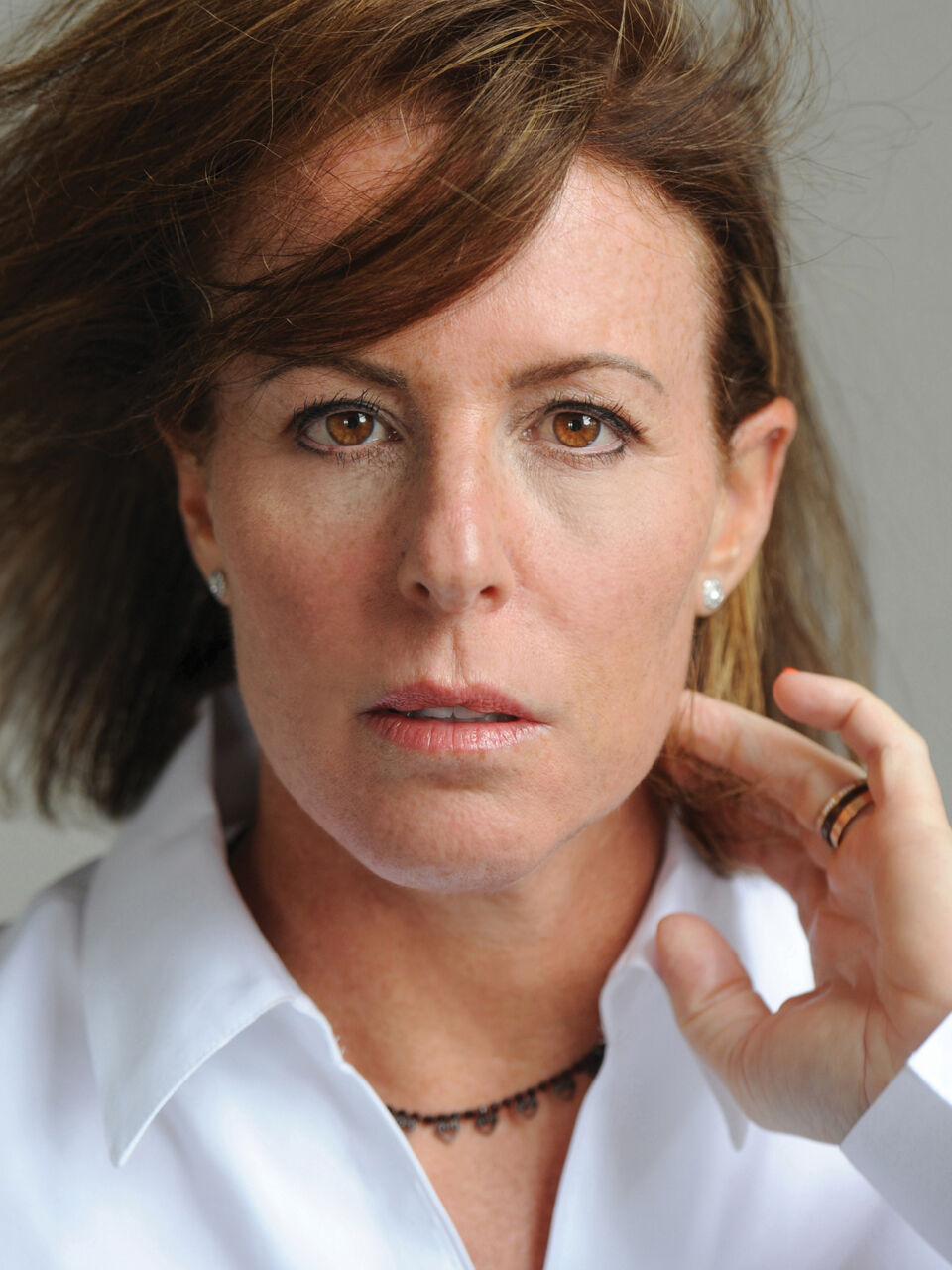
Poet-in-residence Dara-Lyn Shrager brings chapters and verse to the Princeton Public Library. (Photo by Laura Pedrick.),

