By Alina O’Donnell
One-story building, vast parking lot part of town hall plan
After nearly a decade of holding town meetings in the Senior Center and scattered rented spaces, Robbinsville Township government now can say it has a space of its very own.
The township council introduced ordinances last month allowing for the $3-million ($2.85-million in bonds) purchase of property and construction of a new municipal building. Robbinsville has been without a town hall since 2005, when its former building along Route 130 was abandoned and later demolished due to mold and asbestos problems.
Township Director of Community and Economic Development Tim McGough estimates that construction will take nine months to a year to complete. Though the township has not yet hired an architect, he expects to submit a recommendation to council in January.
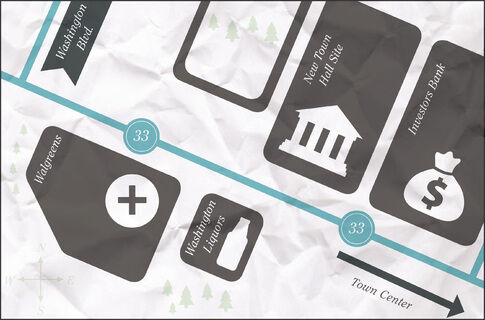
The new town hall will be located on Route 33 in the heart of the Robbinsville Town Center, to the west of the Investors Bank building, the side closer to Foxmoor and the Hamilton border. It is expected to be 15,000 sq. ft., one story and architecturally uniform with the surrounding buildings. It will contain all municipal services, except the police and municipal court, which will remain on the old municipal tract on Route 130.
While the council briefly considered building on the old site, it decided that the property was too small to support the Robbinsville community, which has grown considerably over the past decade.
The council’s action concludes a process that began two years ago, when the former Roma Bank agreed to develop a three-story building that would house municipal offices in conjunction with retail space.
The township would have paid $3-million for the third floor of the building with retail and commercial on the other two floors. That deal died after Roma Bank was acquired by Investors Bank, who did not want to pursue commercial development. Soon after, the project was aborted.
Council president Sheree McGowan said the township looked at many other spaces, but was restricted by its budget.
“We definitely needed one; we needed a place that would be ours,” McGowan said. “It was just a question of where and when. We needed it to be cost-effective,”
After two years of negotiations, Investors Bank agreed to sell the property to the township under the stipulation that the township would not use the property for commercial purposes for the next 20 years. The property had been appraised for $1.8-million and listed for sale at $1.5-million, but Investors offered it to the township for $800,000.
McGough said the property was more valuable because Roma had started construction.
“That’s why it’s really a great deal,” McGough said. “In the ground right now, there is electric, plumbing, drainage, base course of parking lot. We are essentially buying everything you would need to do that’s below ground.”
Despite the deed restriction in place, most township officials expect annual loan payments to be significantly less than what they have been paying to rent office space from Sharbell Development along Washington Boulevard. In 2014 alone, the township’s total rent payments exceeded $165,000. Mayor Dave Fried said the bond payment will be approximately $120,000 annually.
“We will be paying less annually, and once we pay off the rent we’ll own it forever,” Fried said. “It’s a short-term win, and it’s a long-term win. What kind of fiscal leader would I be if I walked away from a something given to us at a million dollars less than market value?”
McGowan anticipates the permanent space will also improve the efficiency of municipal operations, allowing the township to become more productive and host new community gatherings.
“The public doesn’t always know where something is,” she said. “Now, everyone will be in one place, when people come in to do business they won’t go into the basement or third floor. We will have space to work and won’t be on top of each other. Everything will be more connected. Having room for all of our township business, zoning board meetings, council meetings and so on will free up space. Now, the building will be open to other events and community organizations that we had to say no to before.”
However, not all Robbinsville residents agree that this purchase is in the town’s best interest. Councilman Dave Boyne said the plan is a misguided use of viable commercial space.
“It’s highway, it’s commercial,” he said. “It should be an office building or something in that neighborhood rather than something that’s not going to generate tax revenue.”
McGowan countered his argument, noting that the property had been sitting vacant for the past year and a half. She maintained ample development opportunities remain in Town Center.
“It is a viable commercial base, but there’s so much building going on already, and there are a lot of vacant parcels on 33,” McGowan said. “If it was such a viable commercial piece, someone would have snatched it up already.”
Another point of contention is its location. Residents have expressed concern that the building is not centrally stationed. Fried admitted this is true, but said the property is located in the core of Robbinsville’s most populated area.
“Technically speaking, if you stick a pin in the middle of Robbinsville, it’s not central,” he said. “But 75 percent of our population lives within one mile. Clearly it’s the right place to put it.”
McGowan also hopes that its location will help bring business to the area.
“Being that it’s right next to Town Center, it’s an area that’s convenient to the town,” she said. “When residents have things to do at the municipal building, other businesses in the area may see increase in traffic.”
Fried expects that the location will help to alleviate the problem of parking in the Town Center. The building will only occupy one third of the property, freeing up the remaining space for a sprawling parking lot, which will be accessible to anyone.
“One of the biggest problems I hear is that there is not enough parking,” he said. “Putting a 30,000 sq. ft. building in the town’s center, when there is already a parking problem, will only hurt businesses. It creates a better situation for our residents, for everyone. It will be more attractive, less crowded.”
,

