Here’s a fact that sounds incredibly obvious until you look under the blankets: Composers are still writing great music.
Of course, you say! There’s a new song out there every day. But we’re not talking about music you hear while you wait in line for your too-expensive coffee. We’re actually talking about music you’ve almost certainly never heard, but absolutely should.
We’re talking about new music — not recently released, music, but as a genre all its own. One so alive, its skin quivers to the hum of strings and voices, yet one so in-the-shadows that the very groups looking to find the sunlight go by names that include the words “under the radar” and “undercurrent.”
What makes this all the more ironic is that Princeton is part of a hub for new music. Between here and New York City, young voices sing challenging pieces by young composers pushing new boundaries. And so few people know about it that the majority of the audiences turning out to see local performances are musicians who already know what they’d be missing if they weren’t already in the loop.
Enter the Contemporary Undercurrent in Song Project, or CUSP, and its founder, Alexandra Porter. At its heart, CUSP strives to elevate modern art song composition and to bring unheard composers and performers to the world at large.
“It’s important to recognize that people are still composing and singing and coming up with new instrumental compositions,” Porter says. “People do have the potential to hear great composers.”
To wit, people will have the potential to hear great composers and performers when CUSP puts on its second-ever program on Sunday, Dec. 5 in Princeton. The program, “Princeton Connection: The Music of Local Composers,” will feature the music of Benjamin Boyle, Paul Moravec, Sebastian Currier, Andrew Lovett, and Jon Magnussen. A pre-show pot luck dinner will begin at 7 p.m., and the show at 8.
The concert will be held at a private residence, so the address is not being announced, except to ticket buyers. Porter says the venue has been used for other musical gatherings and seats as many as 40 people. After the program, guests, performers, and composers can mingle and talk. Tickets for the show will be $10, $5 for students, and you can get them by emailing alexandra@princetonopera.org or visiting contemporaryundercurrent.com.
A big question, of course, is: What is new music? Well, that’s not so easy to answer. “‘New music’ can have a lot of definitions,” Porter says. “It could be music written this year. It could be music written in the past 50 years. I tend to think of new music as being from the 21st century.”
One of those 21st century pieces is by composer Andrew Davis, who wrote a piece based on the poem “Bamboo Grove” by Michael Vickman for Porter to sing at CUSP’s inaugural performance in September. Porter had met Davis at a summer music program and stayed in touch. When she was looking for something to sing for CUSP, he asked her to offer him ideas for “something you really want to work on,” she says.
She sent him recordings of her singing so he’d know what he was working with. “He wanted to write something that could show all the things my voice could do,” she says.
The result was a composition in the classical style that pushed Porter’s vocal range, coupling lush piano with soft vocals that eventually grow to the loudest voice she could sing.
“It’s a lot of responsibility to be given this piece no one’s ever done,” Porter says.
Exactly how does one manage that responsibility? The same way you get to Carnegie Hall: practice, practice, practice.
“I worked on that piece a lot,” Porter says. “It was a seven-minute piece and I put about 50 hours of work into it.”
One of the challenges to doing music no one’s heard before, by the way, is the fact that the performers haven’t heard them either. If you were going to sing an aria from Rigoletto, for example, you could listen to countless recordings of it to get a feel for what to do. But a piece that’s never been played for anyone but you, so that you have to come up with the best interpretation? Quite another story, Porter says.
The roots of CUSP go back to Porter’s college days. The Pittsburgh native grew up singing in choirs and playing violin, not getting the singing lessons she wanted because her aunt, a singer and voice teacher, discouraged voice lessons until that pesky adolescent voice-change thing happened.
“She was the musician in the family,” Porter says. “Whenever my mom had questions about music, she’d ask her.” Though her aunt lived far away, Porter has done some recitals with her. In fact, in August, the two sang French-inspired pieces at a summer music camp in Alaska.
But after high school the aspiring soprano studied voice performance at Penn State. She graduated with her bachelor’s in 2008 and came to Princeton to attend Westminster Choir College for her master’s in voice performance. While there, Porter did some administrative work for Opera MODO, which “brings opera to the people through intriguing and modern productions of classical to contemporary operas.”
While working for the organization, porter met fellow Westminster student and singer Rachel Barker, who would go on to found the Princeton Opera Alliance after Opera MODO and its founder, Danielle Wright, moved from Princeton to Detroit.
After graduating from Westminster in 2011, Porter figured she’d go the traditional route of auditions for shows between Philadelphia and New York, singing traditional pieces. That turned out to be a less-than-fruitful path. But one of the other people she’d met while at Westminster, pianist J.J. Penna, who also works on the faculty at Westminster and Juilliard, gave her a solid piece of advice to start performing new music.
Penna had seen countless students graduate hopefully and then become frustrated with the harsh realities of trying to make a living in the arts. “He told me, ‘The only way to continue your musical life is to be in charge of it,’” she says.
The advice wasn’t all he gave her, by the way. Porter and Penna are now husband and wife.
She took his advice and ran with it. She operates a private studio from her Princeton home, where she mostly teaches high school students, but she also does some work at Princeton Day School. She sings at Trinity Church, she is the social media manager for Cortona Sessions for New Music, she volunteers as artistic administrator for the Resonant Bodies Festival in New York every September, and teaches a musical theater class at the Rutgers High School Musical Theater Academy.
Still, she wanted to create her own new music project, so with the encouragement of her husband and the germ of the new music idea sprouting in her head, she developed the Contemporary Undercurrent in Song Project.
The very name belies the state of new music. Similar to an organization in Omaha, Nebraska, called Under the Radar, the “undercurrent” speaks to the fact that there is a deep sea of contemporary, challenging, innovative music that pulls from what barker calls “a whole pallet of songs” over the past 500 years. A reservoir of music that, like operas and classic theatrical productions when they were new, are inspired by current events and trends and celebrities. There are operas out there right now based on Stephen King novels and the life of Anna Nicole Smith, for example.
Most new music is not that big-budget, of course, but it does underline the idea that people are indeed writing new things. And performers like Porter want people to stop thinking of music the way high school English teachers think about literature — rather than keep offering the same pieces written in the 19th century, acknowledge that there are new pieces worth experiencing.
With the CUSP idea in hand, Porter figured she’d ask her friend, Rachel Barker, for some advice on how to start a music project organization along the lines of the Princeton Opera Alliance, or POA.
“Allie approached me searching for a way to do something with contemporary music,” Barker says. As it turned out, “her vision fit in with our vision.”
Vision or not, Porter quickly learned that there’s a big difference between being a performer and taking charge of her music career. CUSP became part of POA’s umbrella, as POA already had done the groundwork of attaining 501c3 status, and because the styles and visions of the two entities, both of which want to educate the community about great music, complemented each other so well, the partnership became a natural fit.
Porter then set out to do all the things one must do to run a business these days â social media presence, website building, finding people to help design graphics—and those things needed to put together a program of music no one knows about, but should hear. There was the music, yes, but there were also posters and invitations and tickets to make up, word to get out, schedules to coordinate, and, of course, finding a way to get people to care.
“It’s very challenging,” Porter says. A lot of people have preconceived notions about new music — not the genre, just music they haven’t heard before — and think “I won’t like that,” she says. “I think there’s a tendency to only attend concerts when you already know the names. But it’s great to discover new composers and have a new experience.”
She admits she’s “a little worried that most of my audience is musicians,” she says. “There are lots of people who are interested, and that’s great, but I do hope that more people will attend and that [new music] will develop a following.”
On the slate for Dec. 5 will be four pieces by composer Benjamin Boyle that Porter will sing. Boyle, inspired by French composition, will perform pieces that porter says “you’d almost think you should recognize, even though you haven’t heard it.” The pieces will tell the story of Shakespeare’s Ophelia, through her own words and through the prism of poet Elizabeth Wharton
Barker, who worked the door—one of the many tiny details of event planning that Porter says she didn’t think about until close to showtime—at CUSP’s September 19 concert be on stage with CUSP on Dec. 5 too. She will sing four pieces by composer Paul Moravec, whom she met while singing some Mozart pieces earlier this year. As for what Moravek’s pieces will be, well, that’s going to have to be a surprise.
Also on the ticket will be singers Heather Jones, Will Vestal, and Randal Scarlata. J.J. Penna, Eric Petterson, and James Sparks will provide the piano accompaniment.
Porter is looking forward to it with a combinations of nerves and vision.
It’s very scary, but very rewarding,” she says. “Will this work? Will people be interested, will people like it? What will I do next? It’s scary but it’s exciting.”
One thing she might do next is an opera—new music of course—with POA. But that’s still being nailed down. For now, Porter is concentrating on the next CUSP show. And firmly hoping people come to help get new music from undercurrent to light of day.
Scott Morgan is a multi-award-winning reporter and writer covering the Princeton area since 2001.
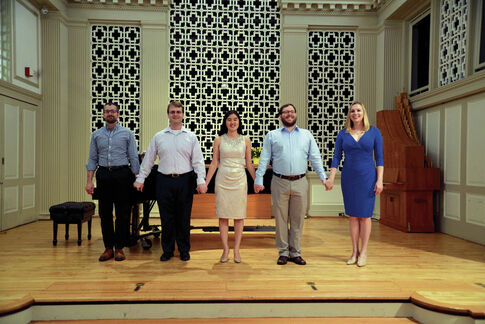
Performers J. J. Penna, Scott Purcell, Meagan Lee Hodson, Christopher Hodson and Alexandra Porter at the first Contemporary Undercurrent in Song Project concert, “Renascence,” Sept. 19, 2015 at All Saints’ Episcopal Church in Princeton.,

