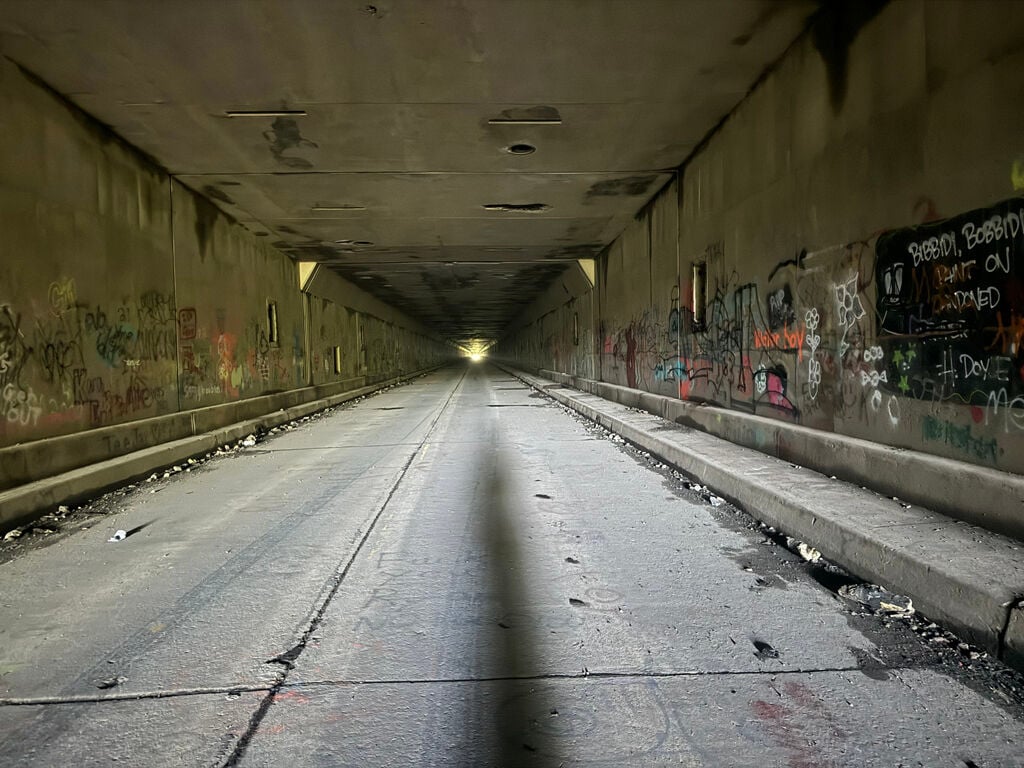
The Talking Heads had a big hit with the song “Road to Nowhere” back in 1985, and now in 2024, I finally got to see a real one.
This particular road to nowhere is a 13-mile stretch of the Pennsylvania Turnpike that was abandoned in 1968, when the highway was rerouted to alleviate backups caused by two-lane traffic passing into one-lane tunnels. In its current incarnation, most of the road (about 8.5 miles from one end to the other), is a popular hiking and biking spot, with tunnels and abandoned buildings waiting to be explored.
A recent bike excursion in New Jersey’s D&R Canal State Park had me riding on a flat tire for the last 2 miles of the 8.9 mile Bull’s Head-to-Frenchtown stretch; luckily, a bike shop in Frenchtown was able to repair the tire while we ate lunch. From what I’d read, the Abandoned PA Turnpike was a much rougher surface to ride than the canal towpath: once paved roadway, it was now crumbling, much of it overtaken by nature.
Most concerning, warnings about broken glass on the route were common. I had no desire to repeat my flat tire experience in a more remote area without the ready aid of civilization and commerce. I bought a bike repair kit, packed some WD-40, and tried to prepare for any potential mishap, but a giant leap of faith, along with a three-hour drive, would be required to satisfy my curiosity.
My daughter and I arrived at the Breezewood parking area on a pretty perfect Labor Day, sun shining, not too hot. We unpacked our bikes and started our ride on the grass-invaded roadway, which was marked by colorful graffiti, some encouraging (“ONLY 1 MILE TO THE TUNNEL”), some not so much (“TURN BACK NOW”).
The first tunnel didn’t seem too intimidating, a bit less than three quarters of a mile long from the accounts I’d read, with a bit of daylight visible at the far end of it. My daughter turned on the LED light we’d attached to her handlebars, and in we went. I followed behind her, and by drifting farther back at times, just out of range of the light’s illumination, I got a sense of how difficult it would be to ride through in the dark.
It was cold in the tunnel. Pieces of the roof hung down from the ceiling, and in some places we had to swerve to avoid rubble on the ground. It was like a real-life, imagination-aided video game—stay away from the far edges of the roadway, where broken glass seemed most likely to accumulate, but also avoid other debris, which could be anywhere.
Graffiti decorated nearly every inch of wall in the tunnels, some of it crude and unimpressive, some of it clever and showing real artistic skill; all of it added to the post-apocalyptic atmosphere.
After about another 4 miles, we came to the second tunnel; this one was twice as long as the first, and because of a slight arc in its run, we couldn’t see the opening on the other side. A sign warned that the Sideling Hill Tunnel was unlit and “may contain dangers including, but not limited to: Spalling Concrete • Falling Debris • Wild Animals • Shattered Glass.”
I had to look up the word “spalling” (fragments breaking off from a larger body), but of more interest was the vague, all-encompassing legal disclaimer “not limited to,” which distanced the Commonwealth of Pennsylvania from liability while, strictly speaking, allowing for the presence of robbers, psychos, zombies and anything else.
Scenes from the 2009 film The Road were shot here, but as we entered, I recalled not just that movie, but every post-apocalyptic tunnel scene I’d ever seen or read in any movie, book, or TV show. Maze Runner, The Stand, The Walking Dead… whether live bodies, dead bodies, or animated dead bodies, I mentally prepared myself.
Naturally, I eyed with suspicion the groups of flashlight-toting families and friends hiking through the tunnels. Occasionally, there’d be a lone hiker, shuffling along, footsteps echoing through the cavernous space. We kept our distance—to keep from slamming into them, but also to stay more than arm’s reach away, just in case there were some undead brain-cravers among them.
Upon emerging from the tunnel, we again noted the stark contrasts in tone of the scrawled messages that greeted us. We read them upside-down on the ground, since they were intended for people arriving from the opposite terminus of the Abandoned Turnpike. One advised “ENTER IF YOU DARE,” while another, showing more sensitivity than the average graffito, read, “YOU ARE ENOUGH.”
We took a break, leaving the road and our bikes to explore an abandoned ventilation room on top of the tunnel. This is the sort of decision that leaves horror-movie audiences flabbergasted, and it did feel risky to ignore my New York City-imparted sense of vigilance and leave our bikes unattended.
But this was Pennsylvania, and even teenagers in search of a hangout, or homeless people seeking shelter might hesitate before making the trek to the tunnel. Certainly, all but the most dedicated and physically fit miscreants would avoid such an undertaking just to steal a bike.
After a few minutes navigating creepy stairways and deteriorating floors, we returned to find our bikes exactly as we left them, and resumed our journey.
The roadway went on for another mile or so, then came to an abrupt end. We turned and headed back, my daughter and I now switching bikes regularly. I don’t remember how many years ago we bought her bike, but it turns out, it isn’t ideal for her current height. Unable to fully extend her legs, uphills posed a much harder obstacle on her bike than on mine, so we switched often, me taking her bike for the steeper inclines and wondering how the heck she’d gotten this far.
It felt like we were earning that return trip, pedaling through the tunnels and open air with more urgency and effort than ever. The adrenaline boost fueled more Hollywood-inspired thoughts of escaping cave-ins and fighting off bandits. All of the people we talked to along the ride seemed very nice, actually. But was it just a façade, setting us up as an easy mark for later?
We passed a solo shuffler again, who, from behind, now looked even more like a foot-dragging zombie. He might have simply been tired, but he also might have recently risen from the grave, seeking sustenance from the craniums of unwary travelers. I figure it was a coin flip, 50/50.
We finally arrived at our car, exhausted but alive, satisfied that the shuffler and any brain-eating buddies of his were left safely behind. As paranoia faded, we looked at pictures we’d taken during the trip, and, scrolling from one to the next, watched an alarming transformation take place. We’d started as cheerful, vigorous, healthy-looking adventurers, but by the end we’d become something… less than human.
We were disheveled and haggard, muscles stiff and strained. I realized that instead of picking my feet up high as I walked, I’d begun to shuffle a bit. We were both hungry, and would have eaten just about anything—maybe even a brain. We looked at each other, and in a cinematic twist worthy of any horror movie, I realized that—(dramatic pause and music)—WE had become the zombies.
Nonetheless, I craved some decidedly pre-apocalyptic victuals, so instead of human brains, I decided to indulge in two McDonald’s McDoubles and two McChicken sandwiches before the ride home. Some might question how much of an upgrade that actually is, but it seemed like a better choice at the time. For me, an occasional fast food meal is an enjoyable experience that outweighs a few concerns—real or imagined— about personal health and longevity.
Which, come to think of it, pretty well describes our trip on the creepy-cool Road to Nowhere.