When I was a kid in New York, TV was simple. CBS was channel 2, NBC was channel 4, ABC was channel 7. WWOR was channel 9 and carried Mets games, while WPIX, channel 11, had the Yankees. Channel 5 showed reruns of M*A*S*H, and for a taste of the brainy or exotic, you ventured way up to channel 13 and PBS. One dial took you everywhere you wanted to go.
A second dial took you where most people didn’t care to go. There existed, in the upper reaches of the airwaves, ultra-high frequency, or UHF channels—31, 40, and 48 were a few. Even now, those numbers seem less suited to TV channels than to a 7th grade math problem (“Which one is a prime number?”).
These channels used a different dial on the TV set, below the main one, and the UHF knob made a distinct zipper-like sound when you moved it quickly. The “reception” consisted of ghostly black and white images, mixed with plenty of static. Images fell off the screen (sometimes rapidly, sometimes slowly) and reappeared at the top, usually in a consistent pattern, so a viewer with good eyes and a keen sense of anticipation could just about make out what was going on—if the weather was good, and if you were willing to wiggle the “rabbit ears” antenna as needed, or fine-tune the reception by carefully spinning the outer ring that surrounded the dial itself. You had to work pretty hard to get at those Lone Ranger reruns.
This marked the limit of television capabilities for a long time.
Then came cable, and digital TV, and streaming. All improvements, unless you factor in the increased human tendency toward couch potatoing. Then came smart TVs—devices that let you watch TV in high definition and also manage a variety of modern video entertainment options. Sounds great, right?
Except that my smart TV is dumb. Actually, “slow” is a better description—and that’s not just a polite euphemism. It can do all sorts of amazing things, like handle external USBs, and browse the internet, and serve as the central hub for streaming services, but often there’s a lag that makes me think the TV might be too smart for its own good—not quite plotting a revolution, but maybe just a bit resentful at wasting all that computing power just to keep us carbon-based life forms entertained. To get it to fulfill some of these higher capabilities often requires scrolling through a maze of options while being blasted by full-volume advertisements and previews. It’s like being attacked by entertainment.
Other times my smart TV seems downright dysfunctional; as proof, I point to the existence of an abundance of YouTube tutorials for turning on smart TVs without remotes. Operating a television shouldn’t require research.
Still, smart TV designers and engineers aren’t to blame for all my frustrations; much of the problem is just the state of the television industry in 2024. There are network channels, and there are cable channels. There are on-demand offerings, and there are streaming networks. So. Many. Streaming. Networks.
In a succession of increasingly irritating events, I recently tried to watch three movies.
First, I wanted to check out a documentary I’d heard about, called BLAM! Roy Lichtenstein and the Art of Appropriation, which interviews original comic book artists who drew panels that Roy Lichtenstein “re-interpreted” for his own art. I had to consult the internet on how to watch it—annoying, but not much worse than checking a TV Guide or newspaper listing years ago. It was on a channel called Tubi, which I’d never heard of. Tubi is free to viewers, funded by 90 seconds of commercials every fifteen minutes. (Not to discount the accomplishments of modern marketing executives, but that business model seems strangely familiar, does it not?) I found Tubi, subscribed to it, found the film, and watched it. The movie was fascinating, infuriating, and solidified my skepticism of Lichtenstein’s “talent.”
I’ve been on a Beatles kick lately, and the next movie I wanted to see was a documentary from 1982 called The Compleat Beatles. Checking online showed it was available through Roku. I thought this meant the Roku Channel, another free service available on my smart TV, but further investigation showed it was actually available on Freevee. No problem, I could access that too. But when I searched those services, I found a dozen other Beatles-themed documentaries and no Compleat Beatles. Confused, I went to the Roku website and found an agent to chat with. She explained that the viewing options for Freevee are different if you’re watching through a Fire TV than if you’re watching through a Roku device. I checked on my son’s TV, which uses the Roku device I’d thought was unnecessary with a smart TV, but couldn’t find it there, either.
The smart TV allowed the option of tuning to YouTube and watching the documentary there—surely it had to be available, given the popularity of the Beatles? But all I found were postings that seemed to be skirting some real or perceived copyright law; I could watch parts 1 and 2 through one user, and parts 4, 7, and 10 through another, but couldn’t find anyone with part 5. Even if the complete film were available, switching around after every 8-minute section would be a pretty annoying way to watch a movie.
In the end, I found and watched it on my smart TV through a website called The Internet Archive. The Compleat Beatles holds up as a concise video history of The Beatles, and a perfect introduction to the band—as opposed to Peter Jackson’s eight-hour documentary The Beatles: Get Back, which might test the endurance of all but diehard fans.
The third movie I tried to watch was a return to the art world, a profile of an comic book and fantasy artist whose work I recently rediscovered. Better Things: The Life and Choices of Jeffrey Catherine Jones is a 2012 documentary, one I looked forward to watching for a detailed discussion of the artist and his work, and also to find out how and why he decided to go from “Jeffrey” to “Catherine” at a time (1998) when gender transitions were far less common than today.
Consulting the internet again, I saw that the film was available through another free streaming service, called Kanopy. I’d never heard of Kanopy, but its website revealed that the service operates through library subscriptions. Viewing is free to end users, but expensive for libraries to offer. Hamilton’s library doesn’t have an agreement with Kanopy, so I was out of luck. I couldn’t even find a DVD on eBay or Amazon, so don’t ask me if the movie’s any good, because I still haven’t seen it.
It’s somewhat satisfying to exercise my “old man” privileges by nostalgizing about ancient televisions and ranting about the failures of modern technology—but it would be more satisfying to have a simple way to watch movies at home, even obscure documentaries. By now, every movie ever made should be accessible in one form or another, but I guess I can lump that with the flying cars and other visions of the future that never came to fruition.
Another future fantasy is that at some point, TV executives will have a eureka moment, and the same way they’ve rediscovered commercial-based television, they’ll see the appeal of merging multiple channels and streaming services into one monthly package, for a set price. But right now, it’s separate portals—and fees—for Netflix, Prime Video, Max, Hulu, Disney+, Paramount+, and Apple TV.
Maybe this chaos resembles what it was like in those first years of cable TV, when HBO and Showtime made their debuts (1972 and 1976, respectively). I’m not old enough to know. But I do remember the excitement—and comparative ease—of channel-surfing cable television circa 1984, the days of “I want my MTV.”
Maybe the problem is as simple as “smart TV, dumb owner,” but I maintain my desperate cry for a return to simplicity: I want my dumb TV.
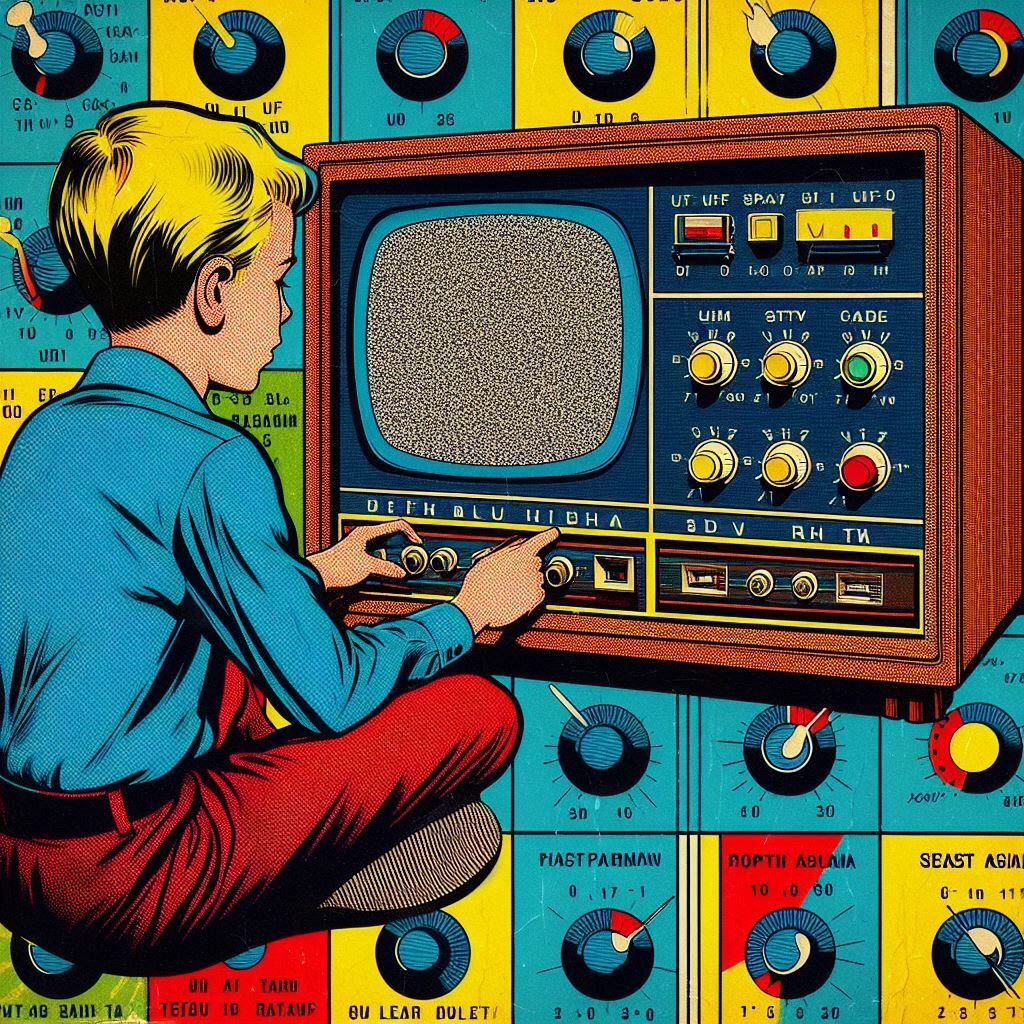
Image created with AI.,

