In the digital age books are often seen as the ultimate portable resource — something that can be accessed whenever, wherever, regardless of Internet connectivity or battery charge. But there is one slim volume, now on sale at Labyrinth on Nassau Street, Jane on Spring Street, Lisa Jones at 16 Witherspoon Street, and the Princeton Public Library, that is totally portable but, ironically, designed for reading no more than a few hundred yards from Nassau Street.
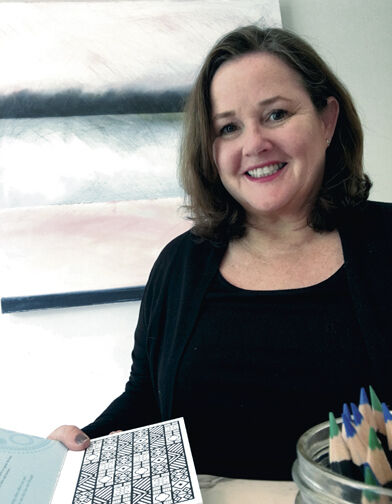
The book, “Visual Patterns/Princeton,” features 10 detachable postcards that feature graphic designs inspired by architectural detail from the Princeton University campus and Nassau Street. The reader can use the book as a starting point for a campus tour, seeing the exact location that inspired the graphic, and also as a canvas for some personal illustrations, coloring in the images and then mailing or e-mailing the images to the book’s publisher.
This interactive work, priced at $14.95, is the brainchild of Sarah Lewis Smith, whose graphic designs are already visible all over town. Parents scrutinizing report cards have no doubt seen the Princeton Public Schools logo, the work of Smith + Manning Design, a partnership formed by Smith with Princeton resident Cameron Manning. Smith + Manning has also created designs for Jane consignment shop and Brick Farm Market in Hopewell, among others.
For 30 years Smith has aimed to create memorable “visual identities” when branding for clients, visuals that resonate with observers.
“It’s a shame to come to Princeton and not see the beautiful things that are available. Visitors can not just look for the tigers at Nassau Hall, but learn the history of the ivy,” says Smith, referring to the building’s ivy that inspired one pattern.
All of the patterns’ real-life inspirations can be found within a 10-minute walk. Nine of the patterns are located on campus, where Smith walks her dog and regularly encounters people asking for directions. Smith created an enticing guide map for the booklet that shows where each pattern can be found.
The guide’s orientation is unlike other Princeton maps. It is designed to make campus navigation easier: the main stretch of Nassau Street divides the map into two sections, with the campus on the top half and the downtown area below. During her campus dog walks, she also photographed prominent university buildings, a catalog that helped her draw the buildings on the map.
The visual patterns may have discoveries in store for longtime Princeton residents too. One of the patterns mimics the ribbed Collegiate Gothic design underneath the vaulted ceiling of Blair Arch. Smith extracted the original design, etched in old stonework, and transposed it onto paper in clean lines. She leaves the coloring and exploration to others.
“Understanding a pattern’s elements may not be obvious, but when you go to the environment and observe, you can make the connections,” Smith said. “There’s seeing something you see every day and maybe understanding it in a new way.”
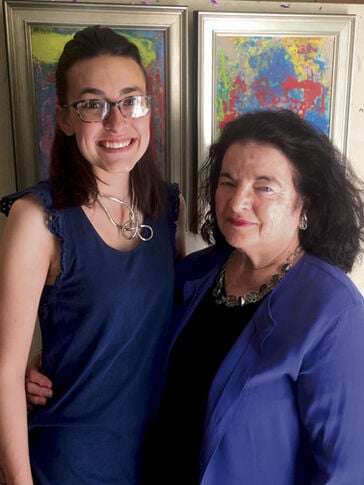
Smith was born in London and grew up in Princeton. Her father, Arthur Lewis, was an organic chemist and her mother, Rosemary Walmsley, is a retired grade school teacher who also lives in Princeton. She studied at the Rhode Island School of Design after Princeton High School. Upon graduation, she worked as a graphic designer for design consultancies based in New York, London, and then East Asia.
A long-ago college course at RISD gave Smith the idea of learning about a place through researching a specific visual. “The first day of class, the professor handed each student a Polaroid of an object within a two-mile radius,” Smith says. “We were told to go find it and I thought that was such a great way to learn about the place.”
Her object? A manhole cover two miles away.
She returned to Princeton to raise her two children in 2002. Her son Bertrand is a rising junior and daughter Camilla enters Princeton High next year. Visual Patterns / Princeton was a weekend endeavor, though with college tours on the horizon Smith is thinking about creating booklets for other campuses.
“The ideas are endless but time is not,” Smith said.
Visual Patterns / Princeton is a different focus than Smith’s day job as the creative director of her design firm, Smith + Manning. Smith started the firm a few years after returning to Princeton, and she met her managing partner at their children’s pre-school.
For Visual Patterns / Princeton, Smith has set up a website, www.signedby.us, where people can upload and share their colored patterns.
Smith too has caught the coloring bug. “Coloring something is quite relaxing. It’s fun. Once you start, you want to finish,” Smith says. “I’ve asked people why they like to color. They say they prefer coloring over drawing because it’s easy, we’ve all done it since we’re small. It’s fun. I recently hosted a coloring party, they stayed from 7 to 11, a little longer than they otherwise would have.”
Smith has also embarked on a small experiment to find the best colored pencil brands. Certain brands have better colors for some hues but not others, and a lot depends on personal coloring comfort. Smith likes Prismacolor and Derwent brand colored pencils, and she also enjoys Faber-Castel colored markers.
Hands On: Sara Lewis Smith will discuss the patterns and inspiration behind her project at a coloring session at the Princeton Public Library on Thursday, July 7, at 3 p.m.
Rabon Replaces Newton
After more than two decades as vice president of Palmer Square Management, the company that manages the mixed-use retail, office, and condominium space in the heart of downtown, David Newton has turned over the reins to Lori Rabon, who will also continue in her role as manager of the Nassau Inn.
In an interview with U.S. 1 Newton said he had worked to turn the square, which opened in 1939, into a shopping center focused on “affordable luxury” that could compete with the larger suburban malls nearby.
There are currently seven vacancies. “Palmer Square always tells a very good story,” Newton said. “We got sideswiped a little bit this Christmas when we got four immediate vacancies, one on top of the other.”
According to Newton, filling those vacancies would actually be easy if the square lifted its self-imposed restrictions on the number of food sellers. Instead, he has tried to maintain a good mix of different kinds of stores. “If the square becomes one great big food court, it may be a short-term fix, but in the long term it’s not a good thing at all.”
Pop-Up Galleries
In downtown Princeton even an officially vacant property can provide some retail life. In the last month two “pop-up” galleries have emerged in spaces where landlords are still hunting for permanent tenants.
Artist Priscilla Algava has taken over the vacant space at the site of the old Army-Navy store at 14 1/2 Witherspoon Street and created an art gallery called Wondrous on Witherspoon, or WOW. Her former student at South Brunswick High School, Shannon Rose Moriarty, will curate the exhibit. The gallery is open Fridays, Saturdays, and Sundays from 11 a.m. to 5 p.m. through June. An artists’ reception will be Friday, June 3, from 5 to 10 p.m.
Algava says that after Moriarty graduated from South Brunswick in 2011, the two found that their common interests in art helped their student-teacher connection. Says Algava: “I’m proud to have taught and shared my philosophy of living and working with Shannon. This exhibit is a kaleidoscope of our joint commitment to art-making, creativity, community, teaching, and learning.”
Among the featured artists at the gallery are Leon Rainbow, Ilene Dube, Suzanne Dominguez, Florence Moonan, Elizabeth Aubrey (wife of arts editor Dan Aubrey), and Trudy Glucksberg. A percentage of the artwork sales will be donated to Princeton Suppers, the Trenton Soup Kitchen Artists A-TEAM, and the Arts Council of Princeton.
Gallery visitors will have the opportunity to make hands-on original art. All art materials will be supplied.
‘Art Attack’
As an artist who has referred to himself as a “reverse engineer,” capable — for example — of turning old wooden pallets into low-cost shelters, Pete Abrams immediate saw an opportunity to turn the former yoga studio at 43 North Tulane Street, behind Judy King Interiors, into a pop-up art gallery.
Known to many in the region for his design work that uses metal cables to create fire pits and furniture — exhibited at the Trenton City Museum — and for establishing the influential Trenton Atelier, Abrams was raised in Manhattan, studied design and art history at Cornell, Evergreen State in Washington, and the University of Wisconsin, and came to central New Jersey to work at the Seward Johnson Atelier in the fabrication department, making other artists’ work.
He then moved from Trenton to Princeton, where his wife’s family was located.
On display is artwork by Chris Harford (also leader of a successful rock band), Tom Sheeran, Will “Kasso” Condry, Leon Rainbow, and Katelyn Liepin, among others.
Abrams also has on display a scale model of the forthcoming “Tilt Alley,” a design for a temporary outdoor gathering place — an “intellectual arrest stop” — in the 10-by-80-foot unused space off Nassau Street between Landau’s store and Starbucks Coffee. Abrams is working with Peter Soderman, Kevin Wilkes, and Richard Chenoweth on that project (www.tiltalley.org).
When the space on North Tulane is taken over by a paying tenant, Abrams will disappear. But — not to worry — he will pop up soon somewhere else, and in a most creative way.
For more information: www.princetonartattack.com.
On the walls
Princeton University Art Museum, Princeton University campus, 609-258-3788, artmuseum.princeton.edu.
Through Sunday, June 12: “By Dawn’s Early Light: Jewish Contributions to American Culture from the Nation’s Founding to the Civil War.”
Through Tuesday, July 19: “Women, Art and Social Change: The Newcomb Pottery Enterprise.”
Free “Highlights Tours” Saturdays and Sundays from 2 to 3 p.m. The tours provide an overview of the collections that span antiquity to contemporary. Tours meet at the entrance to the Museum. Other special events include:
Sunday, June 5, at 3 p.m.: Discussion of Women, Art, & Social Change: The Newcomb Pottery Enterprise, led by docent Allegra D’Adamo. Free. Also Sunday, June 19, at 3 p.m. with docent Mike Mayo.
Thursday, June 9, 6 p.m.: Yoga on the museum lawn.
Saturday, June 18, 3 p.m.: Lecture on “Newcomb Pottery: Myths of Regionalism and Gender,” by Martin Eidelberg, professor emeritus of art history, Rutgers University. Talk related to the exhibition Women, Art, and Social Change: The Newcomb Pottery Enterprise.
Thursday, June 23, 8 p.m.: The museum’s sixth annual outdoor summer film series — Girl Power — celebrates women in film. The series begins with “Frida” (2002).
Bernstein Gallery, Woodrow Wilson School, Washington Road, wws.princeton.edu. Through October 28: “In the Nation’s Service? Woodrow Wilson Revisited.”
Gallery 353, 353 Nassau Street, 803-334-8838. Gallery 353 on Facebook. Summer hours Friday 2 to 6 p.m., Saturday 1 to 7 p.m. or by appointment.
Through June: Second annual exhibition of “California Colors” — plein air and still life paintings by Heather Sturt Haaga, an artist who lives in California but keeps a home in Princeton. Described as a “colorist,” Haaga uses a rich and varied palette in her compositions.
Small World Coffee, 14 Witherspoon Street, 609-924-4377, www.smallworldcoffee.com. Kaitlin Deering Kassel, on view through June 7.
Works by Marina A. Vorojeykina — whose subjects range from Princeton University architecture to motorcycles — will be on display beginning Friday, June 10, 7 to 9 p.m.
Small World Coffee, 254 Nassau Street. Paintings and prints by Jacqui Alexander, formerly a barista at Small World, is on view through June.
Arts Council of Princeton, 102 Witherspoon Street, 609-924-8777, www.artscouncilofprinceton.com. Through June 24: “Start Fresh” is a group exhibition of prints by students ages 15 to 102 from the Arts in Healthcare programs.
D&R Greenway, 1 Preservation Place (off Rosedale Road), 609-924-4646. www.drgreenway.org.
Through Friday, June 17: “Wild Designs: Animal Constructions,” artwork by Harry Bower, Linda Gebhard, Susan Hoenig, Gyuri Hollosy, Joy Kreves, Eva Mantell, Donna Payton, Kathleen Preziosi, Libby Ramage, and Richard Sanders.
Also “Brush for the Earth: Local landscapes,” works by Heather Barros of Art Collaborations!
Real estate notes: Zoning OKs 4 plans
All four applications were approved at the May 25 Zoning Board meeting.
A subdivision of 75 Cleveland Lane. Formerly owned by Barbara “Kristina” Johnson, first wife of Grounds For Sculpture founder J. Seward Johnson Jr., the property was purchased by builder Jay Grant for $1.6 million. The 1.05-acre site already received Planning Board subdivision approval for two conforming half-acre lots. The amended subdivision before the Zoning Board would save the existing house, secondary residence/garage, and foundry. A 5,400 square feet house is permitted on the subdivided lot.
The house was designed by architect Ernest Flagg and listed as a historic site in the Master Plan. The denial of zoning variances would have resulted in demolition. The Historic Preservation Commission (HPC) unanimously supported the application.
A tear-down at 30 Dorann Avenue. The 0.23-acre property was purchased by Georgina Ricca’s Property Sellers LLC for $275,000 cash. The lot is below the 0.25 acre minimum lot area for its zone. A variance is needed to make the nonconforming parcel legal to build anew.
Ten neighbors showed up to protest the application, citing the multiple McMansions already built in the neighborhood. Anticipating this, the applicant’s attorney, Chris Tarr, said, “If your house burned down, you’d have to come and ask for variance relief.” Board chair Barrie Royce said what is constructed at the site is not within the purview of the Zoning Board, and he encouraged residents to speak to Council members about the zoning bulk regulations that govern new construction.
A 300-square-foot second story addition at 253 Moore Street for homeowners Peter Andolfatto and Ladan Mehrenver. A bath and bedroom will be built above the existing one-story den.
A carport at 16 Alexander Street for homeowners Christopher Olsen and Kim Howie. Located in a historic district, the HPC previously approved the 20-by-11-foot carport, 6-2. The Zoning Board approved the application 5-2, the lone split vote of the night.
The first 0.53-acre lot with the historic house received lot area, lot depth, and accessory building coverage variances. With the pre-existing structures, the floor area ratio (FAR) is 45.53 percent, exceeding the maximum of 25 percent. An FAR variance was granted, contingent on the preservation of the residences.
The second lot required variances for prevailing setback, accessory building coverage, and FAR. A new 5,400-square-foot home facing Lafayette Road is permitted on the site, and the floor area variance is to accommodate the 645 square feet area of the preserved foundry.
,