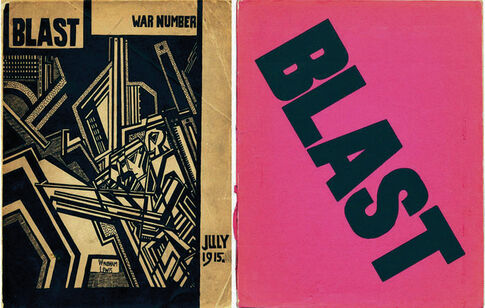
Blast magazine, a London art journal published just twice in 1915 and copies of which are held at Princeton University. Left: the July 1915 cover.
By Annie Batterman
World War I permanently changed Western art as well as culture. But a little-known magazine from 1915 was already challenging what people considered acceptable in the art world, and copies of it can be found in Princeton University’s Firestone Library.
Blast magazine was a British publication focusing on the Vorticist art movement. Vorticism was a radical art movement based in London in the years before and during World War I. According to information gathered online from a Vorticist exhibition at the Tate Modern in London, the goal of the movement was to express the energy of the modern world.
The full title of the magazine was Blast: Review of the Great English Vortex, and this summer marks the magazine’s 100th anniversary. Blast was ahead of its time, using new typographical techniques to draw the attention of readers with bold fonts and lettering, foreshadowing common styles used in magazines and newspapers today. Vorticist style was influenced by Cubism (the art movement popularized by Picasso) and modern industry.
This first issue of Blast contained Vorticist artwork and drawings by several artists, short stories, and various editorials and opinion pieces on a variety of subjects. Wyndham Lewis, a leader of the Vorticist movement and founder of Blast, wrote a majority of these articles, focusing on an art world that was rapidly changing because of the war and the important role of art in national culture (which, according to Lewis, must be continued no matter the outcome of the war).
Perhaps unexpected is the inclusion of several poems by the writers T.S Eliot and Ezra Pound, who proved to be heavily involved with the Vorticist movement. The magazine also included some unexpected viewpoints and descriptions: in a review of contemporary art, Lewis predicted that new American art “will be Mongol, inhuman, [and] optimistic.”
Another intriguing feature is a short opinion piece by the sculptor Henri Gaudier-Brzeska, written from the trenches in France in 1914. A note following the piece revealed that Gaudier-Brzeska had been killed in action prior to publication.
Publication of Blast stopped largely due to the war, never to resume: many other contributors were also on the front lines. Only two issues were published. Vorticism came to an end at around the same time. According to the exhibition at the Tate Modern, Lewis attempted to revive the movement in 1920, but was unsuccessful.
Blast is a fascinating introduction to the art and literature of the time period, as well as the process of getting into a research library and seeing some of the amazing (and accessible) works the university has in its archives. To view Blast, or any other book in the collection, a short process must be completed. If one wishes to see a specific book, an online request form must be filled out ahead of a visit so the book can be brought up from the archives. This also involves registering for a Special Collections Research Account, which is an easy and quick process.
To enter the reading room, a visitor must also get an Access pass (which requires a photo ID) upon arrival at the library. That can be obtained at the Access Office in the lobby. Hand-washing is also required, but that is the final step before entering the reading room.
Visitors can then spend as much time as they would like with the items they’ve gone to see.
,

