High on an outcrop of ancient boulders in Texas, a masked lawman and his trusty steed hides from view, hoping that an infamous horse thief would appear on the trodden trail below. Then, as dust clouds quickly rise above the sagebrush, a shadowy figure on horseback approaches.
At that moment, the lawman springs into action from his perch and confronts the man with a warrant gripped in one hand and a drawn revolver in the other. Startled, the desperado throws his hands in the air as he hears the hammer cock from the stranger’s weapon.
Although embellished, tales of the Old West were popularized in the mid-twentieth century through books, radio, television, films, and comics. Standing tall above fictional characters that achieved pop culture status as an American icon was none other than the lawman with an affinity for dispensing justice… the Lone Ranger.
Perhaps you know the identity of that “masked man” but how about one of the illustrators who designed and painted the instrumental cover artwork that drew young children to comic book and magazine racks to follow the adventures of their favorite hero? Well, his name was Henry Hartman (1913-2011), and his connection to Bordentown was pure Americana.
Born in Bordentown, Hartman was the youngest child in a family of six, with three elder sisters: Eleanor, Marguerite, and Miriam. His parents, John Hartman (1879-1955) and Sarah Jane Williams (1880-1956) were both natives of the Lehigh Valley in Pennsylvania. They moved to Bordentown in the 1890s, when John took a job as a dispatcher with the Pennsylvania Railroad.
They lived in a modest home on the corner of Prince and Church Streets that was within a short distance of the railroad station. Screeching wheels, the clash of metal, and plumes of smoke energized the landscape.
Henry’s father worked hard and was a practical man. At the age of 13, his father outfitted him with hunting gear and a shotgun. He did not enjoy the frigid winter weather or the purpose of the sport to which he remarked, “I’d rather paint deer than shoot them.” Taking a bold stand, he told his father that he never wanted to hunt again.
Preferring sports, he excelled in football despite his slight build. In fact, his athletic skill and tenacity led to being named captain of the team during his Junior and Senior years at William MacFarland High School in Bordentown. Also, he was recognized as a New Jersey All State. His outgoing personality led to being voted President of his class in 1929, 1930, and 1931.
After graduation, the hardships surrounding the Great Depression became a concern. He enrolled at Drexel University to appease his father but soon realized that college was not right for him. He had a natural ability to draw any subject that he either saw or imagined. Art was a gift that he wanted to share even though his father thought that it was a foolhardy occupation for his son to pursue.
For a while, he worked as a bank teller at the Bordentown Bank. He also began taking classes at the Trenton School for the Industrial Arts. First in the evenings and then later during the day. His teachers understood his potential and encouraged him with advanced painting classes. This was the beginning of his real art education.
Through contacts at the school, he heard about Mortimer Wilson, Jr. (1906-1996) who was a rising magazine illustrator. Teaching locally and providing instruction, Henry was thrilled to learn art from a true master.
As they grew to know each other, their professional and personal relationship grew on many levels as well. Henry described this period (1935) as one of the biggest “lucky’ breaks in his life.
His second lucky break was hearing about a job opening in Trenton that involved preparing graphics and photography for the State of New Jersey. This brought him in direct contact with the governor’s office and New Jersey Gov. Harold Hoffman (1896-1954). Impressed with the young man’s skills, the governor made referrals that led to some lucrative art assignments for Henry in his free time.
One of his most memorable assignments pertained to a charitable organization known as the Circus, Saints, and Sinners Association. Established in 1932, its mission was to provide health care facilities for “aged and indigent members of the circus profession.” Henry’s responsibility was to create charcoal portraits for presentation to famous guests who were honored monthly during fundraising luncheons in the Grand Ballroom of the Waldorf Astoria Hotel.
He also designed promotional flyers, painted 8’ x 40’ backdrop scenery panels, and photographed every event. Renting studio space in Trenton without the luxury of heat or fans, he was able to do this for over 30 years.
As World War II raged in 1942, thousands of men in this country were recruited to serve in the military. Henry was no exception and reported for training at Fort Dix on June 5. Then he was sent to the Brooklyn Army Terminal which was the world’s largest military supply base at the time. His responsibility was to create illustration material for training and morale.
The following year, he married his high school sweetheart, Muriel Elizabeth Molyneux (1914-2008), in her parent’s home on Prince Street in Bordentown. In 1944, they found an apartment in Brooklyn after he had crossed the Atlantic Ocean on a troop ship. The vessel didn’t participate in the D-Day invasion, but it did bring back German POWs on its return voyage. Henry drew sketches of the soldiers onboard.
After the war, the couple resettled in Bordentown. Henry returned to his job with the State of New Jersey. Muriel, a teacher at the Clara Barton Elementary School, took a leave of absence in 1947 when their first child, John Molyneux, was born.
This continued until 1955 when their second child, Gail Elizabeth (born 1950) was old enough to attend grade school. In order to accommodate their growing family, Henry and Muriel bought their first home on Farnsworth Avenue in 1950.
It wasn’t long until Mortimer Wilson Jr. asked Henry if he would travel to New York City to assist him in preparing illustrations for magazines. Ecstatic, he obtained a Leave of Absence from the State of New Jersey. Commuting by train, he helped Wilson in his 10th Street third floor studio.
The experience was exhilarating, as the building was brimming with illustrators. Wilson held Henry in high esteem as perhaps his best student and trusted him in satisfying his elevated standards. Regarded by the Society of Illustrators as one of the top five illustrators in the country, Wilson worked on assignments from many major publications, including Redbook, Cosmopolitan, and the Saturday Evening Post which was famous for Norman Rockwell’s contributions.
Henry worked with Wilson until 1952 when the latter had to close his studio and relocate to Arizona for health reasons. Returning to his state job with New Jersey, Henry held one of the three positions as a graphic artist. Although this was his primary employment, he took other jobs and worked many nights and weekends.
In 1952, he had another referral from former Governor Hoffman. It was an opportunity to meet the founder of Dell Publishing Company, George T. Delacorte, Jr. (1896-1991). The company was one of the largest magazine and comic book publishers in the world. Delacorte interviewed Henry and evaluated his portfolio as a possible cover artist for some of their western products, including Zane Grey, Western Marshall, and the Lone Ranger. Luckily Henry was hired. Before he exited the room, Delacorte asked him about signing his name as “Hank” Hartman since it had a western flare to it. He agreed.
Dell Publishing Company didn’t direct Henry on what to paint. Instead, they relied on upon him to create covers that he submitted in sketch form in advance for approval. His first Lone Ranger cover was No. 65, which hit the newsstands in 1953. His last was No. 108 in 1957. This was the end of an era known as the “Golden Age” of comic books.
Dell’s last “painted” cover was No. 111. In 1958, No. 112 was the first cover to feature photography. Clayton Moore, the actor who portrayed the Lone Ranger on television, appeared on every comic book. In total, 145 Dell Lone Ranger comic book covers were produced.
Using family members, friends, and residents from Bordentown as models, Henry painted dramatic images of the Lone Ranger and the perilous landscapes from the second-floor bedroom of his home. Although he was not the only Lone Ranger cover artist, he fully enjoyed it. Delacorte retained the paintings defining them “to serve as the standard” that he wanted other illustrators to approach.
In 1961, the family moved to Bank Street which was the location where another artist, Samuel Bell Waugh, kept a summer home for four decades in the 1800s. Overlooking Crosswicks Creek, the solitude and scenery were ideal and inspired Henry to construct a studio with a vaulted ceiling and large windows onto the back of the house. Lighting was important. In the basement was wall space to evaluate and display his handiwork as well as a darkroom for photography.
When Henry retired in 1975, he served 38 years with the State of New Jersey. This ushered in a new phase where personal enrichment was possible. Especially after Muriel retired. He entered art shows and participated in solo exhibits held at galleries in other states. Best of all were the invitations to comic book conventions where he happily signed autographs for children and adults alike. He never imagined that five years of his 60-year career would solidify his legacy as the illustrator of Lone Ranger comics cover art.
In 1998, after 85 wonderful years in Bordentown, he and Muriel sold their home and moved to a retirement community in Delaware close to their daughter. It was a good investment due to the welcoming community, the staff, and the services that were provided. Most of all, they made new friends.
Henry Hartman was modest and always considered himself a lucky man. He gave credit to others and was grateful to be able to make a living in doing what he loved. He cherished everything about his long life and he wasn’t afraid to express it.
Muriel died in 2008. Henry’s health declined too, but he remained in good spirits. In November of 2011, he joined his beloved Muriel.
Like all happy endings, they rode off into the sunset.
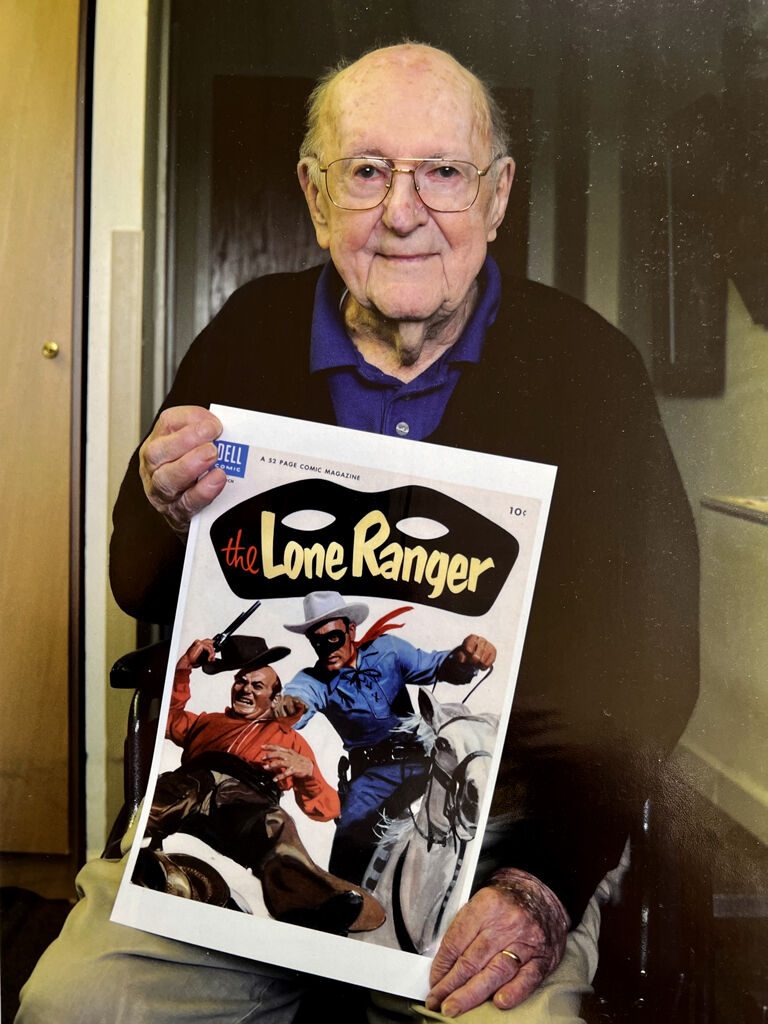
Henry Hartman showing a copy of a Dell comic book cover that he did of the Lone Ranger. He was 95 years old in the photo. (Photo courtesy of John Hartman.),

