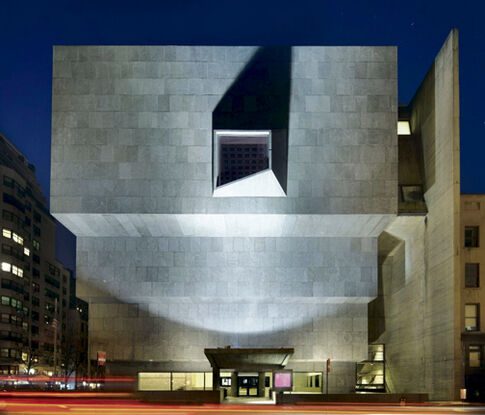
At 945 Madison Ave. in New York sits a striking dark gray building with seven randomly placed trapezoidal windows of differing sizes. Last month, the Metropolitan Museum of Art relocated its modern collection to the building, which is the former site of the Whitney Museum.
The structure sticks out among the traditional brick buildings that surround it. Its presence is assertive, suggesting importance and adding a sense of mystery to the otherwise simple street. Now known as the Met Breuer, the building is named after its world-renowned designer, Marcel Breuer, a legend of the architecture world.
Breuer was born in Hungary in 1902. In his 79 years, he was instrumental in transforming the architectural mainstream and ushering in an era of modernism. Breuer’s influence can be seen all over; while his mark on New York City is indisputable, he operated globally. Other notable buildings in his portfolio include the UNESCO building in Paris, the department of HUD headquarters in Washington, and Yale’s Becton laboratory building.
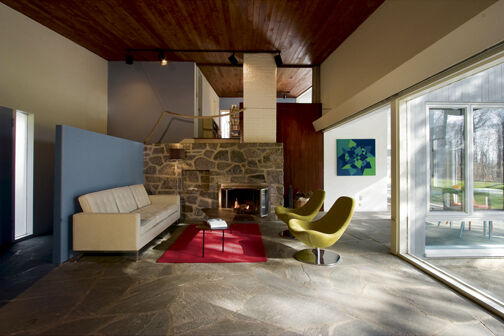
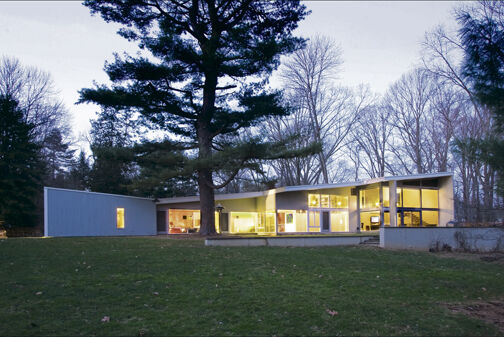
A few hours from the Met Breuer sits another Breuer-designed structure: Princeton’s Lauck House, 4 bedrooms, 4 bathrooms, and 3,800 square feet of modernist bliss. With a sleek white frame huge windows comprising much of the design, the house is boldly open to the outside world. The home is currently offered up for sale by Rafi and Sara Segal, an architectural couple that has lived in it for over eight years. The asking price for the Lauck House is $1.63 million. Breuer also designed another home in Princeton, the Levy House, at 102 Russell Road.
“It’s very difficult, because we love the house,” said Segal, discussing the decision to sell. “But at the same time, it’s my profession,” he said matter-of-factly.
Segal, an architectural superstar in his own right, has worked on various high-profile projects around the world, including the National Library of Israel in Jerusalem and the Kitgum Peace Museum in Uganda. He cites Breuer as one of his key influences.
Segal is also a professor of architecture at MIT, and says the long commute to work is the main reason the couple is selling the house and moving to Boston. “It’s also a bit too big for us now,” he added, mentioning how his kids have left for college.
Segal and his wife bought the house out of their own personal interest in its history. “Historically the house has a lot of significance, because it really integrated a lot of ideas that were then incorporated into the single family house,” he said. “Breuer explored that very early on, which made the house iconic,” Segal said.
The Lauck house is part of a string of houses that were built in the ’50’s, based on a design Breuer made in 1949 for the MOMA’s “House in the Garden” exhibition. The Rockefellers bought the original MOMA house in 1950.
The first owner of the Lauck House was Gerald Lauck, a prominent ad man. “He made money in the forties off of the famous ‘Diamonds are Forever’ campaign,” said Segal.
Lauck lived in New Jersey, but worked in Manhattan. “He went to the MOMA, saw the design there, and he liked it, so he commissioned the house from Breuer based on that design,” Segal said.
The Lauck House is thus part of the first generation of suburban homes in America. “It’s really a fascinating part of history in terms of the idea of the 1950’s commuter family,” said Segal.
As far as structure goes, however, the Lauck House does not fit the stereotype of the cookie-cutter suburban dwelling. “[Breuer] introduced into the design a few very significant ideas that weren’t present in the single family home, like the kitchen being centralized and open, views to all the other spaces, the kid’s room and the parents’ room being in two separate wings of the house, large windows and openings, and doors from every room to the outside,” Segal said.
Despite its unconventional design, the house was widely popular. “Breuer knew how to relate to a broader public taste. It was well received, because people appreciated that it was modern, but it still found a way to bring in the more homey feelings that people look for in a house,” Segal said.
Indeed, Segal and his wife have had a comfortable eight-year stay. “It’s amazing how the design, which was done in the 1950s, suits so well our current living needs and habits,” said Segal. “It’s really a very well thought out design. It interacts with the landscape beautifully, so you walk around in the house and you basically feel like you’re outside.”
After the couple purchased the house in 2008, they immediately went to work on restoring it to its original form. With access to the original plans for the house, the Segals spent half a year replacing aspects of the house with their intended materials.
Segal stated he wanted to recapture the subtle elements that made the house unique. “[Breuer] was very hands-on with the materials he used,” said Segal. “It’s not a modernism of white walls and geometry and pristine spaces, it’s a use of materials and sensitivity and control of how different raw materials, whether it’s cedar wood, or the blue stone floors, all give off a sense of warmth.”
For Segal, Breuer’s ability to introduce new concepts while still remaining accessible is what made him great. “Even people who don’t necessarily appreciate modern design immediately relate to the house when they come and visit, because there’s something almost vernacular about it,” he said. “In a way that’s why MOMA commissioned him.”
In terms of Breuer’s legacy, Segal believes Breuer continues to influence contemporary architecture. “He’s more relevant than ever,” said Segal. “The Met calling that space ‘The Met Breuer’ is incredible. It’s named after the designer!” exclaimed Segal. “I think Breuer is more and more appreciated, especially for the houses. They’re just being rediscovered.”
If you’re not an architecture buff, Segal says the house has another big selling point. “It’s an incredible house for parties, by the way,” he added. “Whenever we have people over, they don’t want to leave.”
Marcer Breuer on modern architecture
Excerpted from Architecture and Design, 1890-1939: An International Anthology of Original Articles. (Whitney Library of Design. New York, NY: 1975). Translated from the Dutch by Charlotte Benton, Tim Benton, et al.
I should like to consider traditionalism for a moment. And by tradition I do not mean the unconscious dependence on the immediate past. That the type of men who are described as modern architects have the sincerest admiration and love for genuine national art, for old peasant houses and for the masterpieces of the great epochs in art, is a point which needs to be stressed.
What interests us most when travelling, for instance, is to find places where the daily activity of the population has remained unchanged. Nothing is such a relief as to discover a creative craftsmanship that has been developed and handed down for generations from father to son, and that is free of the pretentious pomp and empty vanity of the architecture of the last century. Here is something from which we can learn, though not with a view to imitation. For us the attempt to build in a national tradition or an old-world style would be inadequate and insincere.
The modern world has no tradition for its eight-hour day, its electric light, its central heating, its water supply, its liners, or for any of its technical methods. One can roundly damn the whole of our age; one can commiserate with, or dissociate oneself from, or hope to transform the men and women who have lost their mental equilibrium in the vortex of modern life — but I do not believe that to decorate their homes with traditional gables and dormers helps them in the least. On the contrary, this only widens the gulf between appearance and reality and removes them still further from that ideal equilibrium which is, or should be, the ultimate object of all thought and action.
,
The living room of the Lauck House. Photo by Jeff Tryon.,