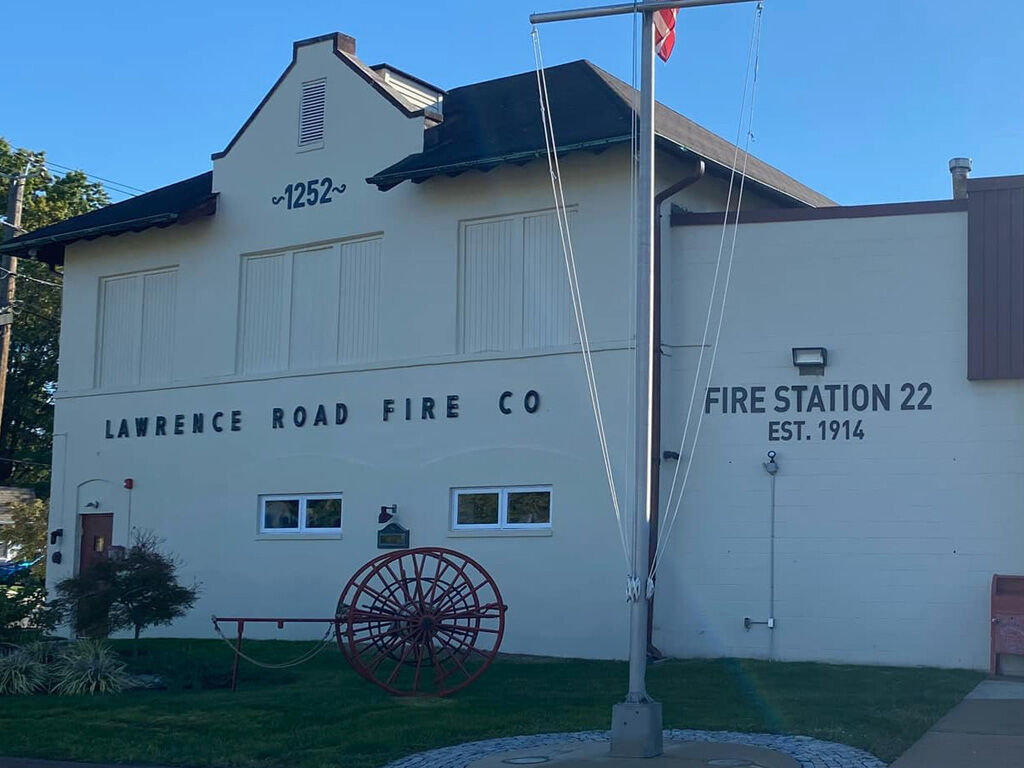
After the completion of a fire study in 2021, it was clear that Lawrence Township needed to bolster the ranks of firefighters serving the community.
Since then, the township has been working to implement the recommendations of the 171-report in an effort to make sure that there is enough coverage to protect the town 24 hours a day, seven days a week.
Currently, Lawrence is served by three volunteer fire companies (located in the south, central and northern areas of town) and career staff. The career firefighters cover the day shift Monday through Friday, and the volunteers cover the evening, weekends and holidays.
According to Municipal Manager Kevin Nerwinski, there has been a dramatic decrease in volunteer firefighters in recent years.
One of the report’s most significant recommendations is to create a single combination volunteer and career fire division under the authority of a full-time career fire chief.
The report also recommended an in-depth study to determine the feasibility of constructing a new fire station in a central location that would accommodate the Fire Department, EMS, and Emergency Management functions of the Township.
To that end, last year the township obtained $725,000 from the state to fund the study and design of a new emergency management operations facility.
Lawrence Gazette editor Bill Sanservino recently sat down with Municipal Manager Kevin Nerwinski to talk about the state of the township as it enters 2023. Fire protection and public safety were a top priority in his mind.
Below is the first part of a Q&A based on the interview with Nerwinski. It has been edited for length and clarity. More of the interview, which deals with different township issues, will run in next month’s issue.
Lawrence Gazette: What do you see as some of the biggest challenges facing the township in 2023?
Kevin Nerwinski: I think the most important service that the municipal government provides its community is the service of public safety—police, fire and EMT service.
Right now, it’s one of the primary concerns that I have, and we’ve been in the midst of a two-year rebuild of our firefighting program, which historically, for more than the past 100 years, has been served by the volunteer fire companies—Slackwood, Lawrence Road and Lawrenceville.
They’ve been an incredible resource and an asset to our community for generations, but the trend has been that the volunteer corps is depleted. The ones that actually go and jump on the apparatus and respond to fire calls. It’s not there like it was before, and as we need it to be, and so as a result, a couple of years ago, we did a fire study that provided us with a framework of what we need to improve our firefighting service and response.
We’ve been engaging in that process systematically, and this year in this budget, we are adding three more firemen and two more EMTs.
With the three additional firefighters. We hope to eventually cover Monday through Friday, 24-7, and have the volunteers cover the weekends. The trend is ultimately going to be that the career is going to be providing a service every day of the year, every hour of each day.
But we want to make sure that we continue to preserve and include the volunteers in whatever we do. So in that regard, my main goal is to work through this process, which will include the construction of a central firefighting station.
We received a $750,000 grant to study and develop and design plans for the creation of a centralized station, and that’s what we’re engaging in now in that process.
LG: And the career firefighters and EMTs would operate out of that station?
KN: Yeah. Right now we have three stations that serve the community. The fire study indicated to us that we should be operating out of a centralized station.
They identified the municipal complex as geographically the most appropriate, and we’re exploring that option over on the southern portion of our lot. That’s going to be our first investigation to see if we could put something there.
First, we need to determine what we need to actually have in terms of apparatus and offices and equipment. And then we design a building and structure around that, and that will dictate where this needs to be situated.
The other site is Lawrence Road Fire Company. So we’re in those stages. It’s a game changing pivot for this community, but it’s necessary. And we’re not alone. Across the country, the number of volunteer firemen—God bless them—who are willing to dedicate their off time to that, is dwindling. And so we see it and we have to respond to it.
LG: It’s problem I’ve seen in every town I’ve ever covered, and it’s been ongoing for a long time. Once the central station is built, would the volunteers still continue to operate out of the fire stations?
KN: Not out of their individual stations. Our firefighting force is going to be operating out of one singular station. However, in my mind I feel like Lawrenceville station is strategically located in an area that we may want to have that continue on in some satellite situation.
LG: Does the township own any of the fire trucks?
KN: We own them all. We own all the apparatus and equipment, and they’re deployed at the different stations.
It’s actually going to be an area of savings. Apparatus now are in excess of $1 million apiece, and we have to fill three sites. I think we’re going to end up realizing some savings over the years by operating out of one site.
LG: Has there been any pushback from the volunteer firefighters or rescue workers over the township’s plans? Is the township working closely with the volunteers in moving forward to implement these plans?
KN: This is a transition that I believe is our fiduciary obligation as a government to make sure that we respond timely and effectively to each fire incident that there is. And this is all data driven.
We know when the alarm goes off, and we know when apparatus get to the site (of a fire) and how many get to the site.
Any friction that there is from the volunteer in terms of them seeing the future is more emotional than it is driven by whether the need exists or not. I think there have been some members of the volunteers that aren’t happy with the transition, but leadership requires us to do what’s necessary.
We have included the volunteers in every aspect of unifying our firefighting force, and they have a seat at the table to voice their opinions and concerns, and I’ll continue to involve them moving forward because there is a place for the volunteers.
They’re respected, they are an asset and they’ll continue to be an asset. So. I think it’s the best way I can describe it. Change isn’t easy for a lot of people, but when you’re in a position where you you’re the one that’s responsible to meet the obligations of the municipal government, it’s easy to do.
LG: I would assume that there’s an organizational and social structure at each of the fire companies, and I would think it would be pretty difficult on their parts in some instances to see that go away.
KN: Yeah. My messaging for the past five years has been that I want to support and empower them and help them grow their numbers so that they can continue to exist and provide the services to the community. And they know that. I think generally they know that.
LG: Having a large volunteer force is to the benefit of the entire community, because you don’t have to pay career firefighters.
KN: Of course. But in the end you have got to kind of be able to respond to fires.
LG: It’s just a statistical fact that in communities across New Jersey—and the nation—that the number of volunteer firefighters and volunteer emergency service workers is down.
KN: It’s also driven by which community you’re in. So in Lawrence, the statistics show us that—I don’t know—let’s say 90% of the calls that the fire department is required to respond to are non-fire-related that are driven by a smoke detector that improperly went off, or an alarm of some kind.
Getting the volunteers to wake up at 2 a.m. to go on a call that they think may not be anything, it’s just difficult. And that’s where the careers personnel come in. It’s their job. They’re supposed to be available and ready to go and they’re getting paid for it. So that’s the reality.
You know, a firefighter’s experience in the city of Trenton or a more populated area is much different than the experience in a suburban area, but we’ve had our fair share of fires that have occurred over the last couple of years where they have responded and performed really well. So it can happen. We have to always make sure that we’re prepared to respond the right way.
LG: Who owns the individual fire stations?
KN: The township owns Slackwood, and the fire companies of Lawrence Road and Lawrenceville own theirs. However, over the last several decades, the township has maintained it and improved the facilites as if they were their own, because of the services that the volunteers have been providing.
LG: So I would assume that eventually there would be a study done to figure out what to do with those stations once they’re no longer deploying?
KN: Yeah. You know, I think in the end, we’d like to get ownership of those too. So we’ll see.