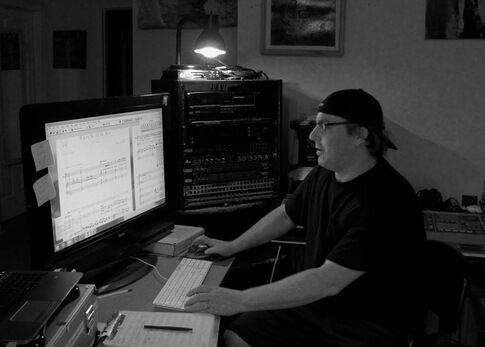
Christopher Beste composes the music for Casterbridge.
By Aliza Alperin-Sheriff
Christopher Beste and David Willinger are set to see the product of a 20-year-long collaboration come to life when their musical, Casterbridge, debuts on June 4.
The musical, based on the Thomas Hardy novel The Mayor of Casterbridge, will be performed at Theater for the New City, an off-Broadway venue in New York City. For Beste, the musical’s composer, Casterbridge will be his first work to be performed on a New York stage. Willinger, who wrote the book and lyrics and is also the director, has written and directed several off-Broadway plays and musicals.
Beste grew up in Lawrence. As a boy, he attended the American Boychoir School in Princeton and later went to the Lawrenceville School. While his family still lives in the area, for the past decade he has lived in Afton, Tennessee, where he moved with his wife so she could attend Tusculum College in nearby Tusculum, Tennessee.
Beste, 47, has always been involved with music. In addition to being a singer, he has been playing piano since he was a child. He also performed in musicals in high school as well as in community theater productions at Washington Crossing State Park and at Artists Showcase Theater, a small theater on the border of Lawrence and Trenton. Later, he studied music and composition at Trenton State College, which is now The College of New Jersey.
Although he does not work because he is on disability, he still manages to make music a big part of his life. He is a singer-songwriter and often serves as an accompanist on piano. For the past five years, he has also been very involved with the theater program Tusculum College.
Beste met Willinger in 1994. At the time, Willinger was dating a former teacher of Beste’s from the Lawrenceville School. He had also recently decided to adapt The Mayor of Casterbridge into a musical.
An avid bookworm, Willinger had been reading through all of Hardy’s novels and instantly felt that The Mayor of Casterbridge belonged on stage.
“It felt musical all the way through,” he said. “I felt the language was saturated with music. The story struck me as a really epic tale of a man’s destiny. It had so many theatrical qualities.”
After a serendipitous meeting at a farmer’s market, Willinger’s girlfriend introduced him to Beste and explained that Beste was a musician and she thought he might be a good composer for Casterbridge. Willinger agreed that Beste would be a good match.
“His kind of music is so based in England and its traditions. It’s just a perfect fit,” Willinger said.
Beste agreed about the English-ness of the piece.
“Hardy’s novels are all kind of the same,” he said. “They’re all set in rural England somewhere in the mid-19th century, so as far as the music, I sort of took it almost like a period piece. It’s got English, Irish and Scottish kinds of melodies.”
At first Beste was hesitant to work on the project, because he wasn’t familiar with the novel.
However, after reading a scene in which two characters meet in a hayloft and “proceed to have a very uptight Victorian sexual thing, blowing hay and chaff off each other,” he was intrigued.
He read the book and decided to join Willinger in crafting Casterbridge. The pair has been working on the musical together on and off since that time.
Willinger would bring Beste lyrics and Beste would work on setting those lyrics to music. Then they would get together and Beste would play his music for Willinger. After meeting up, they would discuss the gestalt of their work and each would go back to work on his own.
At first, Beste wrote the music on big sheets of manuscript paper, which he shared with Willinger when they met up. After moving to Tennessee, sharing his work became much harder, until he got a music notation program for his computer.
Beste said that the process of collaborating with Willinger was weird for him because, as a songwriter, he is used to writing both the lyrics and music together.
“I was concerned at the beginning, because I thought the lyrics were written in stone,” he said. “That has not been the case at all.”
The process of bringing Casterbridge to the stage took off a few years ago when Beste and Willinger gathered a group of singers to produce a seven-song demo. Then, in January 2015, Bob Goldstone, a musical director in the New York theater scene expressed interest in the project and signed on.
“Since then, it’s been an incredibly fast-paced and exciting thing,” Beste said.
He said that in the last three months, he has “put in a couple years of hard work,” often working between 6 p.m. and 8 a.m. because it’s quiet.
Willinger is very pleased with how Beste’s music has turned out. He described Beste’s music as seemingly simple on the surface, but being very nuanced and complex.
“His music is very hummable, but as we rehearse, I’ve realized it’s very intricate music and tricky to sing properly,” he said.
Beste plans to travel to New York from Tennessee a few days before the show opens so he can see a few of the rehearsals. He plans to stay in the area for the entirety of Casterbridge’s three-week run, shuttling between his mother’s house in Lawrence and the city.
“I can’t imagine that after three weeks it’s not going to still be incredibly thrilling and exciting,” Beste said.
,

