In the early 1950s (prehistoric times), my parents gave me a set of Lionel Trains. I started out with an engine, tender, boxcar and caboose. Since then, my trains have entertained generations of children and adults. Despite persistent cleaning, the oxidized tracks prevent the trains from zipping along as speedily as they did over 70 years ago. All of which brings to mind the full-size trains chugging through Hopewell.
I’m no “train buff,” a peculiar type that trains their mind excessively on trains, but I am persistently aware of the trains that run through the township, long strings of freight cars that announce their arrival with nostalgia-inducing lonesome whistles that bring to mind songs composed by blues geniuses stuck in jail cells long ago.
Sometimes, that train whistle wakes us up in the middle of the night. Fortunately, we are able to make that romantic old-time association and can go back to sleep with a bluesy smile.
Sometimes, Hopewell trains actually interfere with our lives, like when a gate comes down across Route 518, or a hundred-car behemoth rumbles through Pennington distracting us from outdoor dining or causing us to spill chocolate ice cream on a spotless shirt.
In lieu of knowing any train buffs, we have the benefit of Hopewell historian Doug Dixon and the Hopewell Valley History Project, the source of all knowledge regarding everything about the Hopewellian past including train traffic.
Train tracks first appeared in the area during the 1870s, the heyday of American railroad construction. In 1876, when the Mercer and Somerset line competed with the Delaware and Bound Brook line for a route through Hopewell, the conflict led to the infamous “Frog War.” The Frog War had nothing to do with amphibians but a lot to do with one railroad company wanting to cross the tracks of the other using a structure called a “frog,” a piece of track that would allow trains on either line to cross (leapfrog) the other’s track.
Ultimately, one line used an engine to block the tracks and the other dispatched a locomotive to ram aside the opposition’s engine. (Don’t you wish you could have been there to watch?)
The governor eventually sent troops to restore order, and the D&BB won a quick order to permit the frog.
Passenger service began in Hopewell in 1879 with stops in Hopewell Borough and Pennington. After almost a century, the Pennington station closed in 1967 and became a private residence. Hopewell’s station, a stop on the West Trenton Line, became a community center in 1982 following the end of local passenger service.
Both train stations date to 1876 and are listed on the NJ Register of Historic Places. They are almost identical in design (Victorian, Second Empire) although the Pennington station is made of sandstone and the Hopewell station of brick.
The Hopewell station is currently going through an exterior renovation (roofing, windows, trim). Anticipated completion is late September.
Relatedly freight trains ran on tracks along the D&R canal through Titusville as recently as the late 1970s. Now the tracks are gone, and the towpath serves hikers and bikers instead of rolling stock.
So whose railroad runs through our community? I ascertained that CSX runs those rails according to bright blue signs posted where tracks cross local roads. After almost three weeks of attempting to find out specifics about our local train traffic, where they went and what they carried, I finally got a profoundly disappointing response from CSX’s “Media Team.”
“The CSX Transportation network encompasses about 20,000 route miles of track serving major population centers in 26 states, the District of Columbia and Canadian provinces.”
Clearly, the tiny stretch of track going through Hopewell is too insignificant for any specifics. However, I did learn that “train horns must be sounded in a standardized pattern of 2 long, 1 short, and 1 long blasts. The pattern must be repeated or prolonged until the lead locomotive or lead cab car occupies the grade crossing … The maximum volume level for the train horn is 110 decibels, and the minimum sound level is 96 decibels.”
Sort of takes the romance out of that mournful midnight wail.
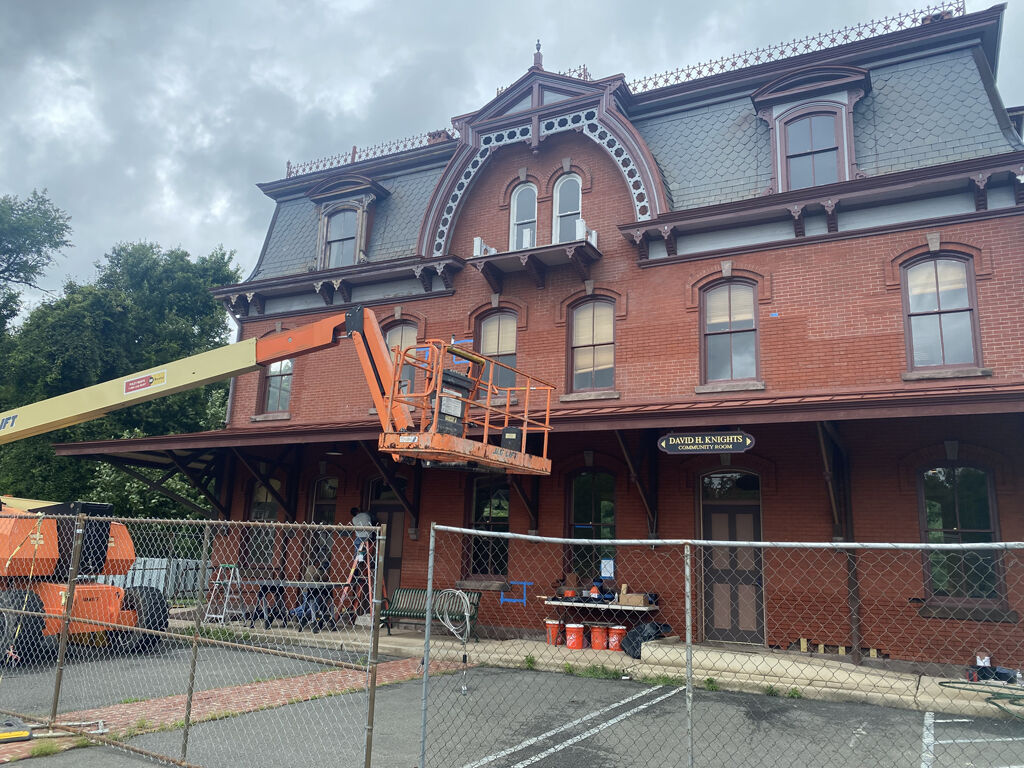
Renovation of the Hopewell Train Station is expected to be completed in September.,

