Benoit Cortet is a photographer, among other things. He also works in wood and marble.
But his main work is photography — and humanity.
The Pennington resident is originally from Dijon, France and has been here since he was a young adult.
Composing with the camera, he likes to capture his subjects in their environment, where they are most comfortable and let their guard down a little bit. His desk has plaques with sayings to remind him and reinforce his method. “Captured not Posed,” reads one. “Simplicity is the ultimate sophistication,” a saying of Leonardo DaVinci, is another.
Capturing people in their element is not as easy as it seems. They somewhat need to forget the photographer is there, on assignment, working to get a perfect image.
Born into a large family of 11 siblings, Cortet started at a young age when cameras used film and were an expensive luxury.
“I am not sure it was art of photography at first but I was seven years old when my godfather gifted me a small instamatic Kodak camera. It was a lot of fun at that age, and already I was looking forward for the small printed photos.” says Cortet.
“I would photograph what was around me, my family, my father, my dog. I would take many photos of the same subject. My parents tried to throttle me, saying maybe only take one of the dog and other subjects.”
“My father was a doctor, but he was also a terrific photographer and movie maker. A friend has gifted him a camera, a Zeiss 6×9. The camera was from 1936 and took beautiful photos.”
He remembers his father being good at composing photos. “He also took good movies. He had the equipment to splice them together, the 8-mm film. He would film our vacations, life events such as communions and other family news. He would get together a 45-minute movie that my mother would set to music. We would set up the chairs and the whole family would watch these films.”
Cortet looks back with nostalgia. “The movies would all be labeled, such as Summer 1961 and so on. He also made wonderful photos albums of family news. It would have the whole years’ worth of images, not just a specific event, it would be the family news of the entire year.”
Growing up in a time when New York was the center of the art, advertising and magazine business, Cortet started in medical school, but did not go far.
“I was getting my color photos developed and printed in a small photo studio near where I lived in Dijon, France. Over the years I became friend with the owner. One day I said to him that I wanted to get into photography. He said that if I wanted to do that, I needed to be in New York. So I went to New York City. I ended up here in the Hopewell Valley after I fell in love. I met my wife who was from here, while in New York, when we both worked for the same photographer.”
In France, his family was supportive, but thought a more traditional education was a better path. He learned a lot by teaching himself. “At home with my brother first, then with a group of four friends, we bought an enlarger and lenses and we printed in my large bathroom at home. It was great fun.”
Later training by working with various New York photographers, such as the famous Annie Leibowitz, Cortet was still influenced originally by his father and those photo albums and movie nights. When asked about other influences, Cortet mentions French photographers Jacques Henri Lartigue, Cartier Bresson, Robert Doisneau, Eugène Atget, Guy Bourdin, the Hungarian-French Brassai and American, Joel Meyerowitz.
“I love to shoot families, street scenes, the sea, artists and landscapes. I get assignments for portraits. I love to shoot children with their families. They are so genuine and pure.”
“Some photographers say and can get a shot in a few minutes. I find that if you spend time and let the subject relax a little, you get better images. If you spend the time you will see a little smile, a look, an expression, a smirk that you may miss if you rush through.”
As you look through Cortet’s work, after he explains his method, these small looks, smiles and expressions can be seen and appreciated.
Cortet worked for many publications locally and nationally. His work has been featured in Princeton Magazine, New Jersey Monthly, Smart Money, Parents and Family Life magazines, to name a few.
Moving to digital camera was a truly moving experience. Moving out of the dark room, with the enlargers and contact sheets was a traumatic experience for many of the photographers of the time.
Cortet feels that the advent of the IPhone with camera and the following economic downturn of 2008 was an especially salient point for magazine photographers.
From hiring outside photographers to using in house people and stock photos, it was a particularly hard time for many photographers.
“I taught myself the computer, Photoshop, storage, the new cameras and everything else I needed to know to evolve.” Cortet says.
“I sometimes shoot 1 or 2 days a week. When I say shoot, I mean 2000 photos. Then I edit. First culling down to the best 100, then the best 10. I try to edit mostly with the camera and the natural light. I also like to remove light and use ‘negative light,’ where I will remove the natural light with black paper or another screen while shooting.”
“I’ve photographed many things for assignments. I have shot food, restaurants, famous people, copy work, table top shoots. I have shot everything.”
Cortet also speaks of working for a law firm that helped clients with injury cases. “I would shoot and film people who were severely injured. I filmed a day in the life of a quadriplegic for the court case. I mean photos and films are worth a thousand words. The person was in misery, helpless. The jury needed to see the hard life was that the person now had. They were not accustomed to seeing people like this. It was extremely hard for me, but I knew it would help the person. I am a humanist, I respect people’s conditions. I am respectful of people.”
When asked of a dream project, Cortet wished that he was able to make a portrait of President Barack Obama.
“I am a big fan. He had his flaws, but he moved the country forward. It is hard in this country for small businesses like mine. Obama’s affordable care act was huge for me and my family. The security this act provided was very rewarding.”
Cortet lives in Pennington with his wife, designer Helen Crowther, and has three grown sons. Cortet gets most of his assignments by word of mouth now. I have a lot of repeat clients and friends of theirs. “I will still travel for 3 hours to shoot for an hour,” he says.
Using his two favorite cameras, a Canon Mark IV and keeping a Leica MP on his shoulder for everyday use, Cortet is nostalgic for photo albums full of “little prints.”
“I get to do what I love. I am blessed.”
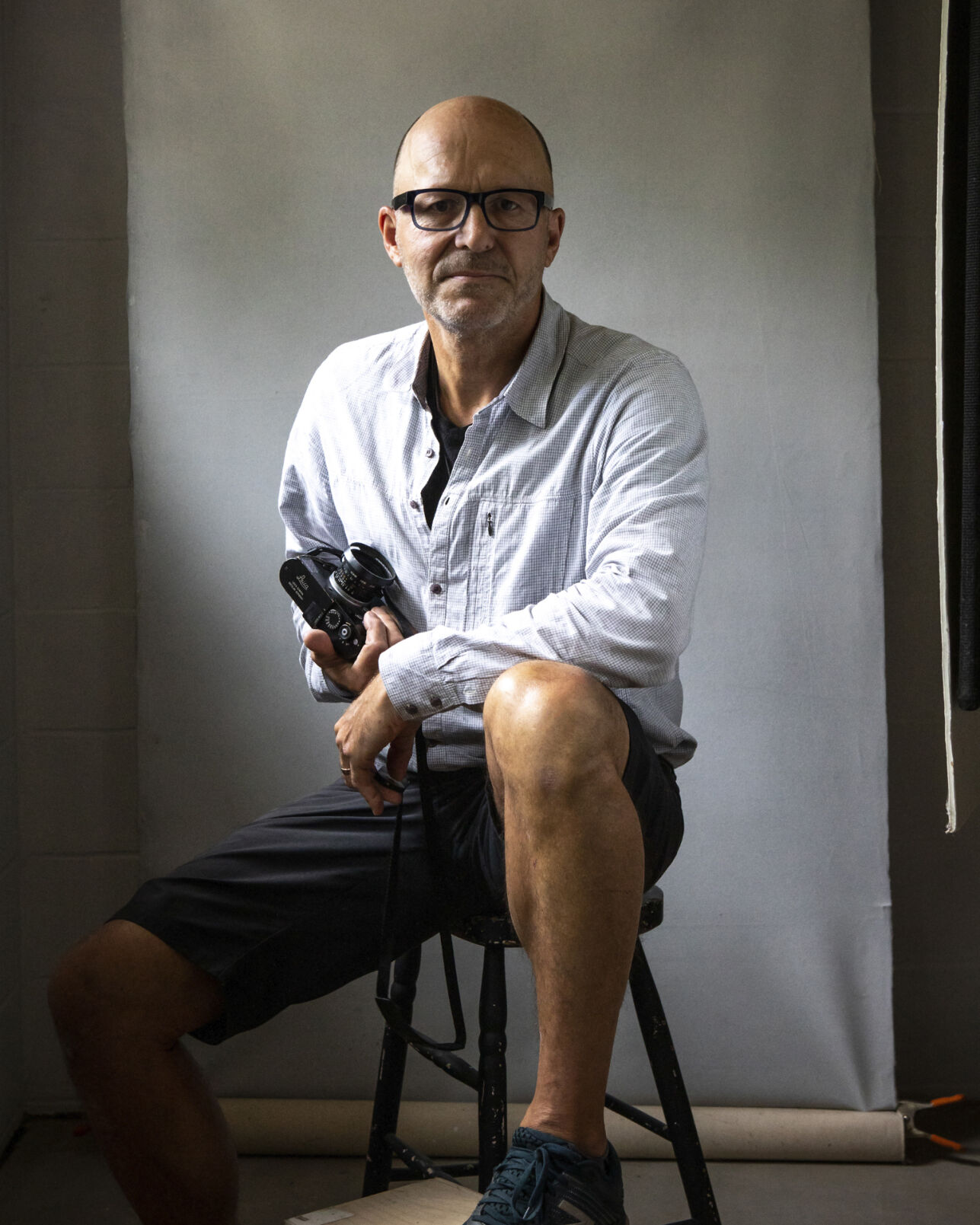
Benoit Cortet photographic self portrait.,