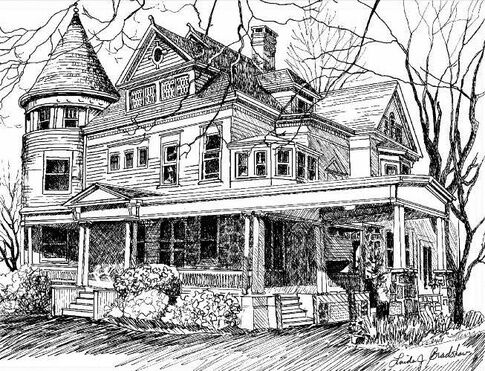
A pen-and-ink drawing of the 1895 Kunkel House by local artist Linda Bradshaw. The house marked the beginning of Pennington’s modern era.
Charming, cute, quaint. However one chooses to describe Pennington, the borough’s undeniable allure has attracted people for 125 years and counting. Those wondering just how Pennington got to be so pleasant will be clued in at one of the last Pennington 125 events, an all-day House Tour on Saturday, Oct. 3.
Organized by the Hopewell Valley Historical Society, advance tickets cost $20 for the self-guided tour, which consists of eight historic houses that trace and reflect the borough’s development from rural farm country to bustling commercial center.
“The oldest intact façade on the tour dates back to 1790 and it goes all the way to 1917,” said David Blackwell, a local historian who wrote the tour’s guide booklet. “There are various milestones along that timeframe, and there are seven architectural styles on the tour.”
Pennington’s official history begins with its incorporation in 1890, but the majority of its history is intertwined with the Hopewell Valley. The area was first settled in 1697, and the entire region was largely farmland.
“The longest part of the area’s history is sturdy farmers and large families,” Blackwell says. “It was a good culture for a long time.”
A north-south road connecting Trenton to Hackettstown traversed through Pennington, and this accounts for the borough’s current linear character. Through the middle of the 19th century, the houses built in Pennington were modest, Federal style houses. According to Blackwell much of Pennington’s streetscape is in this style, which features houses four to five windows wide with roof ridgelines that run parallel to the street. The oldest house on the tour was built in 1790, and its Federal style exterior has remained unaltered.
Prefiguring Pennington’s transition away from farming, in 1840 a doctor built Pennington’s first Greek Revival house on 117 South Main St., designed in a more ornate style that imitates Greek temples.
“It is quite stunning, the interior architecture is unchanged,” Blackwell said. “There are only a few of that quality in the county. It is a premier high style house with all the elements: two roof edges connect in a triangle and heavy detailing around the doorway and windows.”
Further departing from the basic utilitarian farmhouses, in the second half of the 1800s many Federal houses were renovated to include large scroll-like brackets in the Italianate style.
While there are no high style Italianate houses with villa or tower construction, Blackwell says these can be found in Cranbury, Flemington, or Frenchtown, two houses on the tour feature the Italianate detailing gaining in popularity at the time.
The arrival of the railroads in the late 1870s dramatically changed Pennington’s trajectory, without which the borough may never have been incorporated. The increasingly commercial section of town differed with the surrounding agrarian region, to the point that Pennington borough incorporated in 1890. Hopewell borough incorporated the next year, and there will be a 125 anniversary celebration in 2016.
“Two railroads was what led to the creation of the two boroughs, because they were small villages with stations,” Blackwell said. “It led to a boom in business, the area was able to import and export. In both towns this led to men founding improvement, or business, associations.”
A foundry and a canning company relocated to Pennington, and in Hopewell there arrived a canning company and a shirt company. Col. John A. Kunkel was a business operator who founded the Pennington Improvement Association, the group that wooed industry to the borough, started the Pennington Post newspaper and brought electricity to the town.
In 1895 Kunkel built the town’s first Queen Anne style house on 121 East Delaware Ave., featuring a deep porch and prominent tower, which will be on the tour. A prominent multi-millionaire egg merchant who relocated to Pennington from New York City, he was one of many wealthy New Yorkers and Philadelphians who snatched up farm land in Hopewell Valley. This further transformed the region.
Kunkel is considered the boro’s first developer, and the second one arrived in 1910 from Tennessee. Nurseryman William Howe bought land on both sides of South Main street. He layed streets, donated land to the Episcopal church and the Toll Gate school, and sold corner lots that became occupied by middle class houses.
An example on tour is the Foursquare-style house on 102 Lanning Ave. The 1914 corner house is square and has a wraparound porch fronting two streets. A block away on 304 Burd St. is Howe’s own house, also on the tour, a large two-story colonial revival house built in 1917.
“Farming faded after about 1900,” Blackwell says. “Up until that time, the value of land was based on what you could produce. Farmers had the bulk of the wealth previously. Two thirds of the of real estate value belonged to farmers in 1870. Once the outsiders could buy local real estate, it drove the prices up that you couldn’t afford to farm.”
In addition to the rising cost of land, industrialization meant the presence of many jobs outside of farming. Those who otherwise may have stayed on with the family farm now had other options.
Blackwell himself hails from a large Hopewell Valley family of “sturdy farmer” stock. The Blackwell family farm grew wheat at Elm Ridge Road beginning in 1801, before eventually transitioning to dairy farming.
Blackwell’s immediate family moved to Pennington in 1950. After attending high school in Hopewell, he studied architecture at UPenn and construction management at Cornell. He moved back to Pennington in 1984. Two projects he worked on were the original Bristol Myers headquarterse and the 700,000-square-feet former BMS commercial space on Scudders Mill Road. He currently resides in downtown Princeton, renovating a house he inherited from one of his cousins a couple years ago.
Large family gatherings during his childhood sparked Blackwell’s interest in local history.
“There would be 60 to 70 people, and I wanted to understand who those people were,” Blackwell said. “You expand from the nucleus of the family dinner table, it gets bigger and bigger, and I’ve learned Hopewell since then.”
Blackwell also contributes articles to the Historical Society’s quarterly newsletter. He co-wrote an article on George Washington’s 1778 march through Hopewell en route to the Battle of Monmouth. General Washington’s Continental army had just grinded through the winter at Valley Forge.
The other author of that article is Tom Ogren, a Society board member who helped plan the tour. The Society last organized a house tour in 2007, and since March Ogren has been busy coordinating this year’s event.
“Pennington has an amazing collection of older homes that are worth preserving and showcasing,” Ogren said.
He estimates 75 volunteer docents will safeguard the eight historic homes on the tour, and an additional 25 volunteers will sell tickets. The Society drew up a wish list of 16 houses for inclusion on the house tour. Several months later, after personal requests from volunteers Kit Chandler, Rachel Donington, Eric Holtermann and Winn Thompson, eight borough homeowners were recruited to open their houses for the tour.
The tour booklet was designed by Pennington-based Zoe Graphics, and the booklet’s pen-and-ink drawings of the houses were created by Hopewell artists Betsy Ackerman, Linda Bradshaw, and Susan Ewart.
Attracted to Pennington’s small town atmosphere and the school system, Ogren, his wife Karen, and his two children relocated from Ewing in 2002. He grew up in the suburbs of Chicago. His father worked in the Chicago Stock Exchange, his mother was a homemaker and part time sales clerk. Ogren was drafted by the army in 1970 and moved to Philadelphia to work as a clerk typist for the University of Pennsyvania’s ROTC office. After leaving the army, Ogren worked in municipal government, first for the city of Trenton and then for the township of East Windsor.
Ogren is also involved with Friends of Hopewell Valley Open Space, serving as a board member and officer, and he previously served on borough Council from 2008 to 2014. During that time Pennington Council passed a regulatory ordinance designating the borough center a historic district.
Known as the Pennington Crossroads Historic District, its historic character is guarded by the seven-member Historic Preservation Commission, which reviews exterior property applications and discourages demolition in the area.
Though he says every house on the upcoming tour is a “must-see,” Ogren’s favorite is the Kunkel House at 121 E. Delaware Ave.
“The scale and size of the house, it’s spectacular,” Ogren said. “It takes your breath away when you go in the front door, seeing the interior wood finish.”
The year-long Pennington 125 celebration concludes with a historical photo slideshow Sunday, Oct. 25 at the Pennington Library, and a community dance Friday night, Nov. 13 at the St. James Church Parish Hall.
Next year is Hopewell borough’s 125th anniversary. Anniversary committee chairs Cydney Perske and Deb Stuhler are developing a calendar of events, and Blackwell is already busy writing up Hopewell’s local history.
,

