

Baldpate Mountain is home to the highest point in Mercer County. The upper parking lot is about a mile climb up the driveway. Recent tornadoes, snowstorms, and heavy rains left the sole road up the mountain loaded with potholes and erosion.
Safety is the top priority of Baldpate owner Mercer County Park Commission, so they planned to repave the driveway. Since Friends of Hopewell Valley Open Space does research, reforestation, and joint land stewardship on the mountain under a formal Stewardship Assistance Agreement, the Park Commission naturalist staff called FoHVOS to discuss how the road closure could be timed to cause the least disruption to stewardship efforts, wildlife, and rare species. They also brought the New Jersey DEP Fish and Wildlife into the conversation.
Informed by wildlife research and observations made by Mercer County and FoHVOS, the state recommended that county officials consider adding subsurface wildlife crossings, also known as wildlife underpasses, that are designed to facilitate the safe movement of wildlife beneath the driveway. MCPC leadership enthusiastically pursued the suggestion.
“The Park Commission and Mercer County are committed to protecting, restoring, and learning more about the threatened and rare species throughout our park system,” said Aaron T. Watson, Mercer County Park Commission Executive Director. “Knowing that Baldpate Mountain harbors so many critical species, we were glad to invest in additional features to make our improved driveway up the mountain safe for not only people but also reptiles, amphibians and other local wildlife.”
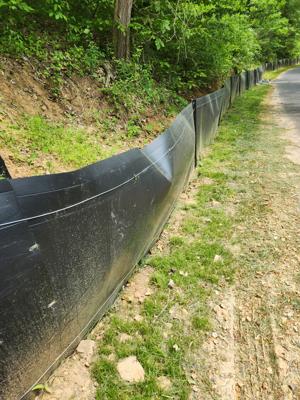
The subsurface wildlife crossing areas, located under the roadway, are not observable to human visitors. However, park users will notice guide fences along the driveway. The guide fence is constructed to stop wildlife from heading into the road. It is too tall for reptiles to climb over; it is designed to guide their travel along the fence until they reach the underpass.
Subsurface crossings are customized for the species that they target. In this case, they are specified and sized for reptiles and amphibians, though other wildlife may use them as well.
Kris Schantz, NJDEP Principal Zoologist, shared: “Fish & Wildlife’s Endangered and Nongame Species Program staff are very pleased with Mercer County’s implementation of reptile and amphibian passages on one of their busy park roads. The area has long been documented for various species, and such passages will improve their ability to safely move about the landscape.”
However, she also cautioned that there may be a delay before the passages are used frequently. “It will take time for reptiles and amphibians to locate and use the passages, but yes, ultimately I do believe it will help reduce road mortality along this road,” she said. As animals use the crossings, she added, they will leave a scent that more wildlife will follow.
FoHVOS and MCPC will install cameras to track usage over time.
Schantz also added that the DEP and the Department of Transportation have spent the last decade improving the design of terrestrial (land animal) wildlife passages while still meeting DOT regulatory and safety requirements.
DEP created an initiative called Connecting Habitat Across New Jersey (CHANJ — pronounced “change”) that promotes mitigation techniques to help reduce roadkill. Schantz credits CHANJ mapping capabilities with improving planning efforts, as the DOT is able to see which of their proposed/planned projects are “flagged” for wildlife passage needs.
Tyler Christensen, FoHVOS Land Steward and Ph.D. candidate studying copperhead habitat use and spatial ecology at Rutgers University, has been mapping wildlife movement on Baldpate Mountain since 2014. Copperhead snakes are a species of special concern in New Jersey. Their population numbers are severely declining and they may become a candidate to be listed as threatened.
Christensen has consistently documented assorted snakes and turtles that have been hit by cars and found dead on the Baldpate driveway. He observed a small spike in 2021 which may be attributable to increased traffic and usage during the pandemic.
“From our research of the copperheads at Baldpate Mountain, we discovered that this area was being used as a travel corridor,” Christensen noted. “In more remote habitats, copperheads traveling from place to place only have to worry about exposing themselves to natural predators. To minimize this risk, they are phenomenally well-camouflaged, blending in perfectly against rocks and leaf litter. However, camouflage offers copperheads no protection against vehicle tires, and snakes are in danger of being killed every time they cross our driveway. If successful, the new wildlife crossing at Baldpate Mountain will address a major threat to one of our state’s most vulnerable snakes.”
Christensen stressed that even in areas where copperheads are present, their shy, secretive nature makes encounters extremely uncommon. Moreover, the ability to use an underpass will make it even less likely they will cross the path of humans. The crossings offer a dual benefit of both reducing human/wildlife interaction and promoting the conservation of diverse species to maintain healthy ecosystems.
Providing safe passage across otherwise fragmented landscapes is crucial for the long-term survival of animal populations, but knowing where to locate wildlife passages requires research and tracking for the best results. While Tyler Christensen mapped wildlife paths using manual entry, the DEP CHANJ mapping tool allows the public to submit on-road observations of animals of all kinds to help NJ DEP Fish and Wildlife identify problem spots for wildlife on roadways.
MacKenzie Hall, NJDEP Biologist on the CHANJ team, believes that New Jersey will see an exponential increase in underpass numbers. Hall stated, “Wildlife crossings aren’t super common — yet! — but there are at least 30 projects in the ground across NJ, and about a dozen more in the planning or permitting stages. You can see them all in our CHANJ web viewer (at CHANJ.nj.gov).”
Hall noted that the sudden increase in wildlife crossings is primarily due to a 2016 Flood Hazard Area Rule that requires dry passage for land animals under bridges and culverts when certain conditions apply. A local example in Hopewell was the bridge on Route 518 over the Bedens Brook. Since it was being replaced under the new Flood Hazard rules, “the new bridge was built wider and with dry shelves added on both sides of the stream for wildlife to use below the road.”
“We expect that number to increase significantly over time. The Flood Hazard rules alone have advanced the cause exponentially in a pretty short time frame. There’s also more attention now on connectivity & roads issues than ever before, and the recent Infrastructure Act offers up historic support for wildlife crossings. And the CHANJ project tools and all these early projects in the ground in NJ have really helped us crest the learning curve – figuring out where wildlife crossings should go, how to design them effectively, and how to communicate the really important elements between agencies, engineers and contractors. There’s a ton to do, but the pieces are falling into place,” Hall concluded.
Mercer County Park Commission is leading the way by incorporating these features in the Baldpate driveway upgrade. Their subsurface wildlife crossings set a great example for other municipalities by sponsoring wildlife conservation, maintaining connectivity, improving road safety, and promoting a harmonious coexistence between human infrastructure and natural habitats.