During the first-ever, weeklong Community Make-A-Thon, sponsored by the robotics TEAM 293 Spike from Hopewell Valley Central High School, students and adults developed tools and entrepreneurial ideas to support people to deal with the effects of amyotrophic lateral sclerosis, or ALS, also known as Lou Gehrig’s disease.
Hopewell resident Sara Cooper, who was diagnosed with ALS in November 2018, helped kick off the Make-A-Thon by sharing her own experience with the students.
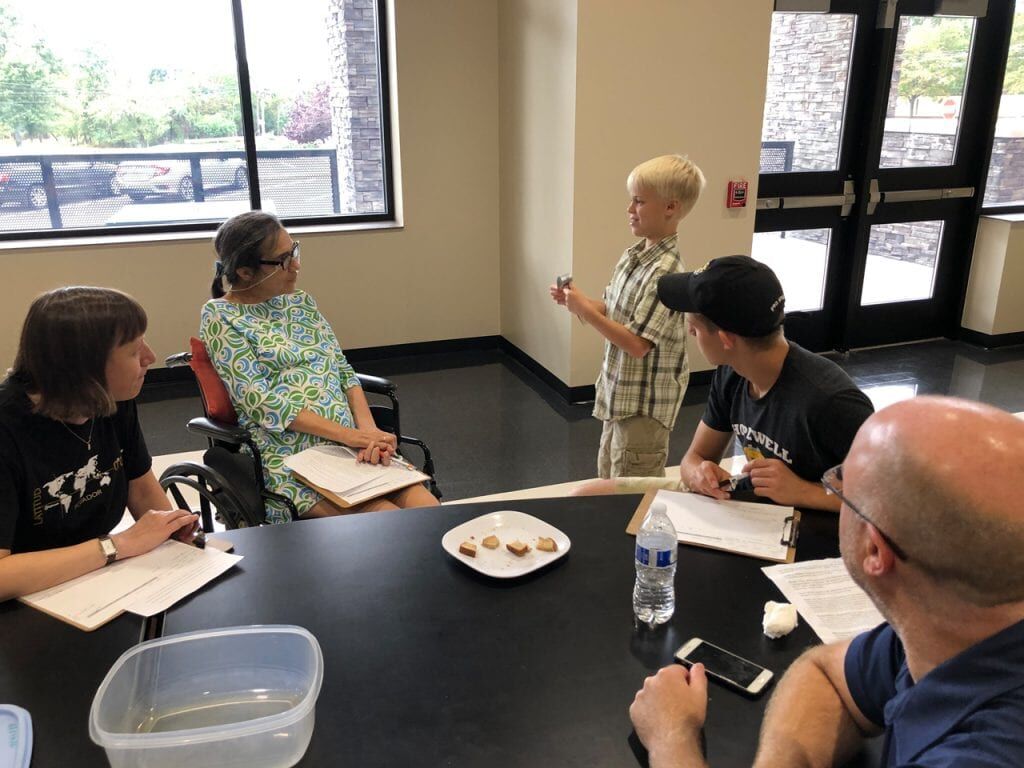
“One of the things that is hard to do is eat because you lose your fine motor skills,” Cooper says of the neurodegenerative disease. But using a tool created by third grader Ben Hartman and his dad, she was able to eat independently at the culminating event of the Make-a-Thon—the SPIKE Innovation Fair on Sept. 28, where the 12 teams shared their innovations.
“There was a little boy who came up with a metal strap that went around your hand and then he soldered onto it a fork. He had pieces of bread, and I put this band on my hand and was able to pick up the bread with the fork and eat it,” Cooper says. “I’m sure that sounds very simplistic, but eating is one of the basic human functions, and I can’t hold a fork. It was just simply amazing.”
Sullivan Meyer, a senior Hopewell Valley Central High School, came up with the idea for the Make-A-Thon. As chief inspiration officer of TEAM 293 Spike (an acronym for Student driven, Pushing for better, Inspirational, Kind and collaborative, Entrepreneurial), Meyer’s job is to ensure that his team exemplifies the core principles of FIRST (For Inspiration and Recognition of Science and Technology), an organization that holds robotics competitions.
“This means I am in charge of making sure TEAM 293 Spike is a rewarding, educational, and fun experience to team members but also an organization that inspires and creates interest in engineering and STEM education in our community and creates a positive impact on our community,” Meyer said
The Make-a-Thon and the SPIKE innovation fair together accomplished these goals. The five prizewinning innovations included an elevating and reclining wheelchair, an exoskeleton, a subscription-based wheelchair service, a slide-on fork, and an electromagnetic glove.
Meyer explains the purpose of the electromagnetic glove and how it works. “People with ALS don’t have great dexterity—it’s hard to take notes, to write, to do lots of things that involve gripping utensils,” he says. The thin gloves with electromagnets inside developed by one team can be used to manipulate utensils with magnets on them.
Another prize-winning innovation was purely entrepreneurial—a subscription-based wheelchair service. As ALS progresses a person’s mobility grows more limited, but, Meyer says, “you want to maximize the freedom you have while you have it.”
Over the course of the disease, a person might require several types of wheelchairs, and “the thought process [behind a wheelchair service] is that instead of having to buy wheelchairs for five different stages, you play a flat fee to the company and they give you a wheelchair to fit what you need.”
One inspiration for the Make-A-Thon was the New York Maker Faire that Meyer had attended a year previously. Inspired by “Make Magazine,” the event celebrated do-it-yourself engineering by showcasing innovative projects.
“It is leading what a lot of people call the ‘make culture’ or ‘the maker revolution.’ It is democratizing engineering, making sure anyone interested in designing and building stuff has that ability,” Meyer says.
Recognizing the marketing potential of the Maker Faire, Meyer says, “We wanted to create our own venue for outreach.” That meant “settling upon some kind of community engineering challenge.”
The specific idea of responding to needs of people struggling with ALS came when C. Schuler “Sky” Morehouse, president of Morehouse Engineering in Hopewell, invited team members to tell him about their plans for the robotics team. He had brought along Paul Kloberg, board member of FIRST-Mid-Atlantic, to hear their pitch.
Kloberg invited them to an ALS fundraiser memorializing the brother of his coworker Deb Fabricatore. Meyer and three other team members attended and “were pretty affected by it,” Meyer says. “There were a lot of engaged people there who were interested in helping out, and we were interested in doing that too.”
Because “ALS is a very physical disease,” Meyer says, “people who suffer from it face tangible physical challenges on a day-to-day basis that are ripe for engineering solutions.” As the disease progresses, people lose the ability to initiate and control muscle movement and in later stages may become totally paralyzed.
The kickoff for the Team 293 Make-A-Thon was September 21, when about 55 competitors listened to personal stories of three speakers whose lives had been touched by ALS. Fabricatore, a retired Bridgewater teacher spent more than three years taking care of her brother and after his death founded a nonprofit to support ALS patients and caregivers. Titusville resident Jodi O’Donnell-Ames, who lost her first husband to ALS when their daughter was three, founded Hope Loves Company to provide support, including camp experiences, for children whose parents have ALS. The third speaker was Sara Cooper, founder of Cooper Creative Group.
In her talk Cooper says she was “pretty head-on about ALS,” talking about her own hardships and emphasizing that “every 90 minutes someone is diagnosed and every 90 minutes someone passes away.” A little concerned that the students might be “freaked out by looking at me,” she wondered whether her speech was “too hardcore,” but parents reassured her, saying: “No, it’s great.”
She told students, for example, that she can’t get dressed or brush her hair by herself. Looking more broadly, she told them that many ALS sufferers are isolated. At present, there is no cure for the disease, and only two drugs exist, she says, “that hope to slow progression.”
“Basically the disease is terminal, and the average lifespan is three to five years from onset,” Cooper said.
The first night of the Make-A-Thon was devoted to brainstorming by teams of high school students as well as groups of friends from middle and elementary school, and a mixed child and adult team. Participants met in the robotics shop at the high school, which includes a machine shop, a fabrication shop, computers, and software.
As he observed participants hard at work, Sullivan realized that the project was more one of product design than of engineering. “We had given the people participating in the challenge customers and had given them a list of the challenges our customers faced, and we asked for the best product they could give us—which included entrepreneurial solutions,” Meyer says.
Meyer says he has always wanted to be a mechanical engineer but before joining the robotics club in eighth grade his understanding of the engineering process was “nebulous—it was kind of, oh, you design a machine.” But through his experiences with TEAM 293 Spike he now understands engineering to be “a collaborative process, both methodical and very creative, with a lot of prototyping involved.”
For the FIRST Robotics Competition each year the team builds a robot but also presents the entrepreneurial activities that enable the team to support and market itself.
On the first Saturday in January, FIRST, founded in 1989, will announce to approximately 7,000 teams a difficult field game in which the industrial-size robots they build will have to compete on the last day of President’s Day weekend.
But producing a new 130-pound, 3-foot by 3-foot robot, run from a 12-volt battery—“a substantial piece of machinery,” Meyer observes—comprises only half the team’s product. “The other half is what we call ‘entrepreneurship’; we have to fund and market the robot. If we want to succeed, we have to build up revenue, which occurs a lot through our sponsors.” The team raises $50,000 to $60,000 a year to cover its costs of about $40,000, with a surplus of $15,000.
A separate team of judges evaluates its entrepreneurial efforts, including business plans, budgets, marketing, community impact, and effective team organization. The points the team is given on both the robot and entrepreneurial sides contribute to their total score, which in turn determines whether they can continue to compete at higher levels.
When Meyer joined Team 293 SPIKE in 2015, “the team was almost solely a really good engineering team,” focused solely on raising funds and making the robot, he says. By his sophomore year, the team faced a crisis: it was down to five or six members, substantially lower than formerly and too small to raise the funds necessary to create a quality robot.
Those still on the team realized, he says, that “either the team goes under—many teams fail—or we pivot the team to become a more comprehensive FIRST team.” So they created a student leadership board and committed themselves to focus on entrepreneurship as much as engineering. “If you’re only an engineering team,” Meyer says, “it’s hard to develop the skill to recruit people and sponsors and generate interest among people.” Meyer served as marketing officer that year, creating the team’s first business plan and recruiting new members.
During Meyer’s sophomore year, the team also committed itself to attending other community events, like Pennington Day, holiday walks, and Hopewell Valley Regional School District science fairs.
Meyer’s mother, Tracy, works in corporate relations for the dean of research at Princeton University. His father, Jason, is a small-business lawyer as well as an entrepreneurship mentor for Team 293 SPIKE. “I didn’t get my engineering genes from them,” Meyer admits.
Cooper, who was one of the judges for the Make-A-Thon says, “The amount of work and the professionalism of their presentations to us was better than I’ve seen at a lot of companies. The PowerPoints, the CAD drawings, the actually makeup, the thought they put into it—it gave me goosebumps.”
In October someone she spoke to at the women’s conference of the Princeton Regional Chamber of Commerce, suggested that the Make-A-Thon had a wider impact than Cooper had realized. The woman, who was one of the teams competing in the Make-a-Thon, told Cooper, “I can’t tell you how grateful I am for your speech; it gave me a different perspective.’” That change had to do with her relationship with her grandfather, who has Parkinson’s.
Cooper says, “It gave her a new way of looking at and interacting with him.”
For Meyer it gave him a different way of looking at his future career choice: “It is a great way to make engineering more than just engineering. It is something important to me personally and going forward important to the team—the concept that engineering is more of a thought process that can be used for a lot of current challenges.”
,

