Tucked away on a country road in Hopewell Township not far from the Delaware River is a remarkable place where you can buy organic produce grown right on the grounds, as well as prepared food made with those ingredients. Where you can take cooking classes from professional chefs to learn everything from knife skills to how to cook Chinese dumplings. Where you can meditate in an herb garden and learn how to make your own herbal medicine. Where kids from the city come to learn about agriculture and the environment. A place where you can even host a gala fundraiser or get married.
This phenomenon on Pleasant Valley Road goes by several names — Roots to River Farm, the Farm Cooking School, Locust Light Farm, and the Barn at Gravity Hill. If you haven’t heard about all the things that are going on there yet, chances are you will soon.
David Earling and Maria Nicolo founded Gravity Hill Farm in 2005 and operated it as a community farm and market for 10 years. They built a folksy-yet-modern market center, and had a 1740s-era barn from South Jersey taken down beam by beam and reassembled on the property.
After spending a decade in the farming life, Earling and Nicolo began thinking about an exit strategy. They wanted to continue to nurture the agricultural education programs they had built. But they wanted to find someone else who could put their fields, market, and equipment to use.
That’s how they met Malaika Spencer, a farmer who already leased some land up in Solebury, Pennsylvania, for her venture, Roots to River Farm. Spencer was looking for acreage to expand her operations. As it happened, she also knew someone who knew just how to use the market building: chef and author Ian Knauer, then her boyfriend, now her husband, who was looking for a new venue for the cooking school he ran with his partner, Shelley Wiseman.
In 2017 Spencer took over the farming and market operations on the property, bringing the Roots to River shingle to Hopewell while continuing to work 30 or so acres back in Solebury. She offers seasonal CSA (Community-Supported Agriculture) programs to shareholders featuring produce from both sites.
Knauer and Wiseman came in and established the Farm Cooking School, building a teaching kitchen in the market where since last year they have been offering a wide variety of cooking classes. They also launched a farm-to-table dinner series featuring Roots to River produce and locally sourced meats and seafood.
Spencer also had a relationship with herbalist Amanda Midkiff, founder of Locust Light Farm in Bucks County, who had worked with her on various farms and was looking for a home for her herb garden and apothecary shop. When Spencer and Knauer set up their new operations at Gravity Hill Farm, Midkiff did too, on a separate lease. Produce and products from all three businesses, as well as Blossom Hill Flowers of Solebury and other local vendors, are available at the farm market every Saturday and Sunday and Thursday evenings in summer.
Earling and Nicolo, meanwhile, haven’t gone anywhere. They continue to run the Barn at Gravity Hill as a space for hosting anything from private events to corporate retreats to yoga classes. They also regularly host area schoolchildren for educational farm tours and summer camps.
In short, a lot has changed at Gravity Hill Farm in the last few years, and people have been slowly catching up to it all. As anyone who has visited the market, taken a cooking class, or meditated in the herb garden recently can tell you, the word has clearly gotten out.
* * * * *
Spencer, 30, grew up in Yardley, Pennsylvania. Her mother, Marna Matthews, is retired after a career as an elementary school teacher. Her late father, Guy Spencer, a native of Kenya, was for many years a sports journalist, working around the world.
Spencer attended all Quaker schools growing up — Newtown Friends School in Pennsylvania, followed by Princeton Friends, and finally Westtown School in West Chester, Pennsylvania, where she boarded as a high school student. She says it was at Westtown School that she became interested in farming and the environment. The school offered an organic farming project that students could do for physical education class credit. Students harvested food grown in the gardens for use in the school cafeteria.
While she was in high school, she worked at the Bent Spoon, the ice cream shop in Princeton that takes pride in using fresh, local ingredients to make its products. She says it was the place where she started making a connection between local food and good food.
Spencer also went to Costa Rica and Mexico to work on farms, exchanging the work on farms for room and board. “It’s a fun way when you’re a young person to travel around and be in a place and contribute to farms,” she says.
She majored in sustainable agriculture at Hampshire College in Massachusetts. On the campus farm she completed a number of projects and “just totally fell in love with it all,” she says.
The first farm where she did a full-season internship was actually Gravity Hill Farm. After that she did an internship at a sheep dairy farm in Vermont called Peaked Mountain Farm. “There I learned that I did not want to be a dairy farmer,” she says. “Although I really loved making cheese.” She also spent a summer at the community-supported garden at Genesis Farm in Blairstown, and spent a winter working on farms in Ecuador.
After graduating from college, she bartered some land on a little farm in the Poconos called Journey’s End Farm. The farm had a dairy and maple syrup operation and also ran a summer camp. In exchange for labor Spencer was given two acres that she farmed by hand with one helper. She describes the experience as “farming on training wheels.”
At Journey’s End she started up a CSA program and also sold her vegetables at three farmers markets. After two years she was ready to return to the Bucks County area and find land to farm closer to where she grew up.
She ended up leasing land in Solebury, Pennsylvania, from some friends she had met during the years of her farming apprenticeship. They were setting up a flower-growing operation, Blossom Hill Flowers, and weren’t going to need all of their land. They offered 13 to Spencer. She accepted, and Roots to River Farm was born. It was January, 2014.
One key member of her staff that first year was Midkiff. Spencer met Midkiff when they both worked at Genesis Farm in 2010. Later Midkiff worked for Spencer for three years helping to get Roots to River Farm off the ground while she was simultaneously cultivating her own interest in herbal medicine. Midkiff founded Locust Light Farm in 2015, based first in Bucks County, and since last year alongside Roots to River Farm at Gravity Hill.
“When we moved here (to Hopewell), it became this perfect opportunity because we love working together and her project so wonderfully complements what we’re doing,” Spencer says. “To have an herbalist who’s so familiar with vegetables — she can be talking to people about herbal medicine and food medicine and what that means for all of us. It is very cool to have.”
Spencer didn’t yet know Knauer that first year in Solebury, although he lived just down the road. They met when a neighbor introduced them. “He hadn’t started the cooking school yet but was looking for spaces,” Spencer says. “He was doing pop-up dinners and his neighbor across the street said, ‘Oh my God, there’s a farm right down the road and you love farms, let’s go.’”
Spencer remembers being impressed when Knauer spotted some late-season peppers on her farm and asked if he could use them before they were destroyed by the season’s first frost. “He was like, ‘Oh, can I use these peppers right before frost, and can we have a dinner in your greenhouse’ and I was like, ‘there’s no electricity’ and he’s like ‘that’s fine.’ It was great to meet someone who’s excited and willing to work in the farm environment,” she says.
Knauer also endeared himself to Spencer by becoming a winter CSA member. “Very brave people became winter CSA members our first year,” she says. “We were a new farm. We had no way to wash the vegetables in the winter because our pipes would freeze. It was rough stuff. Delicious, but you had to get through a layer of dirt and really be into that experience.”
Spencer depends upon a dedicated staff to keep things running smoothly. She finds them on websites that are designed to connecting farmers with relatively inexpensive labor. She is able to provide living quarters for some staff on the farm, which is something she wasn’t able to do when she had only the Solebury site. “It’s generally people who are looking to learn how to farm,” she says. “We do pay people, but it’s not necessarily enough for rent in this area, which is high.”
This being Spencer’s second year farming two separate properties, she feels like she has a better handle on what that means for the business. “I now know that potatoes grow really well on this property, and they were not growing well on the other property, so that’s very exciting,” she says.”
But she is also excited to get to work on engaging the community on all the things that are being offered at Gravity Hill Farm. “Now that we’re here, I want people to feel like it’s accessible and engaging,” she says. “For everyone to be taking cooking classes and coming to the market and taking workshops with Amanda and seeing that that’s all here in one space.” One way the farm has nurtured that community engagement is through their farm fests, held once a season. Garden Fest was held on Mother’s Day in May, and Tomato Fest is set for Saturday, Aug. 11.
Spencer says her long-term goal is to continue to develop the farm as a center for people who are looking for a healthy food experience. Central to this is the onsite farmers market, which is open in summer on Saturdays and Sundays from 10 a.m. to 4 p.m. and Thursdays in summer from 3:30 to 7 p.m.
“The nice thing about the market is that not only can we host our produce and food from the cooking school and the herbs, but we’re also hosting other local meat vendors — Beechtree Farm from Hopewell and Goat Hill Farm from right down the road,” she says. “And sometimes we have local coffee roasters and local mushrooms. All of that is an important part not just to get consumers here but also other farms to access this space.”
Spencer says that there are many reasons she became a farmer, but that there is nothing more satisfying to her than working outside all day and then seeing a freshly prepped field, a clean weeded bed or a stack of crates filled with harvested vegetables. “I love working closely with others on a common mission. It’s work that is physically satisfying, but also since we are very intentional about using organic practices and caring for the land sustainably, I know that I am doing work for the greater good that will help generations in the future,” she says. “Even though the day-to-day can be so challenging, it’s the small wonders of the crew laughing in the fields, or the beauty of a perfect radicchio or new parents telling me the first thing their babies eat is food from our farm that happen so often that it makes it all worth it.”
* * * * *
Ian Knauer, 41, grew up in Allentown, Pennsylvania. His mother, Cindy, was a lifelong educator, now retired, and his father, Robert, still works as a lawyer in Allentown. Knauer went to Hofstra University, where he studied international business. He worked in New York as a stockbroker for less than two years — long enough to know that he didn’t want to make it his career. “And I would cook, because that’s what brought me sanity,” he says. “I realized that I needed to do something that I love for a living, and how much money I make matters a whole lot less than that sort of satisfaction.”
He thought about going to culinary school. He had no desire to work in a restaurant; that lifestyle held no interest for him. He was fortunate to have met Ruth Reichl when she was the New York Times food critic, and after she became editor-in-chief of the erstwhile Gourmet Magazine, she hired Knauer to work part-time as a recipe tester. “The pitch was that I hadn’t been to culinary school, just like her readers, so I would make the same mistakes that her readers made, and in fact that ended up being completely true,” he says.
Gourmet would use his experiences to make recipes clearer prior to publication. He did that for three years until he outgrew the job. Instead of letting him go, Gourmet made him a recipe developer. He worked in that role at Gourmet until Conde Nast, its publisher, closed the magazine in 2009.
When Knauer (pronounce the K) was young, his grandfather had a farm down in Chester County that is still in the family today. Knauer would spend weekends on the farm doing chores like mowing the lawn or harvesting potatoes. “As a kid I just hated it,” he says. “I’d have rather been playing Duck Hunt (on Nintendo).”
But as an adult, living in New York and working with food, he realized that he missed that connection to the land. He started visiting the farm more and more often on weekends, sometimes bringing friends. “It became a place where people liked to be, instead of just chores,” he says.
After Gourmet, Knauer moved back to Pennsylvania and wrote a cookbook called “The Farm: Rustic Recipes for a Year of Incredible Food,” which was published in 2012. With some friends he also made a television show by the same name that aired on PBS. The show is available today on Amazon (free to Prime members).
After the show first aired, Knauer would hear from viewers who had enjoyed it and would ask: where was his restaurant? “And I would say, ‘I never wanted a restaurant!’” he laughs. But he still wanted to work with food.
He realized that because he had spent most of his professional cooking life in a learning environment, he felt most comfortable in such a setting. “There had always been a sense of learning for me, and that’s really something that I enjoy, because there’s so much to know with food,” he says. “Opening a school seemed like a logical step and gave me an opportunity to continue to build that sort of place where we really think about food and are very intentional about it and also experimental with it.”
‘The goal is if you take all of our basic skills classes, you don’t need recipes any more.’
He had kept in touch with many of his Gourmet colleagues after it was shut down, including Shelley Wiseman. Wiseman had heard that he was thinking about opening a cooking school and came down from New York to visit. The pair ended up hosting a pop-up dinner together. “At that point, she said, ‘Well if you don’t want to partner (with me), you should say so now, because otherwise I’m going to quit my job and move here and help you build this thing,” he says. “And that’s exactly what she did.”
First they opened their cooking school on the grounds of Tullamore Farms in Stockton. “There’s an old farmhouse there that’s heavy on charm, and not so heavy on functionality,” Knauer says. Roots to River Farm provided most of their vegetables.
They stuck it out there for two and a half years, until the opportunity in Hopewell came up. Not only was there the additional land that Spencer needed for farming, there was also the large market building, which had a certified commercial kitchen and deluxe brick oven outdoors. “When this opportunity came up, it made even more sense because (the cooking school) could really utilize the commercial kitchen in ways that I wasn’t going to be able to, and really create value out of this space,” Spencer says.
When they took over, the market building was mostly a large bare room. The commercial kitchen, situated in one corner, was a high quality workspace, but too small for classes to use. So Knauer and Wiseman built a wide-open learning kitchen next to it. There are 16 chopping blocks, which means each class at the Farm Cooking School has room for 16 students who can spend an average of two hours per class learning, cooking, and eating what they’ve cooked. At the same time they can be using the certified kitchen for pickling and preserving and preparing soups and pizzas for the market.
The Farm Cooking School offers a wide range of classes on everything from pie and donuts to burgers and seasonal pasta to Indian and Thai cuisine to vegetarian fare from around the world. Knauer and Wiseman teach many of the classes themselves, but they have also tapped into a network of area residents who are experts in particular fields, such as baker Jodi Schad and James Beard Award-winning cookbook author Maricel Presilla.
The school uses Roots to River Farm produce as often as possible in the classes, though they don’t just cook veggies at the school. For seafood classes they bring in fresh sustainable seafood and use the vegetables for accompaniments to the main dishes. In the butchering class offered at the school, they will break down an entire animal from a local farm in the course of a class, then teach students how to cook it. Once a year Knauer does a pig-roasting class, where they break down and cook an entire heirloom pig.
They offer classes in which students learn basic cooking skills and techniques including knife skills, searing, braising, roasting, poaching, and grilling. Students can take these technique classes as one-offs or together in a package called Culinary Boot Camp. “The goal is, if you take all of those classes, you don’t need recipes anymore,” Knauer says. “You have enough technique that you can open your fridge and start cooking. Of course not everybody has the time or wherewithal to commit to take six weeks of classes. So if they want to learn how to make a perfect poached egg, they can just learn how to do that.”
They also offer cooking camps in the summer for both kids and adults, which are more intensive than individual classes. The adult camp includes morning classes that end in lunch and an afternoon activity and evening class that ends in dinner, either at the school or at the restaurant of a chef who has a relationship with the farm, such as Juniper Hill in Annandale, whose chef, Josh DeChellis, is one of the professionals who has taught classes at the school.
Classes typically cost $95 for a two-hour session. Camps and some classes cost more; for all schedule and pricing information, go to thefarmcookingschool.com.
Knauer says classes are geared for students of any experience level. “We have professional chefs who come here who want to bone up on a skill that they’re not sure about. Mostly we have home cooks who like to cook at home and want to get better,” he says.
The only thing that isn’t hands-on at the Farm Cooking School is the farm-to-table dinners, which are offered once a month throughout the year and often sell out. For those, guests get to sit, watch, and eat as the chefs cook five or six-course meals utilizing local ingredients. Reservations are required for these meals, which cost $95 (BYOB). ‘That makes us the most expensive BYO dinner around, which means it has to be the best food around,” Knauer says. “For the most part I think we do a pretty good job of that. We sell out, so we’re doing something right.” The next farm-to-table dinner is scheduled for Saturday, Aug. 18.
The Farm Cooking School does book private events such as birthday parties and teambuilding sessions, for which it has tiered pricing plans. Knauer says most of the time a hands-on cooking-class is part of the event. Though they don’t have enough capacity to do weddings, he points out that the Barn at Gravity Hill, which can fit 80 people, is designed to host bigger events like that. In fact, the barn is where Spencer and Knauer tied the knot themselves in March. They live in Point Pleasant, Pennsylvania, with their dog, Duma.
Knauer says he wants to continue to expand their network of instructors so they can continue to offer a variety of interesting classes for their students. He is putting together instructional videos to post on YouTube, such as a butchering series that they have been filming as classes have happened, and they are also pitching a television show to studios and networks based on everything that happens at the farm.
Knauer credits Earling and Nicolo with setting up great infrastructure on the grounds. “They did it in a way that’s not only functional but is also as sustainable as it can be,” he says. They use solar panels for energy and geothermal systems for heating and cooling. “It makes as little impact on the environment as possible which is really one of the broader points of what we all do here,” he says.
Roots to River Farm, 67 Pleasant Valley Road, Hopewell. Web: rootstoriverfarm.com.
Also on the grounds: Farm Cooking School, thefarmcookingschool.com; the Barn at Gravity Hill, thebarnatgravityhill.com; and Locust Light Farm, locustlightfarm.com.
A version of this story originally ran in the U.S. 1 Newspaper.
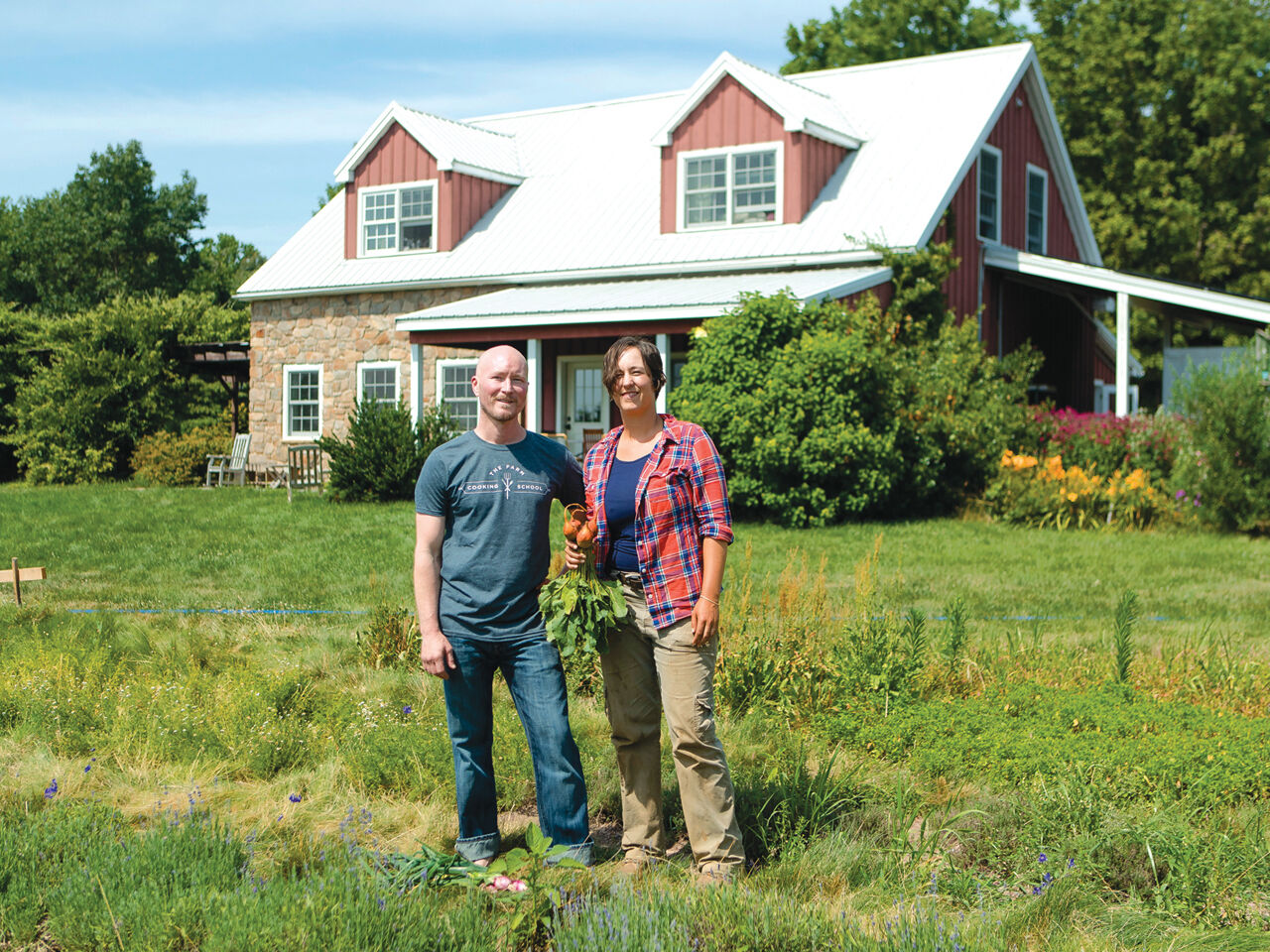
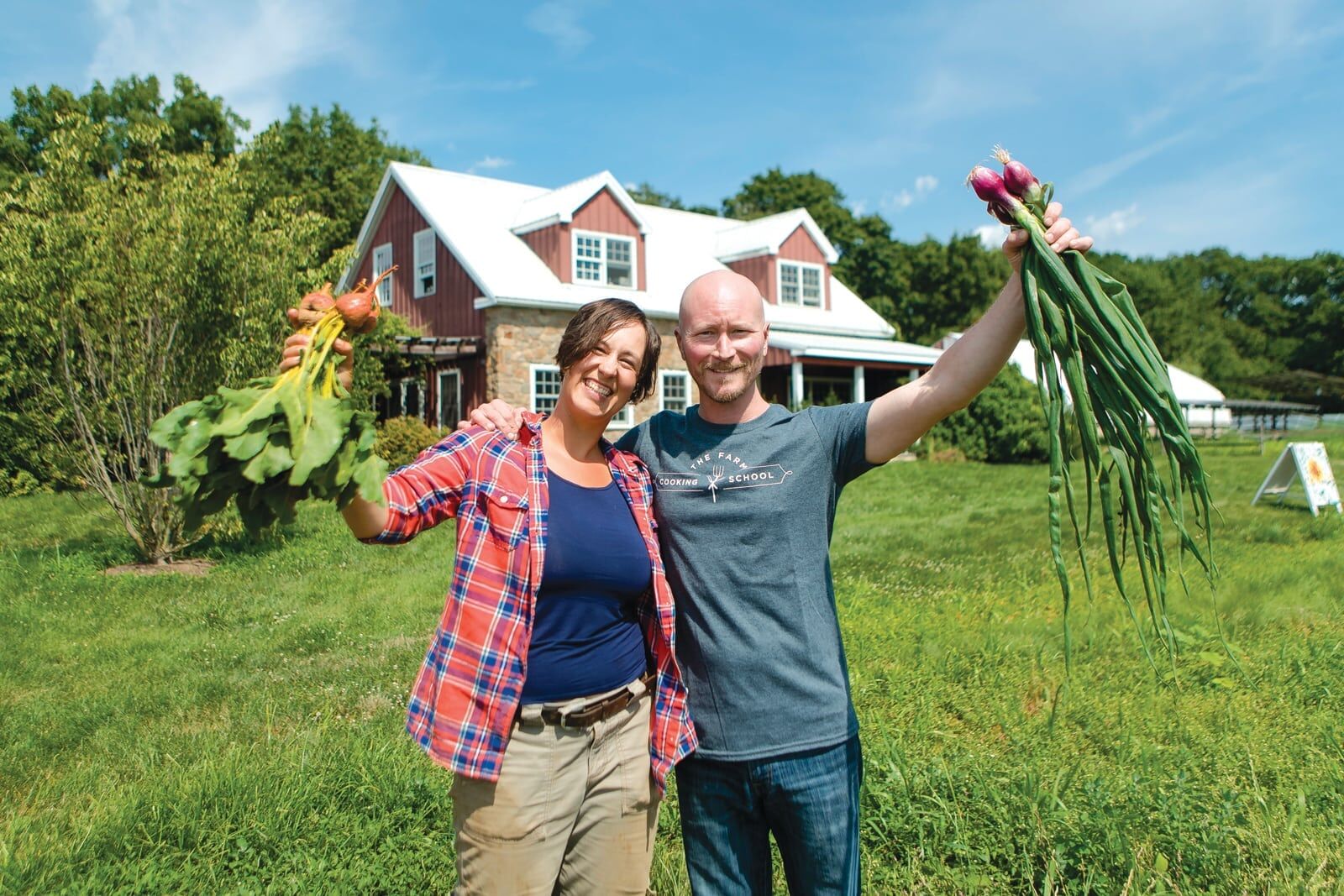
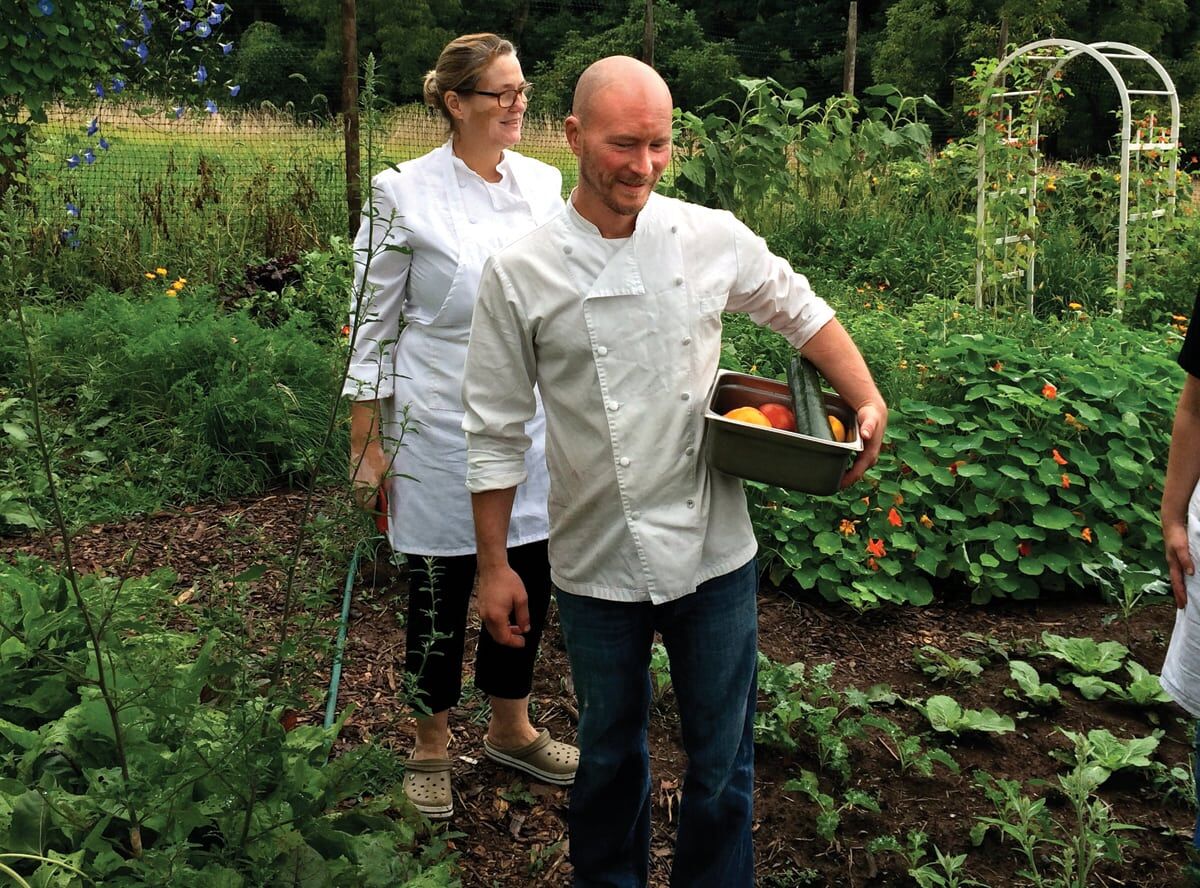
Ian Knauer and Malaika Spencer on the grounds of Roots to River Farm on Pleasant Valley Road in Hopewell. (Photo by Suzette J. Lucas.),
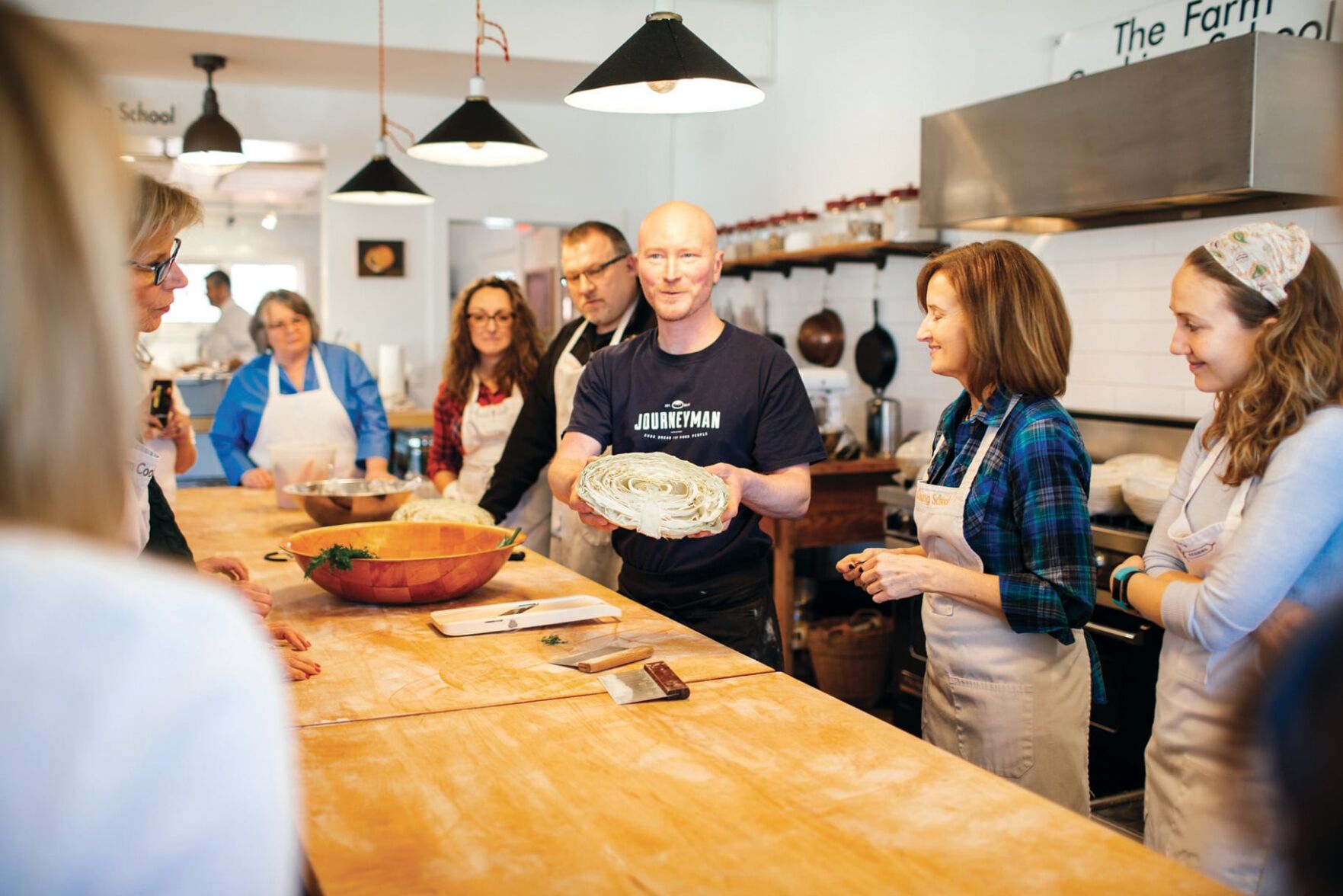
Hone Your Skills: Ian Knauer leads cooking classes that cater to everyone from the total amateur to the near-professional. (Photo by Guy Ambrosino),