For anyone walking the north side of East Broad Street in Hopewell, New Jersey, the picturesque edifice at Number 28—home to The Hopewell Museum—has been a welcoming landmark since its opening in 1922.
The storied 1877 Victorian brownstone has been bustling and brightening over the past few years, despite the necessary closing of its doors to the public in 2022.
What’s going on? Reimagination—the museum’s multi-staged renovation and conservation initiative.
Like many changes that have transpired over the museum’s 100-plus years, Reimagination came about through that wonderful stroke called serendipity. In 2020, the pandemic prompted the museum to close.
But this unexpected shutdown provided a rare opportunity: to conduct a comprehensive evaluation of where the museum was, and what steps were needed to take to ensure the museum’s vibrancy and relevance for generations to come.
Thus a vision and plan, which was dubbed Reimagination. The museum launched it in 2021 by restoring the building’s exterior; in 2022 came a rigorous assessment of archaeology objects (Delaware Indian and Early American). At the same time, we restored our eighteenth- and nineteenth-century fine clocks; and, in 2023, we catalogued our extensive ceramics collection, and appointed our first-ever executive director, Asher Lurie.
The year 2024 marks Reimagination’s next phase: the cataloguing and remediation of our 250-plus-year Hopewell Valley textiles collection.
To give these classic garments, flags, bed linens, and curtains proper stewardship, the museum went big. engaging a pioneering innovator in the discipline of preventative conservation, Wendy Jessup.
Through Jessup’s work at the Metropolitan Museum of Art, the Museum of Fine Arts Boston, and the Smithsonian Institution, she’s employed new techniques and nurtured fresh talent. To start the project, she brought in a graduate fellow at the Winterthur and University of Delaware Program in Art Conservation, Binh-An Nguyen, a rising expert in the field. And the museum recruited two interns: a pre-program textile conservator, Anamaria Cuevas, and an aspiring digital media and graphic designer, Jack Kremer. At the beginning of June, the team delved in.
At the time of this writing, it the textile project was in just day two Project. What we’ve observed so far is something few of us have ever glimpsed, yet what every museum in the world does routinely to protect and preserve its collections: the painstaking, exacting work of the museum conservator.
It’s one thing to maintain garments and furniture, dolls and documents, in a dark and cool storage space. But if a community wishes to see, study and savor its cultural heritage manifest in its museum’s artifacts—their craft, beauty and historical significance—then these all must be displayed.
Light, pollutants, insects, temperature changes, humidity, water, etc.—these variables can wreak havoc on a museum’s collection, i.e., the community’s invaluable, irreplaceable cultural property.
Have you ever lifted a garment from a box in the attic, only for it to disintegrate in your hands, or to find it riddled with holes? That’s just an inkling of what museums are up against.
Within the brief time Jessup and Nguyen have done their garment-by-garment scrutiny, they have catalogued (with measurements and condition assessment) some 20 “rare gems” (as Jessup put it).
These historic textiles, and others, are irreplaceable, yet they can be damaged by pests, such as moths. Avoiding harsh chemical treatments, the optimal pest-prevention is freezing the garments in low temperatures (more than minus 30 degrees Celsius), then vacuuming them through a low-suction high-efficiency particulate filter (HEPA)—key steps in preserving their integrity and extending their lives.
“Sometime around 1860,” Jessup opined as she gently lifted an item, “a mother or grandmother—a seamstress, who probably was female—hand sewed this two-colored blouse. This is a very sweet piece. Its collar has hook-and-eye fasteners; the buttons are metal. And its material…” She feels it, bringing it close to her magnifier, then nods her head, “Silk! It’s just gorgeous.”
After completing the assessment, and filing a digital record, she and Nguyen together—with the care of lifting a sleeping child—removed another gem from its box.
“Let’s see what surprises we have here,” Jessup said. “Ah—a child’s cape. Victorian. Look at the intricate cross-stitching.”
As the two deliberated—identifying the material, the era, the sewing technique, and condition—Jessup provided continuous, enthusiastic, eye-opening commentary:
“This museum contains a cultural heritage, embodied in each of its objects. They tell a story, many individual stories, about the community’s historic talents and values. Which is why we, as conservators, have to be hypercognizant of the interests of Hopewell as seen through the value of these materials.
“It’s really important to remember that museums are holding collections in the public trust. We must be very aware of what’s important to the cultures that lived here and their family backgrounds.”
What may be most exciting about Reimagination is discovering how these textiles—and all the museum’s holdings—provide snapshots into the lives of Hopewell residents, in every decade since the early 1800s and sometimes earlier. Charming, sometimes wondrous, sometimes perplexing, these lively “ghosts of the past” contain stories we all want to be told more about.
When the Hopewell Museum begins renovating its interior in 2025, and with its planned reopening in 2026, our visitors will be engaged by the fascinating stories of our Hopewell Valley forebears, through a one-of-a-kind collection that has been preserved and made accessible for many years to come.
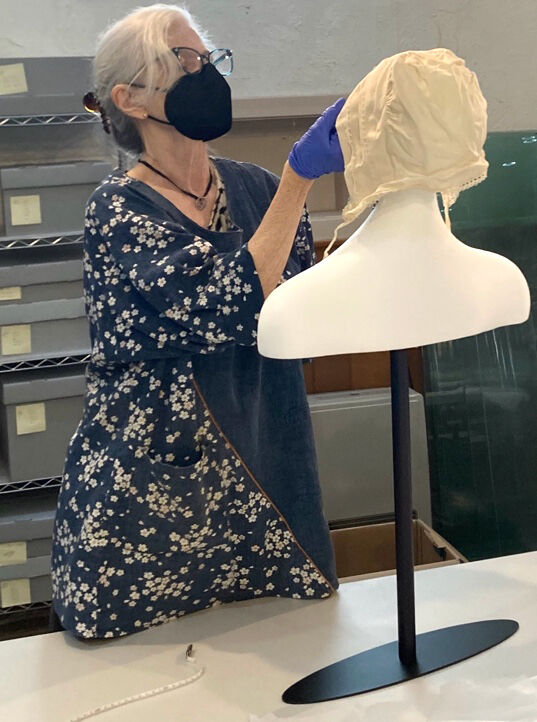
Conservator Wendy Jessup working to preseve the textile collection of the Hopewell Museum.,
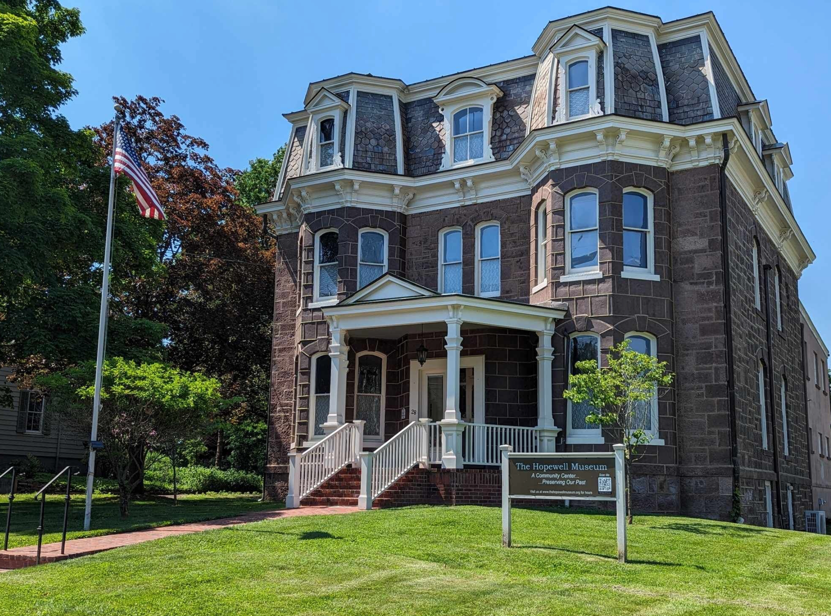
The Hopewell Museum.,

