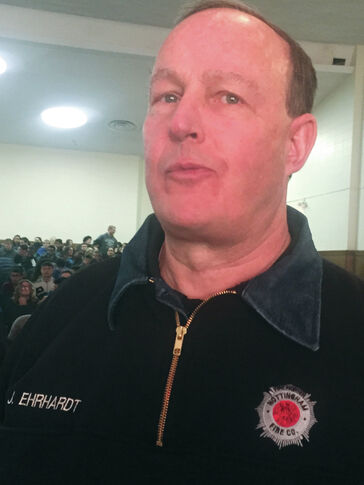
Joe Ehrhardt has always been interested in fire. Inspired by his neighbors growing up who were firefighters in Atlantic City, Ehrhardt became a Plainsboro volunteer firefighter in 1981, and continued to volunteer when he moved to Hamilton three years later.
But as someone who has spent his whole life surrounded by fire, he knows all too well the danger that it can bring.
“The issue about firesetting is that the most innocently set, curiosity fire could end up with death, injury and millions of dollars of destruction, which is primary motivation for me is to help [prevent them],” Ehrhardt said.
Ehrhardt is a member of the Mercer County Youth Firesetter Intervention and Prevention Program. The goal of the program is to reduce the fire setting activities of children and teenagers by a process of identification, education and treatment. The program is comprised of committee members from fire services, law enforcement, child welfare agencies and mental health professionals.
Ehrhardt has a drive to help others. In addition to being a volunteer firefighter, he worked in the Middlesex County Juvenile Justice System for 22 years.
“I have a passion about trying to make kids not be part of the juvenile justice system, and I have a passion about helping families have better lives, and this is an issue that can destroy a family in moments—even though families don’t always recognize that,” he said.
The Mercer County Youth Firesetter Intervention and Prevention Program was first started in the 1980s by Captain Quinton Patterson, a Trenton firefighter. However, after Patterson died there was a reduction in staff and a loss of personnel and the program fell to the wayside.
“Basically, Mercer County has not had an active program for, I would say, the last 15 years,” Ehrhardt said.
Ehrhardt had previously worked with fire prevention programs across the state, and was the ideal candidate to revamp the program in here in Mercer.
When he retired, he worked with Nottingham Fire Company fire marshal Scott McCormick, Mercer County Division of Youth Services chief Robert Taylor and other officials to restart the program in Mercer County.
“Joe is resurrecting the program so we have one again,” Det. Sgt. Lloyd Mathis of the Mercer County Prosecutor’s Office said. “He’s well known regionally and within the state for his involvement in the juvenile firesetters programs.”
Mathis is in charge of the arson investigation unit for the county prosecutor’s office and works closely with the youth firesetter program. He said the prosecutor’s office often sees the damage that can be done by young people playing with fire, and therefore he has a vested interest in ensuring the reborn program becomes a success.
The program first launched in Hamilton three years ago, and in March they began to spread the program across the county. Ehrhardt said he’s now helped children from every town.
“In March we held the first county-wide meeting,” he said. “We’ve had a very good response. Right now we have about 90 percent participation from the fire departments in Mercer County.”
The program finds most of the children by working with different government and youth agencies. The agencies work with the child’s family on different issues and will recognize when the child has an issue with firesetting. Sometimes, the families go to local fire services themselves after seeing their child become enthralled with fires, and they are then connected with the program.
No matter how the children first get into the program, Ehrhardt said it is a critical first step in solving their problems.
“Youth firesetting does not go away unless there’s a definite intervention,” he said.
Ehrhardt explained that without the intervention a child could start a fire—even with innocent intentions—that could be destructive or even deadly.
The sentiment is echoed by Mathis, who is also a volunteer firefighter. Mathis still remembers the details of the first fire he responded to while working with the county prosecutor’s office. A small child was killed in a blaze started by his cousin, who was playing with matches.
“You never forget those kinds of things,” he said. “You remember them very clearly. That’s why people have passion for the work that they do with the program. Literally, there are lives in the balance, and not just the lives of the people starting the fires, but the firefighters as well.”
He continued, “That’s why I think Joe is so passionate because he understands the risks in not having juvenile firesetting intervention.”
The committee determines how to intervene by using a national youth screening tool developed by medical professionals. The screening tests determine the child’s risk level for using fire in an inappropriate way, and an intervention plan is mapped out using the results.
Ehrhardt said the intervention method varies depending on the individual child’s needs, but there is always a fire safety education element for the child and their family.
In many cases, educating the family on important fire safety is just as important as educating the at-risk child. Ehrhardt said many family members don’t think twice about leaving out matches or candles, but not locking them up away from children—especially when they’re young—can make all the difference.
In more extreme circumstances, the committee will work with the juvenile justice system to address the needs of that specific child. The committee will also work with special needs children, who may have a harder time understanding fire safety.
Mathis said the program also provides the courts with an alternative option to incarceration for juvenile offenders. In some cases, the courts have the option to assign children to the firesetter program, and if they complete all areas of the program then they won’t face time in jail.
“Anytime you have programs that are optional for the courts to use rather than incarceration, that’s always going to benefit those that are involved,” he said.
Ehrhardt said there are many factors that lead to youth fire setting.
In children, it often starts simply as curiosity. While Ehrhardt said it’s common for children to be curious about fire, they need to understand the damage fire can cause and never be left unsupervised with lighters, candles or other firesetting tools.
“If there’s no intervention it grows and grows and grow, it becomes an escape from a lot of things,” he said.
Ehrhardt has worked with children who start lighting fires as a way to get attention from their families or outside members of the community. In those cases, the program works to provide the child with more than just fire safety training.
Ehrhardt said he once worked with a child whose friends convinced him to set off fireworks in a dangerous area.
“The situation did cause a fire,” he said. “The family could have lost their home, but they did not because the fire department was called.”
In addition to firesafety education, the child got involved in recreational activities through the township and he stopped using fire in a destructive manner. Ehrhardt said getting children involved with outside counseling or activities has a 90 percent success rate for preventing their negative behavior.
“It was the involvement of him with other things got him in the mindset that he didn’t need negative attention, he was getting positive attention,” he said.
According to the Office of Juvenile Justice and Delinquency Prevention—which is a branch of the U.S. Department of Justice—more children are arrested for arson than any other criminal act. Of those children arrested, 57 percent were younger than 15.
Ehrhardt is unaware of how many of the fires started in Mercer County are caused by at-risk children because they often go unreported.
“If you live in an apartment complex and you let people know that your child is setting fires, you’re going to get evicted,” he said. “If you live in a duplex, the neighbors are going to get up in arms. There’s a certain shame to it.”
In an effort to reach as many children as possible, the program doesn’t just educate at-risk children. They have organized a fire education program for middle school students and their families, and they hold fire safety assemblies in high schools. Many fire stations also bring pre-K students to the station to teach them safe fire practices.
,

