Every year, seniors in Steinert High School’s Government and Law Related Experiences class—GALRE—look forward to the first week in March, when they get to spend three days in Washington seeing how the federal government works up close.
In 1991, Jim Tymon was one of those lucky 12th graders. Operation Desert Storm was just ending, so the White House was off limits. But GALRE students, led by teachers Doug Martin and Barbara Hunt, met with Rep. Chris Smith, got “briefed” by a Pentagon official, visited the Capitol and the Supreme Court, and got glimpses of the Declaration of Independence, Constitution and Bill of Rights under glass in the National Archives, among many other things.
The experience is enlightening for most students. For Tymon, 43, it was also formative. He decided to study economics, political science and public policy at the University of Delaware having been bewitched by Washington on that trip. After completing his bachelor’s and master’s degrees at UD, he moved to D.C. to take a job with the Department of Agriculture.
He’s been a fixture in Washington ever since. For the last three years, he has been chief operating officer and director of policy and management for AASHTO, the American Association of State Highway and Transportation Officials. He’s also worked in the White House and spent 11 years on Capitol Hill as a staff member for the House Transportation and Infrastructure Committee. There, he helped to shape federal policy under three chairmen, rising to the role of senior adviser and playing a key role in the development of major transportation bills signed into law in 2005 and 2012.
His experience both on the Hill and now as an executive with AASHTO gives him a policymaker’s perspective on transit issues facing states right now. Like New Jersey’s 23-cent gas tax increase, which went into effect Nov. 1, and the recently passed Public Question 2, in which voters were asked to decide if gas tax revenues should be dedicated to funding transportation projects.
As COO, Tymon manages the day-to-day operations for AASHTO, which works with Congress and the Department of Transportation as they develop policies and legislation that will have an impact on state DOT’s. AASHTO is in turn advised by a board of directors consisting of chief transportation officers from the 50 states, Puerto Rico and the District of Columbia, as well as transportation personnel from across the country who help AASHTO to set national standards in terms of transportation planning, design, construction and maintenance.
Tymon was with AASHTO last December when President Barack Obama signed the latest major transportation bill, the Fixing America’s Surface Transportation Act, into law. The FAST Act should provide $305 billion in federal surface transportation funding through 2020, and knowing that the money is coming allows state DOT’s to get serious about future projects, Tymon said.
While the year-to-year increases aren’t much, Tymon said, state DOT’s and other local transit agencies like the long-term predictability the FAST Act provides. “Projects that you see under construction have been in the design and planning phase maybe five, 10 years prior to putting a shovel in the ground,” he said. “It takes a long time to secure permits and approvals for construction projects. If you’re not sure where that next dollar is going to come from, it’s hard to put money into a major project.”
* * * * *
Gas tax increases are never popular. They’re so unpopular, in fact, that Congress hasn’t raised the federal gas tax in more than two decades. But with the nation’s aging roads and bridges ever more in need of repair, that inertia has been felt by DOT’s across the country.
Inflation has also played a role. The federal gas tax, raised to 18.4 cents per gallon in 1993, is worth just 11.5 cents in today’s dollars, according to the U.S. General Accounting Office, which has labeled funding for the nation’s surface transportation system a high-risk issue. Add in other factors, including greater average fuel efficiency for today’s cars—meaning drivers are paying less to go farther—and you have the makings of a budget shortfall that states have little choice but to address.
So they are taking matters into their own hands. In a lot of cases, Tymon said, gas taxes are the most efficient way to generate the revenue needed to balance transportation budgets. From time to time it becomes necessary to raise them.
“A lot of what you see at the state level is cyclical,” he said in a recent phone interview. “The states you’ve seen in the last four, five years that have increased state gas taxes hadn’t seen an increase in a while, so they were due.”
Alternatives to gas tax increases, like new tolls and toll increases, are also unpopular. That’s why states have looked for ways to ensure that gas tax revenues go to transportation projects. New Jersey put its amendment question on the ballot in an effort to do just that.
Tymon said that AASHTO doesn’t have data yet to show whether “lockbox” measures like the one New Jersey voters approved on Election Day are effective. But they are tracking which states have them and which don’t with the goal of determining how well they work.
“You’ve got to be careful. If you’re out there making a case for revenue increases for transportation and you don’t have that revenue protected, those projects you’ve promised to do may not materialize,” he said.
Down the road, Tymon said, states could adopt a new revenue-generating model in which motorists are charged for the miles they travel. “It’s being considered and debated, but it’s probably not an idea that’s ready for prime time,” he said. “Until there’s widespread acceptance of that as an option, a gas tax is probably the best option we have.”
* * * * *
Tymon met his wife, Kara, at the University of Delaware, where they were both on the track and field team. They have been married for 15 years, and live in Silver Spring, Maryland, with their twin eight-year-old daughters, Reagan and Rylee.
His parents, Jim and Judi, still live in the house he grew up with on Flock Road. Sister Aimee Turnbull is a guidance counselor at Steinert High School, and sister Meridith Wolski does social work for the school district.
‘You have a front row seat to see how the legislative process works.’
He did not necessarily intend to make transportation his field. He went to Washington in 1997 having been accepted to the two-year Presidential Management Fellowship program. As a fellow, he was placed in the Department of Agriculture, where he worked on food assistance programs.
At one point during the fellowship, he was temporarily rotated to the White House Office of Management and Budget, where he worked on transportation issues for the first time. He enjoyed the challenge of trying to solve budget issues, and liked the work’s fast pace.
After the fellowship was up, he took a full-time job with OMB, working there for three years. He began to become an expert in transportation budgeting and policy, and in 2002, he joined the staff of the Transportation and Infrastructure committee, eventually rising to staff director of the Subcommittee on Highways and Transit.
Tymon worked for Don Young (R-Alaska), the chairman of the House Committee on Transportation and Infrastructure, until 2007, when Democrats took control of the House of Representatives and Democrat Jim Oberstar of Minnesota became the chair. During that time, he worked as a staff member for John Mica (R-Florida), the ranking minority member of the committee.
When the Republicans retook control of the House in 2011, Mica became chairman of the committee, and Tymon restored as subcommittee staff director. Mica was succeeded by Bill Shuster of Pennsylvania in 2013, with Tymon continuing in his position.
Working for a House committee he said, is a job unlike any other.
“You’re working with members of Congress as they put together pieces of legislation,” he said. “You’re trying to negotiate out pieces of legislation with your counterparts on the other side of the aisle. If you’re able to get a bill through the House, then you find yourself sitting across from your counterparts on the Senate side. It’s really an amazing experience, humbling yet extremely rewarding. You have a front row seat to see how the legislative process works.”
Tymon said the chairmen he worked for all felt strongly about providing states with as much flexibility as possible when creating and administering federal programs. “That was a philosophy I agreed with, so it made it very easy to work with those members of Congress,” he said.
When Shuster took over as chair in 2013, he made Tymon his senior adviser in addition to his staff director responsibilities. Tymon enjoyed working with Shuster, but the job with AASHTO was too good to pass up.
“It provided me with a new challenge, and AASHTO’s policy positions matched up well with the issues I had worked on while I was on the Hill,” he said. “At that stage of my career, I don’t think I would have left the Hill for any other job.”
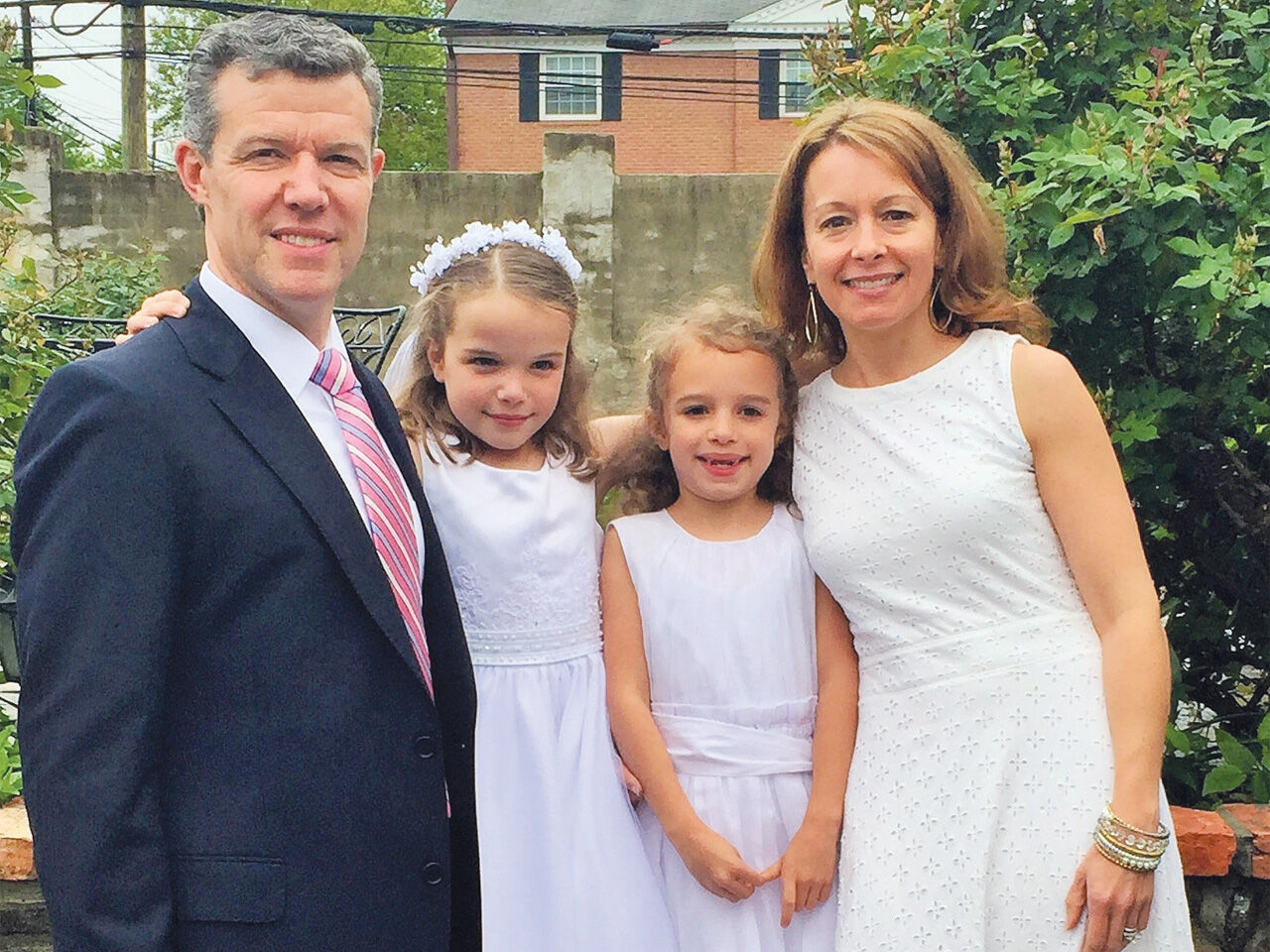
Jim Tymon with wife Kara (right) and daughters Reagan and Rylee.,

