A career that involves making stressful decisions and hearing insults from angry audience members probably doesn’t sound desirable to most people.
But it does to Rob Riley.
The Hamilton native has ascended the basketball refereeing ranks, from making $11 per game officiating Hamilton Little Lads matchups all the way up to Division I hoops, where he currently works.
Longtime friend and fellow referee Tom Carr, who was recently selected as the Colonial Valley Conference Official of the Year, has watched Riley nearly every step of the way. As a 12-year-old, he used to go to local games just to watch Riley man the court.
“He definitely inspired me,” said Carr. “You knew Rob was pretty good even back then. At that age I was no expert on reffing, I just could tell the basic murdering foul. But I thought, ‘Man they’re always yelling at the other guy, but they don’t say a word to Rob.’ I didn’t know the nuances of reffing, but after a while you knew Rob was different, better than anybody else.”
That was in 1985—Riley was 23 at the time—and 30 years later, he has proven Carr’s assessment accurate.
This season, he is a regular official for nine different conferences, including the Big Ten, Big East, Atlantic 10, MAAC, Northeast, Ivy, Patriot, America East and American Athletic. He has officiated NCAA Tournament games the past four years, which gave him the opportunity to meet President Barack Obama and British Prime Minister David Cameron.
It all stems from a love of the game of basketball, which Riley played until graduating from Steinert in 1980. He wanted to stay involved with basketball, and figured being an official was the way to go. After taking his test, he began working recreation, middle school and high school freshman games.
“It was just a way of grabbing a few bucks,” Riley said. “I wasn’t thinking about where it could take me, I was just staying involved.”
He coached his son Rob in youth basketball and quickly realized that it wasn’t for him, so he continued to focus on officiating. He eventually moved on to the Trenton Unlimited League at Trenton’s Cadwalader Park, which was one of the premier summer leagues in the state. By 1985, he was working high school varsity games, and he was hooked.
“I really enjoyed it,” Riley said. “I knew right away it wasn’t like work. I couldn’t work enough.”
That was when he began taking Carr to games. The boys’ parents were good friends, and used to play cards at each other’s houses on Friday nights.
“You knew Rob was really good, it was just a matter of him getting a break, and he was gonna move on,” Carr said. “Sure enough, he did.”
It took some time and patience, though. After watching fellow Hamiltonians Rich Giallella and Jeff Plunkett work college games, Riley wanted to go that route. He joined the College Basketball Officials Association and began doing Junior College and NCAA Division III games.
The next goal was Division I, but Riley wasn’t looking forward to the camps that generally provided that step. After doing JUCO and D III for about five years, he decided to attend the Northeast Conference camp.
“They’ll bring in 60, 70 officials and hire three or four guys,” Riley said. “I went to that camp, and didn’t get in.”
He continued to excel at his levels, however, and was asked to officiate national championship games in both Division II and III. Still reluctant to attend D-I camps, Riley was hoping that would be enough to get him noticed, but it wasn’t working out.
“He’d say, ‘How’s this guy getting Division I games, and I’m not?’” Carr said. “He was getting a lot of games, but was frustrated why he couldn’t take the next step.”
By 1998, Riley had grown disillusioned and told Bob Pugh, who was in the charge of JUCO officials, that he was getting out of the profession.
“I was just getting frustrated,” Riley said. “Part of it was me not going to camps. Some of these guys were going to four or five camps a summer. When I called Bobby to tell him I was resigning, he said ‘Do me a favor, go to these two camps: the MAAC and the Ivy/Patriot League camps. If you don’t get in, then fine, re-think it.’”
Riley attended both camps in 1999. Soon after, MAAC supervisor Brad Tracy offered him a contract. Two weeks later he also got picked up in the Ivy and Patriot leagues, and he was on his way.
Riley added the NEC to his resume and eventually caught the eyes of some influential people. He was asked to attend the invitation-only Big East Camp when the Big East was the nation’s premier conference. Riley went to Pittsburgh to work high-level AAU games and got plenty of compliments. He came home certain he would be hired from among the 22 invitees, but it wasn’t to be.
He did something right, though, as the Big East invited him back the following summer. This time, Riley was hired for the 2009-10 season and has been there ever since. When the Big Ten added Rutgers and Maryland last year, the conference called asking Riley to do games, and he is now in demand all over the place.
“It’s been a pretty good ride,” he said.
Riley, of course, had to show he belonged. Part of that was not being intimidated by or in awe of legendary coaches like Rick Pitino, Tom Izzo and Jim Boeheim.
“Just the environment and going into those big arenas was pretty overwhelming,” he said. “I remember going to Connecticut and (Jim) Calhoun walking in and the place going crazy. I’m like ‘Oh man, this guy’s like a god.’ That happens for a little bit, then you’re just going in and not thinking about it much.”
That’s not to say he doesn’t appreciate it. When it comes to seeing the arenas at schools like Michigan State, Wisconsin and Indiana, Riley admitted that sometimes he is both an official and a fan.
But he doesn’t let the moment overwhelm him. Perhaps the only time that happened was in Riley’s first NCAA game on March 14, 2012 when he did the Western Kentucky-Mississippi Valley State play-in game in Dayton, Ohio. Western Kentucky won 59-58.
“I was terrible in the game,” he said. “I’ve worked a ton of games since then and before then, and I was never more nervous. It was really nothing I’ve ever felt. I watched tape and looked back and thought, ‘Man, I was terrible.’ But it was really a neat experience.”
It was made even neater by the fact Riley shook hands with two world leaders at the game: Obama and Cameron.
“The head of the NCAA Tournament said, ‘Make sure you go over and shake the president’s hand,’” Riley said. “I’m not a big Obama backer, but it really was a great experience.”
As for his self-described “terrible” performance, he couldn’t have been that bad, as Riley has done a first-round game the past three years. In 2013, he handled a huge first-round upset when 13th-seeded LaSalle beat 4th-seed Kansas State.
In a game of such magnitude, Riley made sure the moment didn’t get the best of him.
“That’s one thing about officiating, once you get on the court and you get into it, even when you get started and there’s a packed house, you get the nerves out and you just ref,” he said. “You’re not thinking ‘LaSalle could upset Kansas State,’ you’re just making sure your calls are right.”
Although he has only done first-round games, Riley was the stand-by for last year’s Notre Dame-Kentucky Sweet 16 game, and is hoping to get a later round game one of these years. For now, he notes that just 96 officials are asked to do the NCAA Tournament each year, and he takes pride in the fact he is one of them.
And just as the pressure increases on big-time coaches and players, the same happens with officials. Riley said most of the legendary coaches are pretty fair when dealing with refs.
“These guys are making big livings, so if your calls are right, they’re good,” he said. “Some guys get a little sour but for the most part they’re fine. Sometimes a coach is struggling, and they’ll say ‘I’m fighting for my job,’ and your response is ‘I’m fighting for my job, too.’ You have to be able to take it. I tell young guys you have to be a good self evaluator—know when you’re wrong, and admit when you’re wrong.”
The pressure is magnified with practically every major conference game being televised and the fact that the profession has gotten so competitive due to high paychecks officials now receive.
“This has become a big business and we do really well,” Riley said. “You’ll have some sleepless nights. You screw something up, and you wait a few days for a supervisor to call and you’re answering questions. It’s great, but you’re not leaving the arena and never thinking about a call you made again. You can’t get too many calls wrong. I’ve seen guys end up on Sports Center, you feel bad for those guys.”
Riley knocked on wood as he said that hasn’t happened to him yet.
Carr feels the difference between Riley’s level and other officials is that the big-time refs are able to see things that other people might miss with a game moving at a faster pace.
“I’m not saying they don’t miss calls, but they see things a lot more than an average referee sees,” Carr said. “They also communicate very well. They’re getting yelled at by a big time coach, they know how to talk to a coach. They’re not just spouting things off, they know what happened, they know what their answer is. They stay out of fire, they don’t make things up, they call a game and move on.”
Carr and Riley’s son are both officials with International Association of Approved Basketball Officials Board 193. Rob Sr. has stayed involved with his roots as the IAABO 193 assignor. He is also the state assignor for state tournament games from the quarterfinals on to the Tournament of Champions. Riley proudly notes several of the CVC refs are doing college games, including his son, Carr, Steve Lewis, Wayne Irons, Matt Wolski and Sean Fitzpatrick.
“At the high school level you’re just starting out, you have to be professional, be responsible, make sure you’re there,” Riley said. “You’re not going to worry about a tape getting broken down and making a wrong call but you have to worry about getting a rule wrong. Then I can’t defend them.”
Riley gets a lot of feedback on the local refs from coaches and other officials, but he will try and make games when possible.
“We always joke about Rob and how stern he can be,” Carr said. “He’ll come in the locker room and he won’t tell you how good you looked, he’ll come in and tell you five things you did wrong. On the court he’s the same way. When he needs to address something with player or a coach, he’s strong enough to address it. He’ll also be strong enough to listen and move forward.”
It’s that kind of attitude that has had Riley moving forward in the profession for the past 16 years.
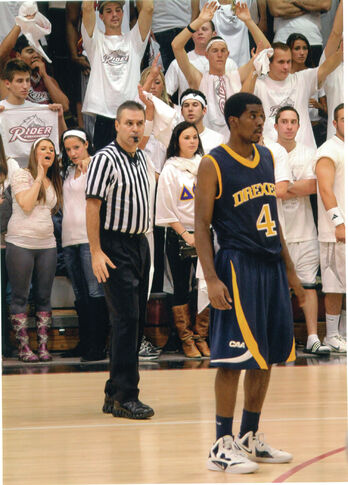
Rob Riley works a Rider-Drexel men’s basketball game in Lawrence Nov. 15, 2011.,

