
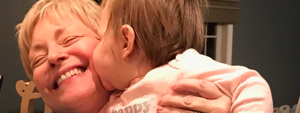

Barbara Tafrow Gerrity was barely two years old when Denver surgeon Thomas Starzl pioneered the world’s first liver transplant using a liver from a deceased donor.
Starzl lost his first patient, but never gave up the pursuit of refining an operation which could help save lives. He died in 2018, at the age of 91, leaving behind a wealth of knowledge contained in over 3,000 papers on the subject.
Fast forward 60 years, and Gerrity, who lives in Mercerville with her husband Jim Gerrity, now finds herself patiently waiting for her own liver transplant. She will benefit from the research Dr. Starzl left behind; but she hopes to take advantage of innovations which now allow a liver donation from a living donor.
She has a transplant team in place at the Penn Liver Transplant Program in Philadelphia. All she needs is one donor.
Gerrity has been diagnosed with fatty liver disease. The problem can be linked to diet. In Gerrity’s case, she said she was feeling poorly, but never knew her ailments might be connected to her liver. Finding a definitive diagnosis took time.
“I knew I had a fatty liver,” Gerrity said during an interview. “Doctors think I have had it for at least 20 years. I would go for blood tests, and my liver enzymes were elevated; but, the doctors didn’t think anything of it. “Then when I would return for follow-up blood tests; the results would be normal.”
Consequently, there seemed to be nothing to treat, or so Gerrity thought.
“I have learned the hard way, you have to be your own advocate,” Gerrity said. “You have to ask questions.”
Eventually, her local gastroenterologist noticed some trends with her liver enzyme tests.
“He suggested that she get to know the liver transplant team at UPenn’s Penn Medicine, she said. That suggestion, which happened pre-pandemic, turned out to be good advice. By March of this year, her Penn Medicine Liver Transplant team suggested she start looking for a living liver donor.
Since March 29, when she entered the National Kidney Registry, Gerrity now finds herself on a mission she never planned for.
“I am on the list for a deceased donor,” she said; “but I am also searching for a living donor.”
Living or deceased donor
While Dr. Starzl, as the pioneer of liver transplants, worked on transplanting complete livers from deceased donors here in the U.S., by the 1980s, physicians in Europe had started transplanting portions of livers from deceased donors in children.
In an interview, Dr. Kim Olthoff, chief of transplant surgery at Penn Medicine in Philadelphia, noted that doctors realized “children were smaller, and there weren’t many pediatric donors,” so the European physicians experimented with transplanting a portion of a decedent’s liver in a procedure which would come to be known as a “reduced-size liver transplant.”
As physicians learned more, the transplantation of livers moved into a split liver phase, where the larger segment of a liver went to an adult, and the smaller portion to a child. According to a 2005 research article in the British Medical Bulletin, split liver transplantation significantly reduced the wait time for children needing new livers “to zero.”
The next phase in liver transplantation involved the transplantation of a portion of a liver from a live donor to a recipient. The same British Medical Bulletin article noted “the first successful living donor liver transplantation was performed in a child in 1989 in Brisbane [Australia] and in an adult in 1994” in Japan.
The beauty of the liver, Olthoff said, “is that it is made of segments. And those segments each have their own plumbing, so to speak — bile ducts — which helps to detox the body.
Allow me to walk you back to your high school biology or health class. Here is an explanation of the liver’s anatomy from Columbia University School of Medicine: “The liver consists of four lobes: the larger right lobe and left lobe, and the smaller caudate lobe and quadrate lobe. The left and right lobe are divided by [a] ligament, which connects the liver to the abdominal wall.” The smaller ducts flow toward a common duct, which “drains bile from the liver.”
But the glory of the liver doesn’t end there. The liver has the ability to heal and restore itself. Olthoff said that the liver “is the only organ that has cells which can regenerate and grow. You take the right lobe out, the left lobe gets bigger.”
The ability to transplant a portion of a living liver to a recipient-in-need revolutionized liver transplantation surgery for at least one very big reason. Waiting for a liver from a deceased donor means the sickest patients are the first to get an available liver.
With a live donation, a person in need of a liver transplant is likely to get a liver sooner and thus have a better postoperative outcome.
That’s why Gerrity hopes a living donor will come through for her.
“The donor’s liver would regenerate,” Gerrity said. “I would get that piece of liver and that would regenerate in my body. It’s better for me. It’s a planned surgery as opposed to waiting by the phone for a call about a deceased donor.”
And while Gerrity has some time, she is hoping to find a donor sooner than later because she knows the sicker she gets, the harder it will be for her to bounce back from surgery. She can already see that her condition is deteriorating.
“I get tired,” she said. “I have leg swelling. I have some jaundice. My muscles have weakened. I have some of the early symptoms. It’s only going to get worse. It’s not going to get better.”
* * *
Gerrity attended Kuser Elementary School, Our Lady of Sorrows, and she was part of the high school class which started at Nottingham High School, but ultimately graduating from Steinert in 1979. She earned an undergraduate degree in business administration from Trenton State College (now TCNJ) in 1983. She then lived in Irvine, California—a sweet time when she and a friend worked and played on the West Coast. She came back East after six years to be closer to family.
Gerrity’s husband, Jim, attended St. Raphael’s school and St. Anthony’s High School. He earned an associate’s degree from Mercer County Community College in Computer Science, and worked at NJTransit’s Corporate Office in Newark. They met late in life, and have no children. They are both retired.
Gerrity worked for many years in Philadelphia for the accounting firm KPMG, accepting a retirement package in 2021. Yet despite having moved on, when former coworkers learned she needed a liver, they stepped up to help.
“The company sent out 1,400 emails,” she said. “I was fortunate that the company would do that for me.”
Those emails are just a part of a campaign Gerrity is running on behalf of her health. “I have been trying all sorts of communication options–church bulletins and [lawn] signs,” Gerrity said. She is on two transplant registries–UNOS (United Network for Organ Sharing) a nonprofit organization under contract with the US. .government, and the National Kidney Registry.
“I am hoping to get a liver before November or December,” Gerrity said. “It only takes one person. I have people who have registered, but because of HIPAA laws, I can’t know anything,” she added.
Some of her Mercerville neighbors have seen her lawn signs and have stopped to talk to her about what is happening with her health. She hopes those visits will help spread the word of her need.
“For me, it’s the only thing I think about 24/7. Am I doing enough? Am I getting the word out? This is a full-time job in and of itself.”
* * *
The surgery for donor and recipient happens on the same day, at the same time, and can take anywhere from six to eight hours, according to the Penn Medicine Liver Donation Program. Donors are typically in the hospital for five days; then depending on the nature of the donor’s profession, the donor can return to work in six to eight weeks. The recovery for Gerrity will be longer and more complicated.
According to Olthoff, living donations provide the best possible outcome for a patient in need of a liver. She added that the donor will get the “most complete physical workup you have ever had.” Potential donors “get imaged; they get a cardiac workup. We want it to be safe for the donor” and the recipient.
People interested in becoming a living donor for the Liver Transplant program can read more about donor qualifications and the transplant process on the site for the Penn Liver Transplant Program. The basic registration requirements include being between the ages of 21 and 50, and being physically fit with no health problems. The donor must also have health insurance. Donors hoping to donate to a specific person, like Gerrity, must have a blood type compatible with the recipient.
Readers can learn more about how to register to donate to Gerrity on her page posted on the National Kidney Foundation site.