Three teenagers from the most devastated neighborhoods in 1980s Newark, Rameck Hunt, George Jenkins, and Sampson Davis met at University High School, a magnet school, and while juniors in high school made a mutual pact that would change their lives.
Through that mutual support, all three made it through Seton Hall University’s Pre Medicine/Pre Dental program and the University of Medicine and Dentistry of New Jersey.
The three doctors are coming to Hamilton Saturday, Sept. 15 to share their story at an event called Mentor Day, where students from grades 6 to 12 and their parents will get to hear from the doctors about the challenges they faced and how they overcame them. The students will also work with mentors from the community while their parents go to “Ed Camp” to learn about what they can do to help their children succeed.
“We are hoping it offers them that window into something they don’t ordinarily see in their everyday lives—a career path, a schooling path—seeing things outside the scope of their normal existence,” said Heather Lieberman, one of several members of the Hamilton Township Board of Education’s District and Community Relations Committee who spearheaded Mentor Day.
The event takes place from 10 a.m. to 4 p.m. for mentors, 11 a.m. to 4 p.m. for students and parents, at Crockett Middle School.
The organizing committee still are looking for potential local mentors to help with the event.
“We are looking for a variety, from teachers to college professors, to tradesmen, to engineers, to people who are working in technology,” Lieberman says.
Hamilton Township students can register at the district’s website, hamilton.k12.nj.us, or by emailing mentorday@hamilton.k12.nj.us. Students outside of Hamilton Township, can register by emailing windy@threedoctorsfoundation.com.
The doctors will be the stars of the show, though.
‘I made a dumb mistake that almost cost me my life. I just knew this is not the life I wanted.’
Davis, now a board certified emergency medicine physician at several emergency departments in New Jersey, grew up in Newark in the 1980s, not too long after the Newark riots.
“It was transformed from a place where a lot of people lived to a place where people were exiting; all that was left was high rises, struggles, and challenges,” he says. “All I saw was people on drugs and in poverty; I didn’t feel a sense of value because of what I was surrounded by.”
Although Davis says that on some level he had “this sense of a better life,” he realized “that I didn’t know how to get to that other place where I was trying to go.”
“I got caught up in a lifestyle, trying to become a young man and doing that without blueprint. My dad was not at home, and I was arrested for robbery at 17 and a half,” Davis says.
But the stars were on his side. “I was adjudicated as a youth; it was my very first major offense with the law; and the jail systems were overcrowded,” he says, “so I was able, through sheer luck to get a two-year sentence that was suspended.”
“If I was six months older, if I was in any other community besides the inner city, if you were in a suburb, middle America, or rural America, you would go to jail—there’s no probation for robbery.
“I’m not excusing it,” Davis says. “I was unaware, impressionable, young, and I made a dumb mistake that almost cost me my life.” But while he was sitting in juvenile detention, he continues, “I just knew pretty confidently this is not the life I wanted.”
Looking back on the childhood that led him off the path to a positive future, he says, “I was put in a misguided situation. No child should have to choose between bad and worse; they should have an opportunity to see the good, to understand the possibilities that exist.”
Because that opportunity was missing from the lives of the three friends, as first-year residents they decided to start the Three Doctors Foundation to create a platform for reaching out to children who face the same challenges they did and let them know that they too can make it.
The absence of mentors in their own lives was another motivation for creating the foundation. “We were trying to figure it out as we went along, trying to step out on faith. We bumped our heads a lot because we didn’t have guides,” Hunt says.
At Mentor Day events elsewhere, kids have responded to the three doctors because they see them as authentic.
“I’ve lived the struggles and obstacles they are going through today,” Davis said. “I grew up years before, but the challenges are still the same today: they are still facing financial hardship, academic hardship, community and environmental challenges. I wish all our schools were optimal and functional but that is not the reality; and family structure—it’s great if you have both parents in the home but even then that doesn’t guarantee that the home is functional.”
What makes the students accept the doctors as guides, Davis says, is that “we are now currently where they want to be.” And the students can see that “we are able to straddle both worlds—the world we came from and the world we live in.”
Hunt, now assistant professor of medicine at Rutgers Robert Wood Johnson Medical School and an internist at the University Medical Center at Princeton, also spent time in legal detention, on a charge of attempted murder. He shares with students why he thinks he ended up in that situation, and how he changed his life when fate set him free.
Trying to impress his neighborhood friends, while they were beating up a man they called “a crackhead,” he says, and Hunt took a knife out of his pocket. On the one hand, he didn’t want to stab the fellow, but on the other he didn’t want the other kids to think badly of him, so he decided to poke him, “and poking him with a knife ended me up with a murder charge.”
Teenagers are often confronted with split-second decisions like these that can change the trajectory of their lives—unless you’re very, very lucky, like Hunt was.
For kids like Hunt, who grew up poor, in a single-parent home in the inner city, these kinds of choices are common, and many end up in prison. Hunt did not.
But while sitting in juvenile detention, he thought to himself, “If I get out of this predicament, I am going to get things straight and get my life together.”
For him, that meant spending more time with his school friends, Sampson Davis and George Jenkins.
“We had just as much fun as with my friends in the neighborhood, with one exception, we didn’t get in trouble,” he says. That realization was for him “the beginning of me maturing and realizing your actions have consequences.”
When talking to students, Hunt tells them, “I always knew what the right decision was—you can feel it in your gut, in your heart,” and he urges them to “go with” what their gut tells them.
But Hunt also understands the circumstances they live under—because that was the life he lived. Where he grew up, friends meant survival.
“When you grow up in areas like I did, it is not like you can pick your friends,” he said. “My friends were people who lived in my neighborhood. You also needed friends for protection; it wouldn’t be safe if you decided not to hang around people.”
The story George Jenkins tells is a little different from those of his friends, and the assistant professor of the clinical dentistry section of adult dentistry at Columbia University attributes this in part to his third grade teacher, who “helped me early on to understand that if I wanted to do something, education would be a sure route to go.”
“She would talk about how smart we were,” he recalls, and would convince them by giving them challenging work, like doing elementary algebra and reading kids’ Shakespeare. She took them to Broadway plays and then had them perform them at school; and she shared detailed geographical, climate, and other information whenever she traveled.
Already “primed to look for my place in the world and not be discouraged by my environment,” he says, in fifth grade he was open to the knowledge shared with him by the resident dentist who worked on him at the New Jersey Dental School.
“He would show me his instruments, tell me what he was doing, and tell me about the classification of teeth and the components of teeth. When I would go back, he would quiz me on what we just learned.”
For Jenkins, the dentist’s mentoring meant “I want to be like this guy who is engaging me and telling me I’m smart.” Not knowing what it would mean to become a dentist or how much it would cost, Jenkins told anyone who asked that dentistry was his career path. He broached the idea for real when a college recruiter from Seton Hall’s Premedical/Pre-dental Plus Program for economically and academically disadvantaged high school students came to their school to talk about careers in medicine and dentistry.
Ironically, the three friends were considering not going to the seminar and instead shooting a few baskets in the gym. But when they nearly got caught, they sneaked over to the seminar. Before hearing out the guy from Seton Hall, Hunt was thinking of becoming a teacher and Davis of going into business, but listening to the recruiter changed Hunt’s mind.
“The things the recruiter was saying were just what I wanted to do,” he says. “I wanted to do something to help people; to teach; to have a meaningful job—something I respected and other people respected; to use my brains; and to be able to make a living.”
‘The feeling you get when you are giving back and doing something for something like that is priceless.’
That afternoon the three teenagers spontaneously decided they would go to Seton Hall together and pursue medical careers.
“Had we thought about what it would take,” observes Hunt, “we probably would have been discouraged then and there.”
Although Jenkins had the same choices as his two friends, he managed to avoid any problems with the law because “I was so clear I wanted to go to college from all that conditioning, and I didn’t want to make it any harder than it was—so I could avoid peer pressure.”
But Jenkins faced his own problems along the way. He got serious cold feet between college and dental school, anxious about whether he could handle the next step, and he thought about instead becoming a dental technician. But because Hunt and Davis had been allowed to begin taking medical school courses during their senior year in high school, Jenkins says, “I got to see their successes and that gave me the information to say, ‘I can do it too.’”
Hunt recalls his experience of shaky finances in college, where he was on the dean’s list, but couldn’t register for classes and even was “threatened to get kicked out” because he hadn’t paid his tuition.
At Mentor Day, the doctors share those experiences, the obstacles they faced, and how they overcame them.
One thing they talk about is what it meant to be the first in their immediate families to go to college and about their own “apprehension, insecurity, and uncertainty.”
The doctors encourage mentors of different races, genders, ages, and creeds to participate to reflect the diverse workplace the students will enter. And Davis points out that the day not only benefits mentees, but also the mentors who “give back, impart wisdom, and a shape young person’s mind to serve as a catalyst for that young person to become what they want to become.”
During the mentoring session, students sit at round tables with mentors from the community. The students may have specific questions or not. Davis said he hopes that “a lot of organic connection will occur” between mentors and students that “will spark someone regarding career choices, aspirations, or hopes they have never perceived that will be born that day.”
The doctors also offer advice specifically to parents, the most important being to “make sure that they are involved—things we may not have had,” Hunt says. This means not only playing a part in their kids’ lives, but in their education. Parents need to be involved all the time—going to PTA meetings, checking homework—“if you only say something when the report card comes, or not even that,” Hunt says, your child will get the sense that you don’t care about their education.
Hunt also tells parents and kids that each individual has different strengths, and “being smart” means knowing what it takes to succeed.
Although the doctors have no hard data on their success, Davis cites the experience of a current foundation volunteer, Zayna Allen, now a college graduate, who told him that the mentoring “opened up possibilities in her mind. We allowed her to know her dreams could be turned into a reality.”
The foundation now offers a small book scholarship for students who went through Seton Hall’s pre-med program, but they are planning in the next couple of years to establish tuition scholarships.
“We call it a ‘pact scholarship,’ where kids make a pact in order to support one another through school; their scholarship will depend on one another so we can foster them supporting one another,” Hunt says.
The foundation continues to make a difference in the doctors’ own lives. The foundation, Jenkins says, “is a balancer for me. It puts life into perspective for me when I see the rat race but I have so much going on with trying to improve people’s lives.”
Hunt, explaining why he finds giving back so important, says, “The feeling you get when you are giving back and doing something for something like that is priceless, especially when you impact somebody else’s life. People say [to us], ‘I might have been dead, now I’m a lawyer.’ We literally save people’s lives, and that feeling is so rewarding. We really enjoy doing it—it’s not hard work. It’s better than money.”
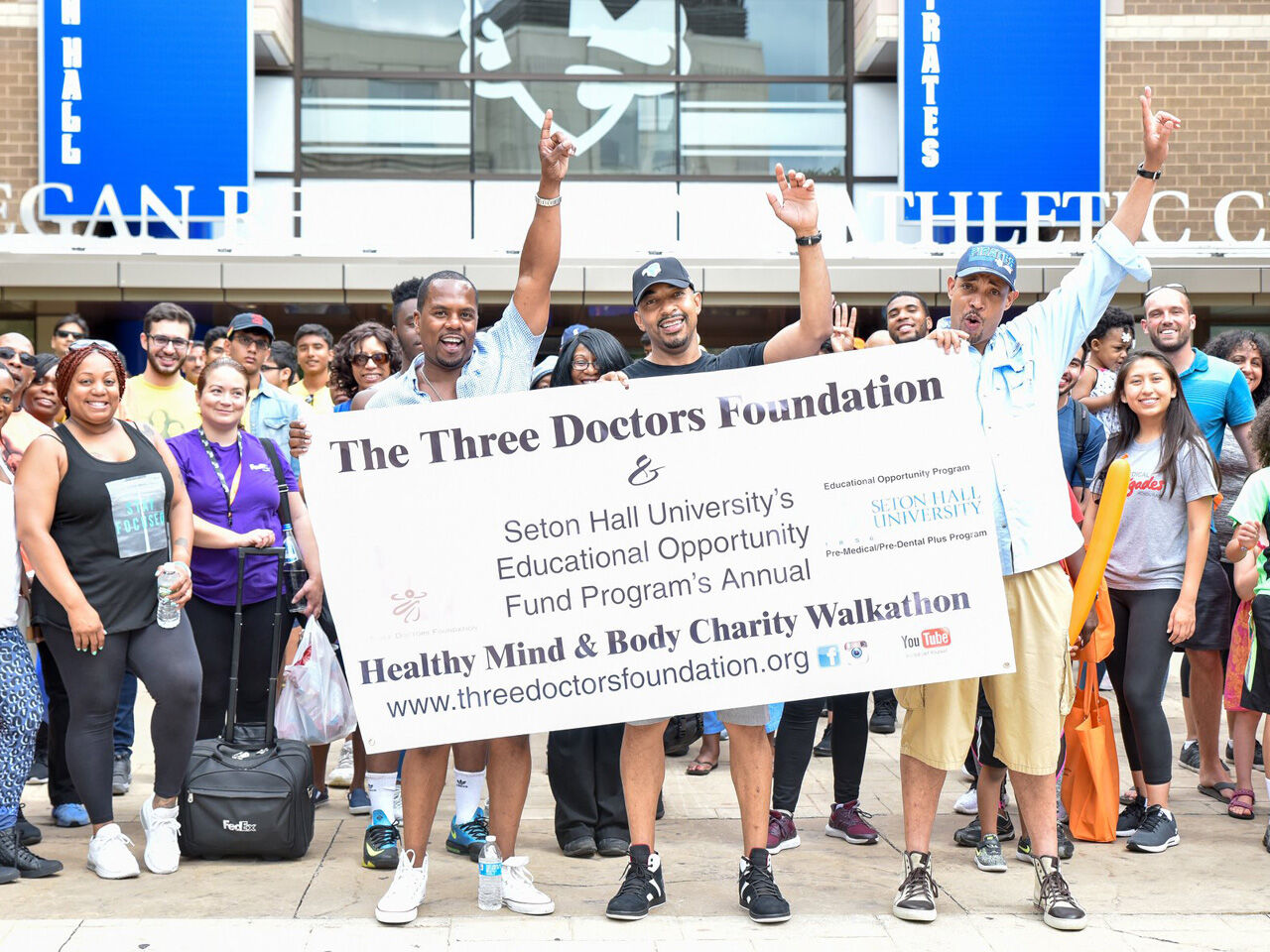
Rameck Hunt, Sampson Davis and George Jenkins made a pact as students to become doctors. They fulfilled their promise, and now tour the country to share their story with students as part of their Three Doctors Foundation. The trio will be at Crockett Middle School Saturday, Sept. 15 for Mentor Day.,

