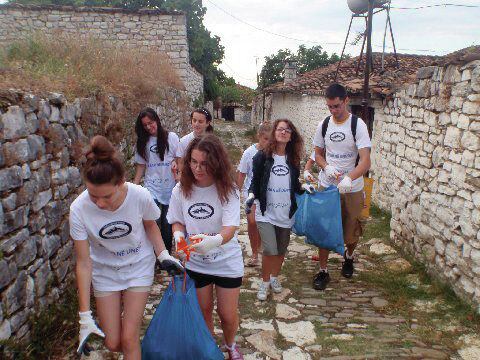
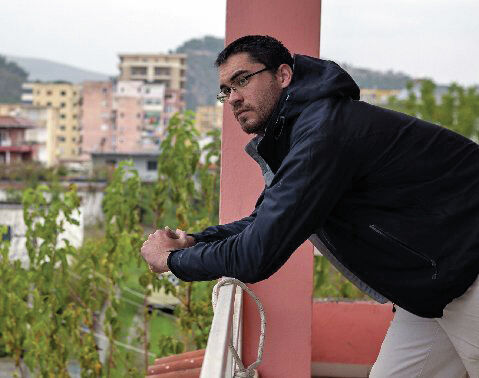
Hamilton native Dan Turkel just returned home from a 3-year Peace Corps tour of duty in Albania. Left, Turkel helps residents clean up their town. Pictured is Turkel on the balcony of his apartment in Berat, Albania.
Turkel helps residents clean up their town during his Peace Corps tour in Albania.
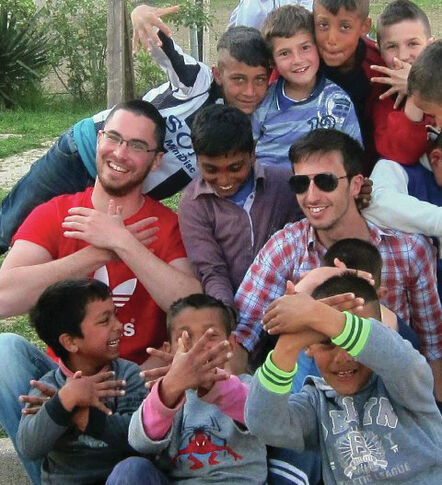
Hamilton native Dan Turkel (in red shirt) mingles with Albanian children during his stint abroad in the Peace Corps.
By Isaiah Tremaine
When he was 15, Daniel Turkel would often race his bike along Route 33 in Hamilton to reach one of his favorite places: the Classic Sub Shop. The memory of those American sandwiches would often bolster Turkel as he walked along the streets of a far-off Balkan country 11 years later, trying to improve the lives of those who live there.
The 26-year-old Hamilton native returned to America in May after a successful two-year tour of service as a Peace Corps volunteer in Albania. Most Albanian homes and buildings don’t have central heating or air conditioning. Sporadic electricity, toilets that are basically holes in the floor and a language that relatively few in the world use are just a few differences between the United States and Albania.
So how did a kid from New Jersey wind up 9,000 miles away, trying to make a difference in the lives of people he didn’t know?
Turkel first learned about the Peace Corps during his early teens. He noted it, and then he continued as a snowboarding, music-loving, cell-phone-carrying American teenager. He graduated from Nottingham High School, Mercer County College and Rutgers University. During his last year at Rutgers, the idea of the Peace Corps returned to his thoughts. He mentioned the idea of joining to friends and family.
“I was hesitant at first,” said Jackie Turkel, Dan’s mother. “I wasn’t even clear what being in the Peace Corps was all about. I looked at all that was required of him including two years away from home. Yes, I was definitely hesitant.”
But her son was intrigued by President John F. Kennedy’s purpose for creating the Corps—to help people of needy countries and to promote a better understanding of Americans.
Turkel saw great purpose and adventure in the Peace Corps. So after a year of vetting, interviews, medical exams and background checks, Turkel was admitted to the Corps and flown to the small, impoverished, formerly Communist country of Albania. When he arrived in March 2013, he was placed with a host family for a few months of orientation and indoctrination.
Once there, he was received by the greeting, “C’kemi? Si ke qen?”
“What’s up? How have you been?” never looked like that before. The Albanian language was just the first of many hurdles for Turkel. He had to live in a small farm house located in a mountain village named Pajove. Milking a cow at 5:30 in the morning and watching the mother of his host family cut the head off a live turkey for dinner became the norm.
Hamilton seemed a million miles away.
Things became a bit more comfortable when Turkel was relocated to the city of Berat. That’s when he started his real engagement with the Albanian people. The last thing the Peace Corps wants is for its volunteers to stand out, but Americans are almost idolized in Albania, Turkel said. And at 6-foot-3, Turkel already towered over most of them.
Nevertheless, he started absorbing Albanian culture. He learned to drink coffee, a must in Albanian society. Berat, a city surrounded by mountains and natural beauty, also allowed garbage to be dumped in the streets. Although the Pope visited during Turkel’s stay, Albania is primarily a Muslim country.
“I found the echoing call to pray rather alien at first, then beautiful and peaceful,” Turkel said. “The mosque-goers were always friendly to me. However, machines guns could often be heard blasting in the air as part of wedding celebrations.”
Turkel was assigned to the city’s health department, where he helped conduct health fairs and gave lectures on AIDS prevention and other STD-related problems that plague the Albanian people. He also worked with the Roma, a gypsy-like segment of the population who are often ostracized by other Albanians.
Within his duties, Turkel eventually discovered two big challenges. For one, Berat had a worn-down youth hangout with practically nothing usable for its teenage membership. He also noticed that the local hospital had a maternity ward that was woefully under-equipped. He saw an autoclave that was literally 50-years old, cold patient rooms and beds with no blankets.
Calling upon his ingenuity to get things done, Turkel rallied the people at the youth center and directed money towards purchasing audiovisual equipment and new furniture. He tenaciously sought and secured Internet service for the teens. The city considered it a major achievement, and named the place “Qendra Rinore Berat” (“Berat Youth Center”). In addition to several other activities, Turkel created and led a club that was all about discovering American culture.
The hospital problem was next. With his Albanian friend, Marius Qytyku, Turkel contacted the doctors at the medical facility to determine their specific needs. A bilirubinometer, a machine that can monitor neonatal jaundice, and an electronic syringe were high on a long list.
Through this contact, Turkel started a year-long commitment to the hospital that included funding medical equipment vendors, overcoming Albanian bureaucracy and setting up a symposium at the hospital to prepare the staff for all the new items.
His presentation to a grateful hospital staff was covered on local Albanian television. Peace Corps headquarters in Washington also noted Turkel’s outstanding efforts.
“I’m thoroughly impressed with all his work,” Peace Corps administrator Darina Kaltani said. “He’s done a great job.”
“It has been a profound pleasure to have been associated with Dan for the past two years,” said Earl Wall, the Director of the Peace Corps in Albania. “He was an effective mentor to many young people and, I know, made a significant difference in their lives. Dan is a remarkable person and made a real impact in his assigned community of Berat, Albania.”
His tour of duty was not only a win for him and the United States Peace Corps: many infants born at the Berat Hospital will have a better chance at life because of Turkel.
Yet when asked about his almost heroic exploits, Turkel only had one thing on his mind.
“Is Classic Sub still open?”
,