There are snowflakes in my kitchen, and it’s not because the freezer isn’t working correctly. Well, not exactly.
As an informal reference to people who are weak, spoiled, or overly delicate, the term “snowflake” gained popularity via Fox News in 2016, during Donald Trump’s first year in office, though it wasn’t actually used to refer to him.
The new usage was added to Merriam-Webster’s dictionary in 2019, and while its appearances are less frequent these days, for a time “snowflakes” were everywhere. Now they’re in my kitchen, in the form of weak, spoiled, overly delicate appliances.
My last refrigerator—now replaced—had been a constant source of trouble, mainly because ice would form behind the freezer wall and block the internal fan from working. The water line would freeze, blocking water flow from the unit’s exterior dispenser. In its final weeks, unplugging the fridge to thaw out the water line had become an everyday occurance, a tricky maneuver when you’re trying to keep your ice cream in a solid state.
We also replaced a dishwasher recently, after the last one began regularly leaking small amounts of water—just enough to trip an internal water detector and prevent the machine from operating.
Both appliances, refrigerator and dishwasher, were about six years old. A moment of silence please, for they died much too young, according to the manufacturer’s lifespan estimates.
In both cases, problems that seemed fixable fell prey to a common out-of-warranty conundrum: maybe a visit from a repair technician would fix the issue, but maybe it wouldn’t. Are you feeling lucky?
With the dishwasher, I rolled the dice and lost. But for $150, I did get some sage advice from the technician: just buy a new dishwasher.
The replacement dishwasher connects to an app on your smartphone —handy if you develop a sudden desire to load your dishwasher before leaving for work, but then withhold the command to run it until lunchtime. After all, sometimes you’ve got to show the dishwasher who’s boss: “You wash dishes when I SAY you wash dishes.”
But, perhaps as a sacrifice to the new features, some useful elements that had been available in the older model were now absent.
For example, the old dishwasher had a screen that could display an error code if something wasn’t working correctly. This code provided valuable information as to the nature of the problem and how to fix it. But when the replacement dishwasher stopped working after three weeks, there was no screen with an error display to read, just a series of beeps, clicks, and flashing lights that even the company’s tech helpline couldn’t interpret.
A visit from an experienced technician—this time, covered by warranty—fixed it. The original installer had placed a screw improperly, a barely noticeable mistake, but one that prevented the dishwasher door from closing completely.
Instead of reading a quick error message from the dishwasher saying “door not closed,” though, we had to go all C-3PO on its R2-D2 to figure out the problem, interpreting patterns of colored flashing lights and sounds in the crude technological language also common to wireless speakers, routers, and a multitude of other electronic devices.
This did nothing to ease the ongoing need for that high cost-per-ounce liquid gold known as “rinse aid,” which modern dishwashers demand like a diva insisting on fresh-cut flowers or a particular brand of snack basket before performing. Meanwhile, previous refrigerators demanded frequent water filter replacements, but the new model introduced yet another maintenance task, changing the air filter every six months as recommended “to ensure optimal performance.”
There was a time, not so long ago, when engineers and even product designers emphasized the practical, the efficient, the easy and successful operation of a product. Alas, that time seems to have passed in favor of a new era, marked by shorter lifespans for products due to systems that are both oversimplified and overcomplicated.
The overcomplicated is easy enough to see—touchscreens that are notoriously touchy, ovens with too many settings, vehicles and thermostats that all but demand wi-fi connections. They offer state-of-the-art conveniences, but every new feature adds to the level of complication, and the raises the odds of something going wrong.
In the old days, your dishwasher was loud and clunky, but it didn’t require rinse aid and it lasted a long time. Your refrigerator didn’t need regular replacement of its air filter, and it lasted a long time. Your thermostat lasted a long time, and its default setting wasn’t to save on energy costs by figuring out your patterns and predicting your needs, as my “smart thermostat” recently did. I noticed something was wrong when, despite the thermostat being set for 70 degrees, the temperature read 60, with no indications of impending change. Maybe AI is finally making its move on humanity—a slow and subtle first step, throwing us off our game by making us all slightly chilly.
At the other end of the dysfunctional spectrum, there’s oversimplication. Looking at many modern products, you might think that the quickest way to lose your job as a product designer is to utilize the English language. In their quest for sleek design, outward displays of information like words, letters, and numbers are frowned upon.
Thus, I’m stuck with power strip outlets that are much too sophisticated to have “ON” or “OFF” labels, but instead offer a filled-in circle and an unfilled-in circle, symbols non-intuitive enough (to me, anyway) that a round of experimentation is required every time to refresh my memory as to which is which.
A new FIOS set-top box I was forced to adopt by Verizon doesn’t show the time like the old one did; it’s smaller and sleeker, but sometimes you just want to know what time it is without having to check your phone. With no visible display of hour and minute, our TV room is beginning to feel like a casino.
In a nice “full (filled-in) circle” moment, an old radio/alarm clock that had gone unused for years may see a second life as a vital indicator of the passage of time.
I blame Steve Jobs for all this. Apple products always looked cool, but in my experience, weren’t as functional as other products on the market. Yet the world fell in love with iDevices, and its appearance-over-function credo has spread like a pandemic. Would it completely destroy the aesthetics of a television to make the on/off button a little more visible, or even a different color than the rest of the TV?
I have a message for the product designers—please stop reinventing the wheel by giving it the new, exciting twist of making it square. It’s unlikely they’ll listen, of course. In the same way text is the kiss of death for modern designers, an admission that “We’re kind of happy keeping things the way they are,” is anathema in the business world, a phenomenon I observed firsthand when I worked as a stock analyst. I attended or listened in on shareholder meetings for Snapple, Wrigley, and other companies, where they’d ask us to drink the delusional Kool-Aid (or Snapple Lemonade) while they explained their grand plans to convert large swaths of the globe into habitual iced tea drinkers and chewing gum enthusiasts.
It would be nice if some company introduced a “retro classic” line of products: simple, unsophisticated, but sturdy and reliable. Will there one day be a line of appliances where the the main feature is the lack of new features?
Hmm. The concept actually does exist in the cell phone industry, with products like the Jitterbug, a smartphone whose technology nearly dates back to the golden era of that dance. It’s extra loud, extra simple, and extra clear, but buying one would also kind of feel like giving up.
So maybe I’ll stick it out with the snowflakes. At least they’ll look pretty for the short time before they disappear. In the meantime, I’ll keep a mop handy, along with a list of technical support phone numbers, ready for their next inevitable meltdown.
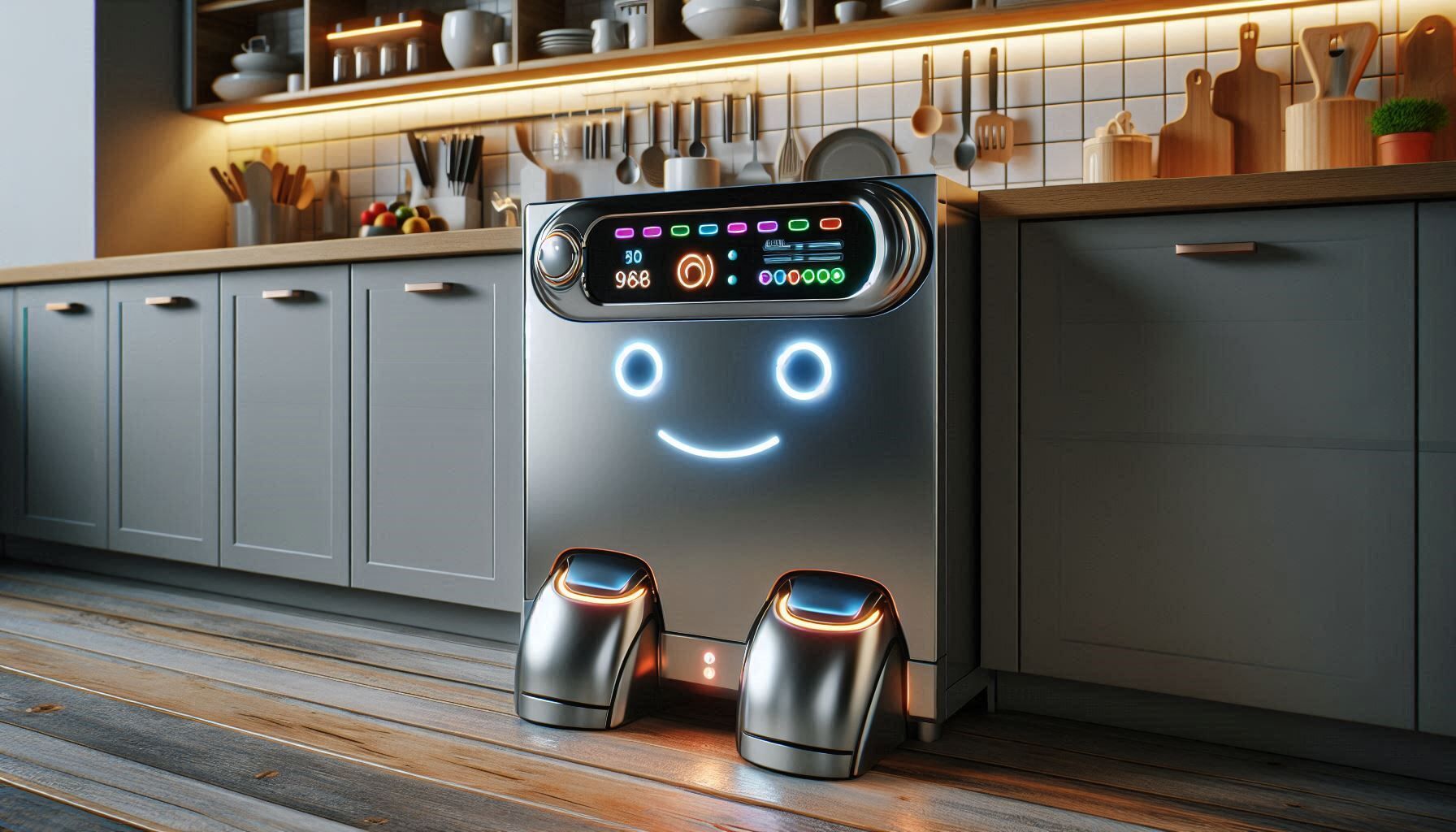
(Image created with Microsoft Designer.),

