Last month, the great solar eclipse of 2024 happened. I hope you caught at least a glimpse; the next total eclipse of the sun visible in the contiguous U.S. won’t be until August 23, 2044, and the next one with 100% totality visible in New Jersey won’t be until 2079.
Despite all the hype surrounding the event, a surprising number of people I encountered were indifferent to it. I think they missed out on an amazing experience, but ignoring the eclipse is, at least, better than attributing undue significance.
In a recent essay in the New York Times, artist Balarama Heller wrote about growing up in a community that believed in a form of Vedic astronomy that considers eclipses the result of a demon’s decapitated head chasing the sun and swallowing it. Heller describes “visceral fear” as they crowded into a temple, reciting prayers to “counteract the forces of darkness.”
I confess, I was a bit shocked at this reminder that as recently as the 1980s, people exhibited a caveman-like fear of eclipses. Though I have to admit, praying to help the world survive is brilliant, in its own scammy way, when compared with all the doomsday cults that predict the end and then have to do some serious P.R. spinning when life goes on.
As I discovered after consulting the digital gods and offering the necessary sacrifices of electricity, ad-viewing, and monthly internet subscription fees, there’s a long history of strange stories and dubious explanations regarding eclipses.
Many cultures embraced a “blame the dog” mentality—as a time-honored excuse for missing homework, purloined food, and mysterious, lingering, noxious smells, this approach is completely understandable. In addition to dogs, dragons, birds, bears, wolves, and an evil toad have all been accused of stealing and/or eating the sun.
For Siberian Tatars, the culprit was a vampire who burned his tongue after trying to swallow the sun. The Incas and Aztecs sacrificed humans to appease their gods, who, in the midst of an eclipse, must have seemed quite angry and eager to turn their favor toward a more compliant, appreciative population. The word “eclipse” comes from a Greek word meaning “abandonment,” but I think we can all agree that abandonment by the gods is preferable to active annihilation by them.
In the face of all this theft, sun-gobbling, fear of abandonment, and murder, it was nice to learn about a few myths that interpreted eclipses from a more romantic perspective. In German, Tahitian and Amazonian cultures, the sun and moon were reunited lovers, and the North American Tlingit tribes went further, proposing that the sun and moon were actively making more children—proven by the sight of “new” stars and planets only visible from Earth during an eclipse. This sounds like two more good reasons to avert one’s eyes during an eclipse—modesty and mortification.
Another positive spin was that of the Battammaliba people of Togo and Benin, who, believing that the sun and moon were fighting during an eclipse, saw it as a time to demonstrate good behavior to the gods by putting aside grudges and ending feuds. Also, nothing makes grudges and feuds more irrelevant than the imminent destruction of the world.
I suspect these stories are now universally understood as mythology, the products of imaginative ancestors who didn’t have access to the same knowledge we do today. But even in 2024, people still hold to irrational explanations of celestial events. How do I know this about people, you may ask? Simple. I read it. In People magazine.
According to a recent People interview with astrologer and author Lisa Stardust—definitely her real name—the eclipse, corresponding with “Mercury in retrograde” (an astronomical optical illusion, as seen from Earth), created a unique predictive situation. Thankfully, she was on the job, providing a series of carefully worded, mostly innocuous, and completely fanciful horoscopes.
* * *
Nothing against Lisa Stardust, but instead of astrology, I placed my confidence in ISO 12312-2, the international standard requirements for filters for direct observation of the sun. In 2017, a solar eclipse blocked about 75% of the sun, as seen from New Jersey. I didn’t buy eclipse glasses in time, so we used the old-fashioned paper and pinhole method to view the event safely. Even if I’d secured protective glasses, I don’t know if I’d have trusted my kids to wear them properly—the temptation to sneak a peek directly at the sun, just to see what all the fuss is about, is omnipresent.
This time, I acted early enough to ensure timely delivery, but I wasn’t counting on the large number of options available through online sellers. Dazzled by different colors and styles, I worried that some key component might be absent or defective in the cheaper glasses, so I did something I never do—I went with the most expensive option. Instead of $10 for 24 pairs, I paid $30 for 5 pairs.
Aside from meeting ISO standards, these glasses had been approved by AAS and CE and other important-sounding acronyms. And if the companies were lying about all that, there’d be lawsuits, right? I might go blind, but at least I’d be rich. In the end, I put my faith not in gods, but in lawyers.
The actual eclipse was an incredible event to witness, even if its peak totality was obscured by clouds in our area.
One man sought medical help after viewing the eclipse directly for ten minutes, but overall the number of injury reports was minimal, and maybe we have entreaties to gods or guidance from astrological experts to thank for that. But it seems likely that somewhere in America, someone looked at the sky wearing old-fashioned 3-D glasses, and through the filter of red and blue lenses, said something like, “It really feels like the sun’s rays are reaching out to burn my eyes!” Somewhere in the world, there’s someone who put sunscreen on his eyeballs to protect them from damage.
If you’re reading this, then it wasn’t you—congratulations! And if you missed the eclipse, don’t despair—I know all this talk of blinding radiation has you anxious to experience it for yourself. There’s a partial solar eclipse visible in New Jersey due March 29, 2025, and total lunar eclipses, in which the Earth passes between the moon and the sun, on March 14, 2025, and March 3, 2026. Maybe by then we’ll have advanced enough as a society that it won’t be—sorry, Bonnie Tyler—a total eclipse of the smart.
Peter Dabbene’s website is peterdabbene.com. His graphic novel biography “George Washington: The Father of a Nation” is now available through Amazon.com for $20 (print) or $10 (ebook).
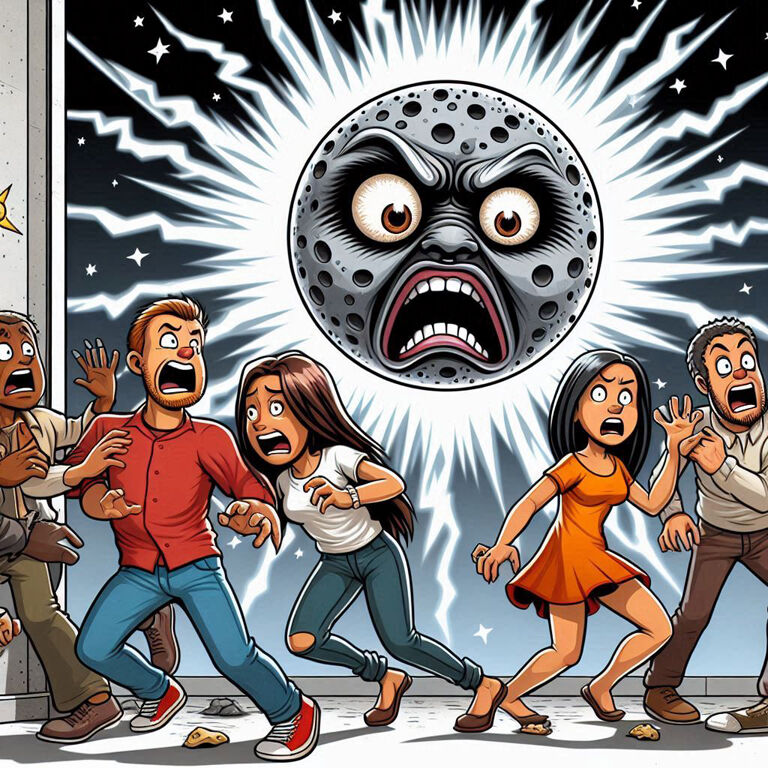
(Image created with AI.),

