I’m not a modern architecture buff—in any traditional sense. I enjoy Frank Lloyd Wright’s style, but it wears thin after a while, and I find Frank Gehry’s work to be big, loud and mostly meaningless. You can see profiles of billionaires’ estates on YouTube, but there’s a category of more obscure, much more interesting modern architecture waiting to be discovered: outsider architecture.
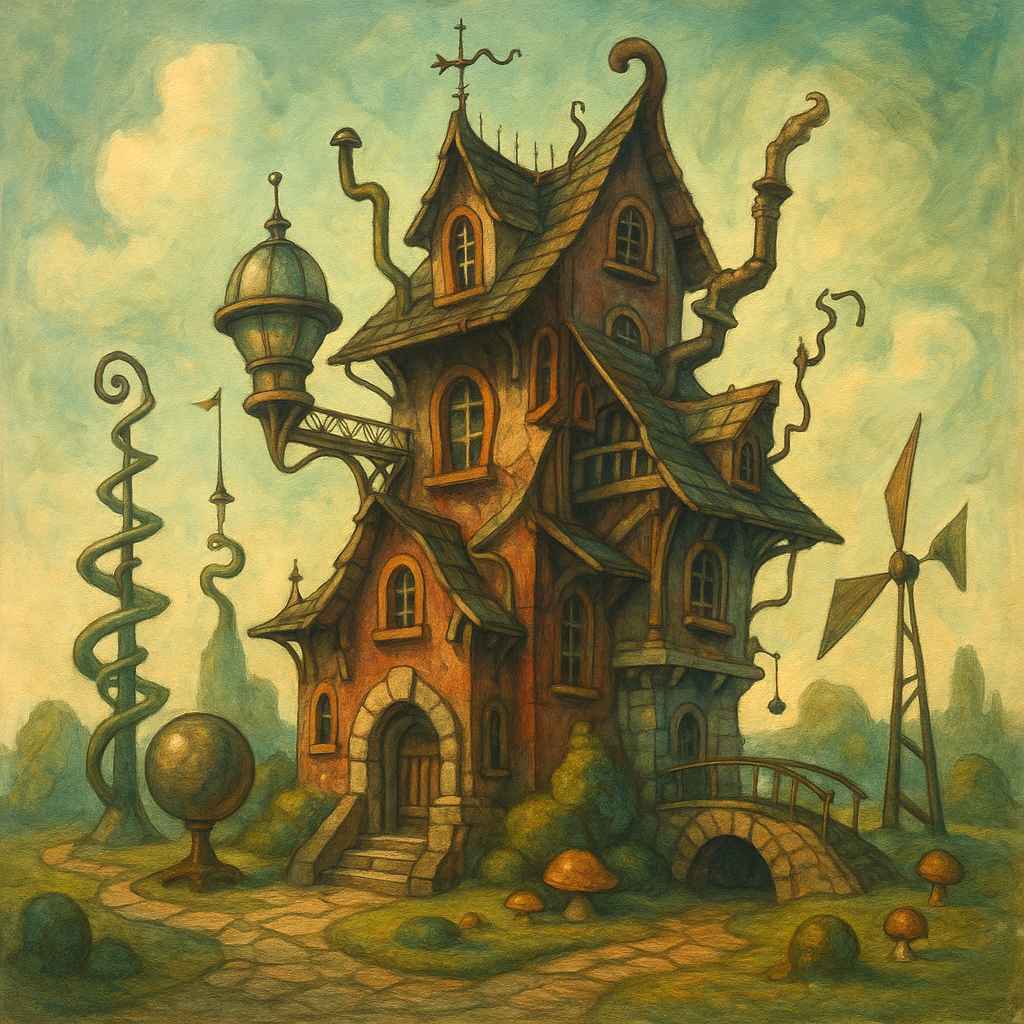
The term “outsider architecture” is used by architecture scholars to indicate the builders’ lack of traditional architectural training. Projects are often driven by a unique personal vision, and tend toward the use of found and recycled materials.
I first came across an example of it without knowing this kind of thing had a formal name (indeed, a lack of formality is one of outsider architecture’s most appealing features.) In 1989 or therabouts, I listened to the album Cheval—Volanté de Rocher by the Swedish band Isildur’s Bane. It was based on the true story of Ferdinand Cheval, a 43-year-old French postman who one day found an unusually beautiful stone on his route.
Declaring “If nature wants to make sculpture, I will make masonry and architecture,” Cheval spent the next 33 years traveling 30 kilometers a day to collect stones to build his “Palais Idéal.” His fellow villagers thought he was crazy, perhaps the first example of someone “going postal.”
Cheval only attended school until age 12, but his imagination was fueled by the illustrated magazines and postcards he delivered. Completed in 1912, his final product incorporates Biblical, Hindu, and Egyptian references, among others. It bears several inscriptions, including “The work of one man,” and “10,000 days, 93,000 hours, 33 years of hardship.”
He said later about the Palais Idéal: “I wanted to prove what the will can do.” At age 77, he began a new eight-year project, building his tomb at the parish cemetery, where he was buried after his death in 1924.
His story gives me chills, in a good way. Those looking for lessons can find them easily: the inspiration of someone following his creative vision despite obstacles and criticism; the importance of defining one’s own sense of purpose.
I had never seen pictures of the Palais Idéal until writing this column; back in 1989, the World Wide Web wasn’t a thing yet, and it hadn’t occurred to me to look it up in all the time since. But I was recently reminded of the story of Cheval, and the equally impressive achievement of Father Paul Dobberstein, who built (with one helper) The Shrine of the Grotto of the Redemption, in West Bend, Iowa. Last year, approximately 20 years after my wife and I visited The Shrine of the Grotto of the Redemption as part of a long cross-country road trip, we had a relaxing visit at the much-closer Wing’s Castle in Millbrook, New York.
Toni Wing, whose late husband Peter was the driving force behind the project, gave us a tour during our stay at the castle, which is now a bed and breakfast. The project began in 1970, when Peter proposed to Toni and promised to build her a castle.
Amid the teary fluttering of my wife’s eyelids as we heard this touching story, there were a couple of squint-eyed glares at me, communicating a silent rebuke at my failure to build a castle for her—or even a shed, for that matter.
Built with mostly recycled materials, Wing’s Castle is, like the other examples I’ve cited, an incredible monument to a singular, sustained vision. I wish Peter Wing were still alive, so I could thank him for opening his creation to the public, and also for ruining the chances of other men ever being considered romantic by comparison.
If that story is a romantic one, the next one is about as close as it gets to wackadoodle crazy. It begins on the island of Iona, off the coast of Scotland, where one William (Bill) H. Cohea, Jr. visited several times. Macbeth and Duncan, kings who inspired Shakespeare’s classic Scottish play, are buried there—but a much stranger legend stems from the site.
According to that legend, Saint Oran and Saint Columba were self-exiled monks who were having trouble building a chapel on the island. The walls crumbled every night, and Oran offered to be buried alive in the footers of the chapel, to appease the ancient energies of Iona.
Columba agreed, and buried his friend, but dug up Oran three days later. Oran was alive and well—a resurrection story somewhat familiar to Christians—and proceeded to tell Columba, “The way you think it is may not be the way it is at all.” This seems to have upset Columba’s delicate theological sensibilities, and he promptly re-buried Oran, with the consolation prize of dedicating the monastery graveyard to his frenemy’s memory.
Perhaps unsurprisingly given this backstory, Bill Cohea, Jr. had several intense dreams at Iona. Having purchased land in Bangor, Pennsylvania in 1975, he became convinced that entities from Iona, including a Guardian of the North Wind called Thor, came back to Pennsylvania with him and “took residence in the stones.”
My wife and I visited Columcille Megalith Park last year. Built in Pennsylvania by Cohea and another man, Fred Lindkvist, it sits on 17 acres, with buildings and over 90 stone settings placed in a vaguely Stonehenge-ish Celtic theme. I wouldn’t recommend a long pilgrimage just to see it, but if you find yourself in the area it’s worth a look.
Even if, like me, you don’t pay much attention to the “spirituality” of a place, it’s still a fascinating testament to the power of crazy… er, eccentric. And if you do go for sacred stones and the like, then you’ll really love it.
The Palais Idéal. Wing’s Castle. Columcille. Fonthill Castle in Doyestown, Pennsylvania. Call them the results of mad delusions, call them the works of visionaries, call them effort-intensive, all-consuming hobbies, call them a gigantic waste of time. Honestly, it doesn’t matter what you call them, because these works are, more than most architecture, completely defined by their creators.
Another name given to these kinds of structures by architecture intellectuals is “naïve art,” but to me, that reads like a not-so-subtle dig at the creators’ lack of formal training. I prefer to think of these creations, conceived without regard to commercial concerns and immune to critics’ critiques, as examples of “pure art.”
As I plan to point out to my wife, that’s at least a little bit romantic, right?
(Image generated by AI.),

