Last year, during the holiday season, a reporter called the Hamilton Township School District, the municipal offices, and the Hamilton Township Public Library with two questions: was McGalliard Elementary school named after William McGalliard? Did William McGalliard start the first Christmas Tree farm in America?
The questions kicked off an historical scavenger hunt. In the end, the answer to both questions was: Yes and Yes.
A bronze plaque adorns the entry to McGalliard Elementary school; it easily answered the first question. McGalliard School, on Arena Drive, is named after two McGalliard brothers—William and Edward.
Edward McGalliard, the younger brother, lived on South Broad Street, and served on the Hamilton Township School Board for 12 years. Born in 1861, Edward died in 1940, at the age of 79, and is buried in Ewing Cemetery.
William, the elder brother, was born in 1857 and lived on White Horse Ave. He died in 1935 at the age of 77. He is buried in Greenwood Cemetery.
A unanimous vote at an August 1951 school board meeting led to naming the school after the McGalliards. An article in the Trenton Evening Times’ noted that by 1951, the McGalliards and their relatives had lived in Hamilton for 150 years. Add this footnote: one of the board members voting on the motion back then was Albert Grice, as in Albert E. Grice Middle School.
Finding the answer to question two (Did William McGalliard start the first Christmas Tree farm in the U.S.?) took some work.
Newspaper accounts portrayed William McGalliard as a visionary, a mover and shaker, and a well known presence in the community. His former home, now the Kingston and Kemp Funeral Home, was purchased by Elmer Kemp in 1948, according to the funeral home’s website.
But it was the acreage around McGalliard’s home, and how he used and shared that land, that created a legacy still visible today.
A story in the 1935 Sunday Times-Advertiser published eight days after his death and titled, “Model Land Developer” mentioned William McGalliard practiced a “different kind of land development.”
The article made the case that most land developers bought farms, laid out the lots, and then sold them. McGalliard, however, “lived amid those he encouraged to buy, [and] took personal interest in their welfare.”
He was known to often visit his neighbors, according to the article. McGalliard reportedly bought the first set of clothes for a child born on the tract he was developing; or, he gave a family $5 (about $170 today) for every male child born.
McGalliard reportedly made 120 such gifts. He started this land development in 1903 under the name McGalliard’s Acre Lots.
William McGalliard also developed a water system for his homebuyers and neighbors. In a 1911 letter to the editor in the Trenton Times, McGalliard wrote that in 1907, he had installed an artesian well on his property.
“And today, I am supplying [water to] twenty-five to thirty houses,” he wrote. McGalliard said he was confident that he could supply 200 homes with water from his well.
William McGalliard was active in the local Democratic party. News articles mentioned McGalliard’s frustration with the size of oversight boards. He bought and sold land in places like Princeton. He was the receiver of Hamilton Township taxes from 1897 to 1900.
According to his obituary in the Trenton Evening Times, he sat on the Mercer County Planning Commission from 1929-1931. And for 20 years, he directed the Bordentown Banking Company.
But even after all of this history had been unearthed, no one could locate a primary source indicating that William had been the first Christmas tree farmer in the United States.
A township history book published in 1998 noted that McGalliard once said his Norway spruce trees were thriving in sandy soil. It was then, according to the account, that McGalliard decided to plant and sell Christmas trees. But there no dates given; no hard evidence as to when this endeavor might have begun.
At one point, there were six people searching for an answer — four township librarians, a New Jersey state librarian, and me — and we could find no primary source. There were no ads, for example, in old newspapers announcing the sale of Christmas trees by William McGalliard. There was no mention of Christmas trees in his obituary.
The reporter who had asked the questions filed a story on Dec. 16, 2022 titled: “Meet the American who planted the first Christmas tree farm: New Jersey entrepreneur W. V. McGalliard” The evidence the reporter cited came from a 1997 book by authors Ann Kirk Davis and Henry H. Albers, titled: The Wonderful World of Christmas Trees.”
Also included in the news story was a quote from a spokesperson with the National Christmas Tree Association, Jill Sidebottom.
After emailing Ms. Sidebottom, she sent me a bibliographic citation from the book. The citation referenced a 1960 letter William McGalliard’s son, David, had written to the “American Christmas Tree Growers’ Journal.” That letter was published in the November 1960 issue of the journal.
North Carolina State University library system in Raleigh had a copy of the journal and provided a copy of the letter.
When David McGalliard’s letter arrived via email, it became clear he was responding to something he had read in the journal’s August 1960 issue. NCSU also provided that article.
And here’s the gist of what likely happened.
In August 1960, the journal published a story titled: “Origin of The National Christmas Tree Growers’ Assn., Inc.” In that article was a paragraph which likely caused McGalliard’s son to respond.
“Christmas tree farming seems to have been started about 1918 in Indiana County, Pennsylvania. For ten years very little progress was made. Then in the 1930’s, it appeared to ‘catch on’ and gradually Christmas tree plantations increased both in size and number.”
David McGalliard, who by then was also growing and selling Christmas trees, set the record straight with a letter to the editor.
The November 1960 issue carried a piece titled: “A New Jersey Priority Claim.” Here is the full text:
In a friendly letter to the editor D. C. McGalliard, Morris Plains, N. J. takes us to task for a misstatement of fact in the article “Background of the the [sic] Movement” in the August 1960 number of the Journal, page 16. There we state in the third paragraph: “Christmas tree farming seems to have started about 1918 in Indiana County, Pennsylvania.” Mr. McGalliard is a Christmas tree grower, an active member of the New Jersey Farm Forestry and Christmas Tree Growers’ Association, and has written us the following:
“In the spring of 1901 my father, the late W. V. McGalliard, planted 25,000 Norway Spruce on our homestead farm in Mercer County (New Jersey), just outside of Trenton, These trees were obtained from Charles Black, nurseryman, of Highstown [sic], New Jersey, and were, I believe, imported from the Scandinavian countries, “twenty thousand (20,000) of them were 8- to 14-inch transplants and the remaining 5,000 were seedlings.
“Since I was six years of age at the time the event naturally made quite an impression on me. It is my recollection that the trees came packed in moss in a large wooden piano shipping case. They were planted on four foot centers and cultivated as long as it was feasible to do so.
“The circumstances which induced my father to go into this venture are interesting. While I think that Mr. Black, the nurseryman, may have suggested the possibilities originally, the fact that we had a ten acre gravelly field on which it had been impossible to grow a profitable farm crop, had much to do with it. Noting that a Norway Spruce hedge along the road in front of the farm grew about as well on poor soil as on good, my father put two and two together and figured that Christmas trees might be a good gamble on the ten acres which had been such a problem. The excellent market in Trenton, only four or five miles away, was no small factor also.
“When the trees were ready for market in 1907 or 1908 as I recall it, a price of one dollar each was established. The customer would make a selection in the field and the tree would be sawed off for him to take along. Many customers preferred to tag their trees weeks in advance for delivery at Christmas. Delivery was made by loading fifty or more trees on a farm wagon drawn by a team of horses and driving the four or five miles into Trenton. The one dollar price was maintained for many years thereafter.
“After the original crop was harvested several other plantings were made by my father and later by my brother. All were Norway Spruce, there being no demand for other varieties.”
One wonders if those towering pine trees in the hills above McGalliard school, west of Whitehorse Ave, were part of his farm. Either way, Hamilton can proudly proclaim itself as the home of the first Christmas Tree Farm in America, thanks to the ingenuity of William V. McGalliard.
P.S. How many of you, like me, have seen E. McGalliard Avenue and W. McGalliard Avenue and concluded the abbreviations were for East and West? Likely, it’s Edward McGalliard Avenue and William McGalliard Avenue After all, it’s not one long street crossing Whitehorse Avenue
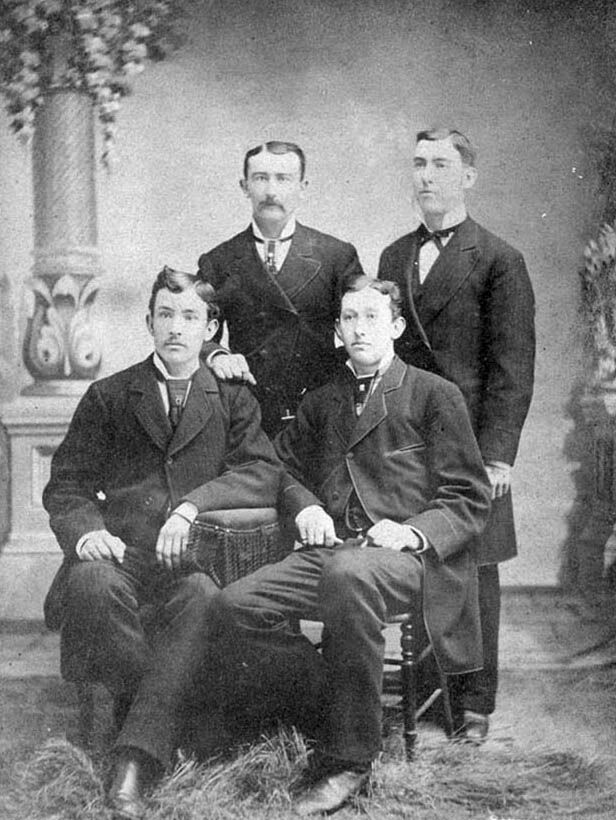
William V. McGalliard, seated front left, with brother Edward T. McGalliard, circa 1912. Standing in the rear are Theodore and Walter Ivins.,

