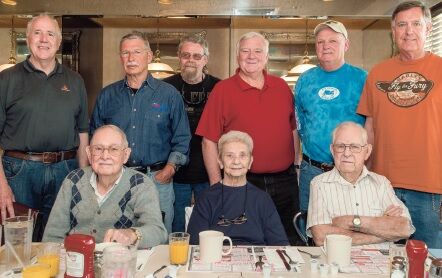
You might say that military service was a family business for the Smiths. It started during World War I, when six maternal uncles fought and their father—due to a hernia—served stateside.
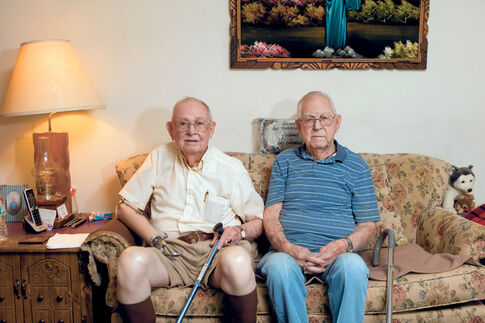
With the onset of World War II, the legacy continued when the two eldest brothers, Hamilton residents Jim Smith, 94, and his brother and neighbor Bill, 92, enlisted.
“We loved our country,” Jim said. “I don’t consider myself a hero, but I figured I had to do my part.”
The tradition of family military service continued not only with Jim’s and Bill’s six brothers, but also with Jim’s three sons, all retired from the Army National Guard, and his two grandsons, who served in Iraq.
Jim and Bill grew up in rural Ewing, but the family, which also included four younger sisters, later moved to Flock Road in Hamilton. Jim recalls riding a neighbor’s horses up and down Quaker Bridge Road for fun.
During the Depression, things were tough for the family because his dad, a machinist, couldn’t get much work, but eventually joined the Works Project Administration in Trenton.
Jim, who went to grade school at Blessed Sacrament on Bellevue Avenue in Trenton, dropped out of Trenton Catholic High School and went to work for the Civilian Conservation Corps in northern Idaho, planting trees in areas that had suffered from forest fires. He was 17, and remembers traveling four days by train to his destination and having to close the windows when going through tunnels, to keep out the steam from the engine.
Back home, Jim worked at Mercer Rubber Company in Hamilton Square.
“The job was boring,” he said. “I couldn’t wait to be drafted, so I signed up.”
At age 20, Jim joined the Army Air Corps, did his basic training in Atlantic City, attended radio school in Wisconsin and became a radio operator for the First Air Division of the Eighth Air Force.
Jim flew in formation with thousands of B-24s across the English Channel in a division that was part of the inspiration for the movie “Twelve O’Clock High.” But Jim said that his allergy problems made it difficult for him to fly at high altitudes, so he was moved to headquarters in Huntington, England.
“After the D-Day invasion, General Patton’s Third Army was moving so fast across Europe that bombers were in danger of hitting our own troops,” Jim says
So he was sent to France, where he operated a mobile radio unit until the war ended. Jim communicated with headquarters via coded messages, mostly notifying them about targets. Although Jim minimized the danger he faced, there were certainly scary moments.
“Once when I was in a truck in the field, I was told if I was sending a message, I would have to cut it off at 3 minutes because the Germans could zero in on the radio signal and aim their 88 cannons right on the spot—so I had to move,” he says.
He did, and no bombs ensued.
He also had a close call with a German patrol.
“I was in a farmer’s field alongside the barn, and patrols were coming around, and the farmer dumped hay from the hayloft on top of my truck, and I waited till the patrol went by,” he says. “Other than that I was pretty safe. You get used to it. It’s not like the infantry, who were under fire all the time, for us it was occasional times we were in danger.”
Jim considers himself fortunate that he did not have to fly, since the Eighth Air Force lost 25,000 men, and that he did not end up in the infantry like his brother Bill.
During the Battle of the Bulge, near Reims, France, at Christmastime, Jim experienced a spark of humanity from his enemy. The German fighter planes were strafing American positions every night for about two weeks, requiring the soldiers to jump quickly into slit trenches for shelter.
“One time I was in my radio truck sending a message when a plane came over, and I had to jump out and run like the devil to get out of there,” Jim said.
But on Christmas Eve, the American soldiers had a big surprise, Jim says. The German plane “came over and wagged his wings at us and went on.”
Jim’s brother Bill, who served in the Second Infantry Division, was not so lucky during the war. He was still 18 years old when he landed on Omaha Beach, wading in from a landing barge with water up to his chest and holding equipment over his head. He and the troops with him who landed on June 10, 1944 were replacements for men lost in the D-Day invasion four days earlier.
“We were constantly under mortar fire and had to take cover,” Bill said.
A few days later, pairs of men were assigned to dig trenches.
“We just got it about finished and they started firing at us,” he said. “They told us it was the Germans’ way to welcome us.”
A couple days in, the Browning automatic rifleman was wounded.
“I can remember them coming up to me,” Bill said. “They took my M1 from me and handed me the BAR. I had never fired a BAR before, not even in training. I had to learn by doing.”
Bill also remembers seeing dead bodies.
“They were laying on the ground,” he said. “One had a newspaper over his face, the other was down in a ditch, and he was in a praying position. We started looking, and they said, ‘Move it up, never mind them.’”
During the Battle of Saint-Lô in Normandy, which destroyed most of the town, Bill was wounded in the nearby town of Vire on August 3, 1944, not long after he turned 19. The Germans surrounded the barn Bill was hiding in, and forced him to run. He was hit from behind by the shrapnel from a German 88mm tank shell.
“I blew my [right] hand off, had internal injuries, lost partial hearing from the war. … I have two ribs missing, and dislocated another rib in 1965, … and have pieces of shrapnel in two parts of my body that were inoperable—the back of my head and lower spine,” Bill said.
The doctors said Bill’s life was saved because of the mandolin he was wearing on his back, taken earlier as a souvenir. Bill was decorated with a Purple Heart and a Bronze Star with an oak leaf cluster.
Bill remembers waking up in the military hospital some days later after being wounded.
“I was in a dark room,” he said. “All of a sudden a light came on and a nurse came in. I asked where I was at. She said, ‘You’re in a hospital in England.’ I asked, ‘What is the date?’ She said, ‘August 17.’ I was wounded on August 3. … I said my hand hurt. She said, ‘You don’t have a hand.’”
His injuries were so severe that when, after the war, he saw a buddy of his who had been a platoon runner after the war, “he thought he was seeing a ghost. The medic said I didn’t make it,” Bill said.
As a result of his injuries, Bill has been disabled for life. His only work has been part-time or temporary, like pumping gas or working as a night watchman in a tobacco plant.
After the war, Jim lived in Hamilton, working first as a checker for the Firestone Distribution Center and later in the print shop at Burlington County College, retiring at age 78. Jim and his wife have three sons, one of whom lives on Kuser Road, and one daughter, 10 grandchildren, and 23 great-grandchildren. A sister, 88, also lives in Hamilton.
Bill’s first stop on his return to the United States was Thomas M. England General Hospital in Atlantic City, where he underwent follow-up operations and rehabilitation. After his discharge, Bill took the train to Trenton and a cab home. The cabby, who insisted on plowing down the narrow, snow-covered lane that led to Jim’s front door, later had to be pushed out by all Bill’s younger brothers.
The cabby also refused payment, saying: “You don’t owe me anything. You’ve paid your price.”
,
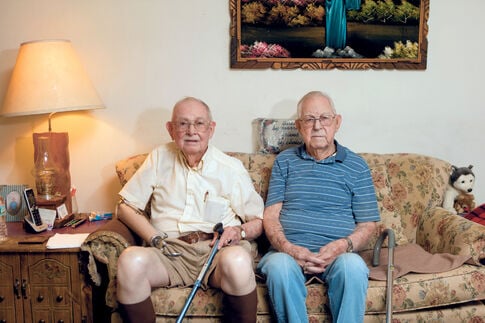
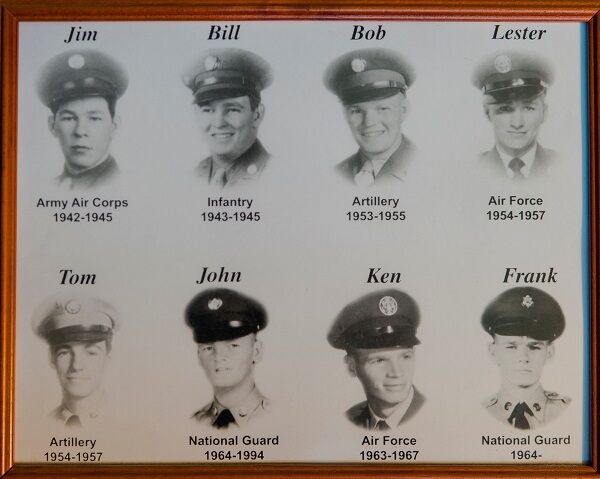
Every year, Frank—the youngest of the Smith brothers—goes on a long distance motorcycle ride with his Army buddies. This year, (front) Bill,Florence and Jim Smith saw off the riders at Golden Dawn Diner June 4, 2016. Pictured at back are Bob Adams, Tom Garrett, Dave Robertson, Michael Smith, Frank Smith and Jay Lovas. (Photo by Suzette J. Lucas.),