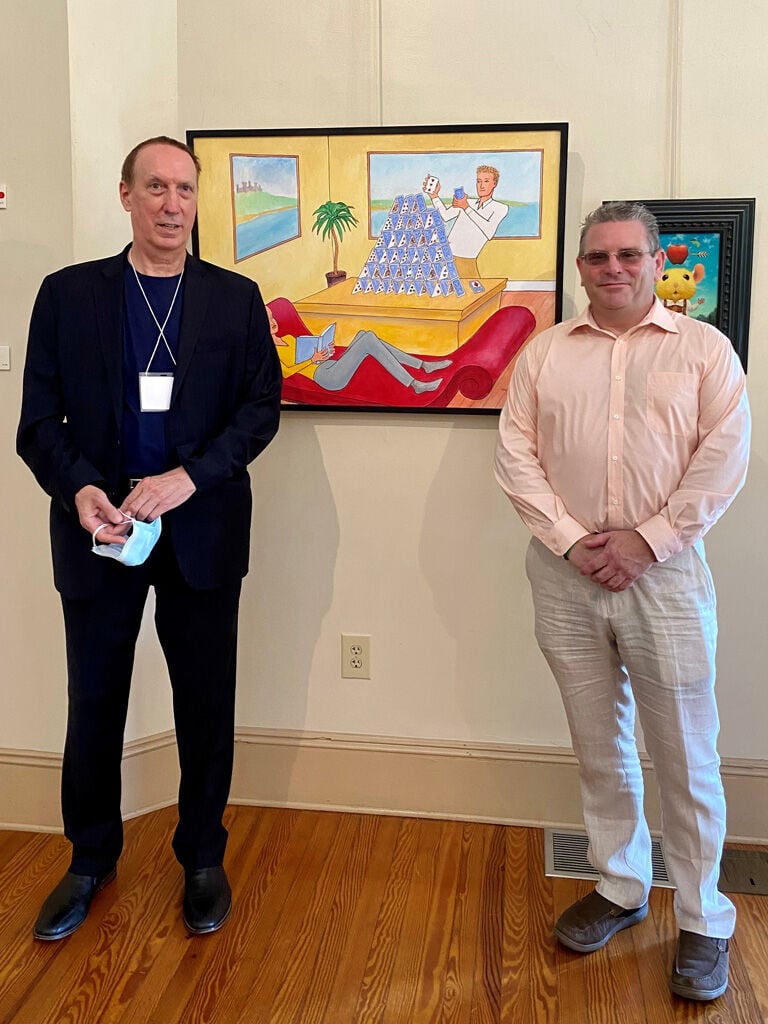
Artist and U.S. 1 arts writer Thomas Kelly is getting the Big Apple treatment as one of the featured artists in the Walter Wickiser Gallery in New York City virtual viewing room.
The exhibition — part of the gallery’s new virtual viewing room presentation — is titled “Schoolyard Forever,” and it reflects Kelly’s belief that all he learned was first learned in the schoolyard.
As noted in a statement, Kelly says, “Respect, time management, personal relationship management, physical fitness, discipline, teamwork, problem solving and having goals were all learned in the schoolyard.” And that “we copy these ideas as adults in various ways. We take strolls on work breaks, get in a run at lunch or play in organized leagues of genteel sport after work. We need these breaks, socializing and physical activity. We needed it then as we do now, and should have Schoolyard Forever.”
An artist using composition and color to create narrative illustration-based images, he has exhibited in New Jersey, New York City, and Philadelphia and has work in public and private collections around the world.
Born in 1963, the son of a pharmacist dad and nurse mother, the Hamilton-raised and based artist started his artmaking in 1993 when he began making sculptures for a house he purchased in Chambersburg.
He then followed a family member’s suggestion and took a series of art classes with Mercer County Community College’s noted faculty, including area artists Mel Leipzg, Jimmy Colavita, Michael Welliver, Frank Rivera, and Terri McNichol.
At the latter’s advice, Kelly submitted work to Artworks’ annual December 10-by-10 show. In addition to being encouraged by its inclusion, he also saw the work featured in a review by Times of Trenton arts writer Janet Purcell.
Like his community-minded instructors, Kelly got involved with the Trenton Artists Workshop Association (founded through MCCC in downtown Trenton), mounted a show at Ellarslie, and made a connection with the Artful Deposit Gallery in Bordentown and has been exhibiting there since 1999. He has also been represented by Beauregard Fine Arts in Rumson, Euphemia Gallery in Spring Lake, and Bethlehem House Gallery in Bethlehem, Pennsylvania.
He connects his deceivingly simple images of everyday life to German expressionism, an early 20th century aesthetic approach using composition and line to stir emotion.
“I was drawn to the simplicity of the Expressionists as I first learned printmaking before I tried painting,” says Kelly. “The emotional aspects of the Expressionists really appealed to me. These artists were tackling heavy duty subjects, such as hunger, angst, war, sexuality, relationship struggles and fear of death. This seriousness and emotion really captured me as opposed to the Impressionists whose work, though more colorful, did not seem to have the emotional depth. As one dealer told me about my work, ‘They can’t all be pretty pictures.’”
Nevertheless, Kelly’s work — even in depictions of darker moods — has a visual buoyancy generally used by illustrators and comic strip artists.
Reflecting on potential influences, Kelly says his parents “were always reading. We would get two newspapers, the Trenton Times and Trentonian, during the week and five newspapers, adding the New York Times, NY Daily News, and Philadelphia Inquirer on the weekends. My dad was also subscribed to Time, Sports Illustrated, Readers Digest, and the New Yorker. So we as kids had a lot of reading material influence and also the comics, photos, and illustrations. The sports and political cartoons in these newspapers may have been an influence that I really never thought about before. The single panel illustrations of Bill Gallo or Herb Block always said a lot from a small space. Plus, of course, reading the Sunday comics splayed on the floor with my two brothers and sister was a normal Sunday morning activity.”
In addition to building a presence as an area artist, Kelly has also been building a presence as an arts writer for U.S. 1 and other Community News Service publications.
It started in 2019 when he volunteered to write a series for the Hamilton Post.
He says the impulse came from an understanding of “how being written about in the press is crucial for an artist to succeed. I was blessed by having early support and encouragement from the press in this area. I read Art in America and Art News and the reviews of New York gallery shows. In some of these reviews the wording and phrasing were so complex that it was sometimes difficult to understand if they liked or disliked the show being reviewed.
“I thought that a column that would let the artist speak and answer some questions in their own voice would be interesting and may appeal to more people, not just the art crowd. I thought this column could be a win-win for both the artist and the readership.”
After contacting a friend at Community News Service and a discussion with the editor of the Hamilton Post, he began seeing his work appear in the same format that appealed to his parents.
He says the “Fight in the Museum” column’s name “came from one of my early paintings, which depicts a fight in a museum directly behind a man gazing undisturbed at a painting on the museum wall. One of the interview questions is ‘What fight/struggle do you have regarding your art? (studio space, money for supplies, physical limitations, time to create, recognition, sales, etc.?).’
“I wanted to know and wanted the artists to share the hurdles they face to be the artist they wish the world to know. We have heard all the struggles above and more. I wanted to show that being an artist is not a fun, carefree endeavor. I wanted the readership to know that making art is work, sometimes very difficult work.”
Kelly notes that the genesis for the current show in New York comes from a combination of output and hustle and participating in a group show at the Walter Wickiser Gallery on 11th Street.
Walter is the son of Ralph Wickiser, who in addition to being the chair for the New York City’s Pratt Institute was active on the regional arts scene during the rise of both abstract expressionism and pop art.
According to Kelly, son Walter grew up in the company of “famous painters and seemed to know everybody in the NYC art scene.
“We sold a few pieces during those group shows, and I stayed in touch with Walter in the years since,” says Kelly. “I would reach out periodically with news of my shows and projects. We reconnected at the Ellarslie Open this past summer, where Walter was asked to be the juror, deciding which submitted works would be accepted to the exhibit. At the opening I chatted with Walter and shared that I rarely enter juried shows because my work needs a little time for viewers to understand and become accustomed to. He agreed and said that my work needs to be shown by itself, not mixed into a group show. He said, ‘I am going to call you in a few weeks, and we will talk business.’
“Wickiser wanted to take on my work because he believes in it and understands what I am trying to portray, universal situations and emotions. Wickiser said my work was ‘very unique, Americana, and very memorable. It is like modern-day Norman Rockwell.’
“He wanted me to work in series and be ready to show for an October virtual, online show on Artsy.net, the online gallery marketplace. Wickiser went virtual after the pandemic when NYC was a ghost town and galleries were mainly closed or closing. Wickiser assured me that he was doing well virtually, and I went to work.
“I added works to a small series I had titled Schoolyard Forever. I grew up a block from my elementary school, and the schoolyard was basically an extension of our own yard but without the supervision. The Schoolyard Forever series features 10 paintings and is a direct interpretation of those times.”
The previously mentioned “hustle” is something that Kelly is always ready to do and talk up as part of the business of being an artist.
He also has written it down in a book titled “One Hundred Rules for the Aspiring Painter.” The idea was born through a series of talks presented for the Allentown Art Guild, Ellarslie, Princeton Rotary, and other organizations.
“(The book) is basically done. I hired an editor, and she helped me tighten it up and make sure that non-artists will also understand it. I am in the midst of shopping the book and wish to get the best distribution for it as I can.
“I am teaching a five-night class at Princeton Adult School in the spring, based on the book’s five sections: Composition, Control (Techniques), Color, Contemplations (How to Think), and Civilities (How to Act).
“The class is titled ‘How to Think and Act Like a Painter.’ I hope to have a way to distribute the book as I feel there will be some interest generated from the class and wish to be ready.”
Kelly adds that while the book has been 10 years in the making, “I’ve really changed very little of the initial ideas along the way. It is an upbeat read, a true combination of book smarts and real world experience.”
For example, in reference to his current schoolyard-inspired exhibition, there’s the lesson, “Paint what you know. If you want to be an honest, heartfelt painter, paint what you know. This honesty will show through in the painting. You are the artist. Tell us your story.”
Thomas Kelly: Schoolyard Forever, Walter Wickiser Gallery. Virtual exhibit on view through Tuesday, January 17 at artsy.net/viewing-room/walter-wickiser-gallery-thomas-kelly-schoolyard-forever
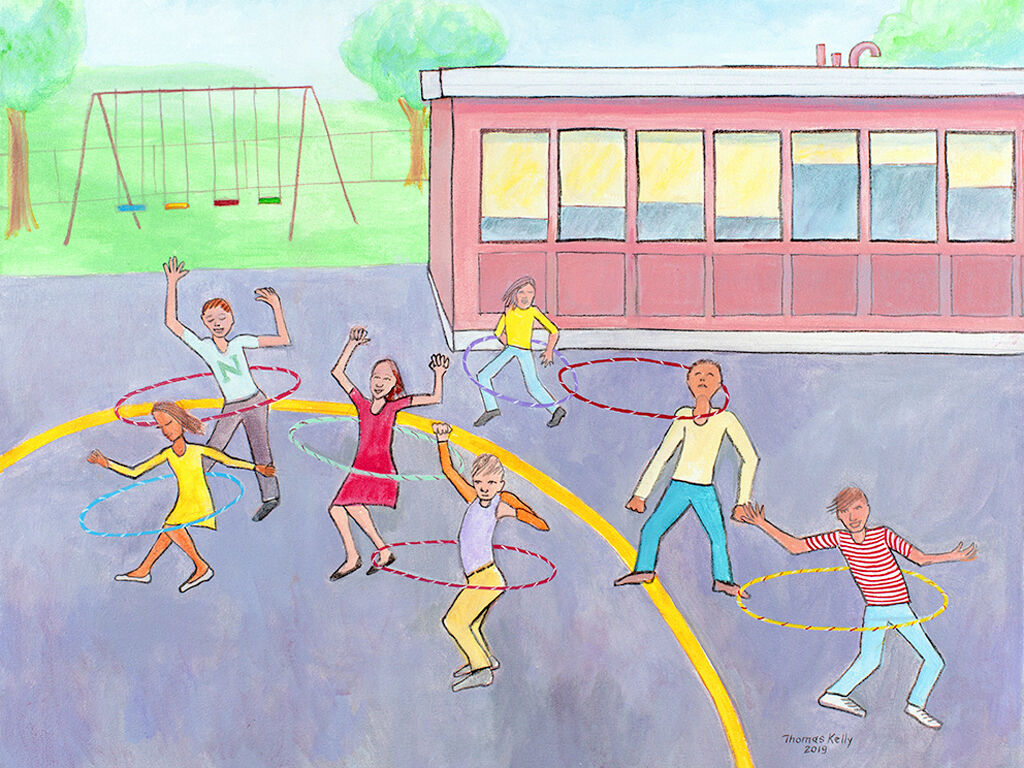
"Hula Hoops," from Tom Kelly’s 'Schoolyard Forever' series, is being exhibited virtually by the Walter Wickiser Gallery.,