Nestled on Kuser Road is a quaint dairy farmhouse landscaped with colorful shrubs and flowers.
Any visitor to the farmhouse should be prepared to step into a pre-Revolutionary home that played a part in New Jersey history.
Welcome to the John Abbott II House. The old part of the house was built in 1730. The house addition was built in 1840.
John Abbott, Sr. came from England and owned 800 acres that encompassed land from the White Horse Circle to the at Robert Wood Johnson University Hospital Hamilton. He was a merchant who owned his own docks on the Crosswicks Creek at Abbottsville. Today the area is known as White Horse.
His son John Abbott built a typical farmhouse on land given to him by his father. He never married and when he died, he left the home to his nephew Samuel.
The house was sold in 1840 to Daniel Ivins. Ivins added a parlor onto house on the first level, and two bedrooms on the second floor. The Ivins family passed the home to the George Tindall family.
Ivins daughter, Anna, married John W. Tindall in 1870. John gave the house to his oldest son, George. He would later sell the house to the Green Acres project of the Hamilton Township Government.
Only two families ever owned the farmhouse: the Abbotts and the Ivins-Tindall families.
The house was going to be demolished by the township government, but was saved by the Historical Society of Hamilton Township in 1969, and restored and opened to the public in 1976.
The house is listed on the State of New Jersey and National Register of Historical Sites.
In 1776 the New Jersey Treasurer, Samuel Tucker asked his friend John Abbott if he could hide the state funds in the farmhouse because British Gen. William Howe and his troops were in Trenton to confiscate the funds.
After Abbott agreed, Tucker hid the unsigned money in a trunk in the attic. All the spendable signed money was hidden in tubs, covered with broken dishes in the basement of the house.
A local barmaid, Mary Pointing of Crosswicks, whose husband was a loyalist, overheard the plan and told the British.
The British, along with Hessian soldiers, raided the farmhouse but only found the unsigned money in the attic. Tucker had saved the signed colonial funds totaling approximately £6,000 in the basement.
Visitors to the museum begin the tour in the 1730 section of the home, starting on the main floor in the keeping room. This room was where all the daily activities took place. All cooking was done in the large fireplace found along the wall that contains a reproduction of a beehive oven.
In the keeping room the ceiling and beams contain the original milk paint. Milk paint was made from buttermilk and mixed with color from brick dust, red clay, flowers, or berries. The wide floor boards of this room are original from the 1730s.
Eighty-five percent of the materials used in the building of the house is original and 15 percent has been restored.
Attached to the house is a shed. The shed is not original, but was taken from a house of the same time period. The shed beams were put together by tree nails or wooden pegs.
Leaving the main room on this floor, visitors would proceed to the butter room or mud room. Next to the butter room is a small bedroom, called the borning room, where a woman would give birth to her children or where an elderly family member would sleep. This was also used as a room to watch over a sick child.
The last room on the first floor is the 1840 parlor.
Upstairs the visitors would first enter the oldest part of the house, climbing up a corner staircase to an open landing. The landing was used by the women to do their handiwork.
In the 1730 part of the house, there are two small rooms and one large room. The large room is the main bedroom. It contains a large rope bed, trunks, chests, and a trundle bed.
One small room is decorated as a child’s bedroom and the other small room is an administrator’s office.
Leaving the old section of the home, visitors step up to the addition added in 1840.
The first of the two rooms on the second floor is the Tindall bedroom. All of the furnishings for this room were donated by the Tindall family.
The second bedroom is a Victorian clothing costume room. The house had no closets or bathroom. Clothing was hung on pegs or placed in dressers or chests.
Each room had crockery pots for the winter and bad weather use and an outhouse or necessary house was located out by the garden.
The remaining part of the house is the basement. There is where history was made by hiding the colonial treasury from the British. The basement also contains a curved arch root cellar. Many artifacts and donations are housed here as well.
Today, the John Abbott II House is a museum open to the public free of charge. Tours are conducted March through the second weekend of December on Saturday and Sunday from 1 p.m. until 4:30 p.m. The museum is closed on major holiday weekends, Easter, Memorial Day, July 4, Labor Day and Thanksgiving.
The Hamilton Township Historical Society has public events planned for the next few months. All three are set to be held at the Hamilton Township Public Library, 1 Justice Samuel A. Alito Way, Hamilton.
First up is “Before the Crossing: The 1776 Hessian Invasion of Nottingham and Bordentown,” a presentation set for Monday, April 6 at 7 p.m.
Following on May 4 at 7 p.m. is a presentation on the history of Grounds For Sculpture. And on June 1, again at 7 p.m., the historical society will present the program, “Remembering Groveville.”
On the web: historicalsocietyofhamiltontwpmercer.org.
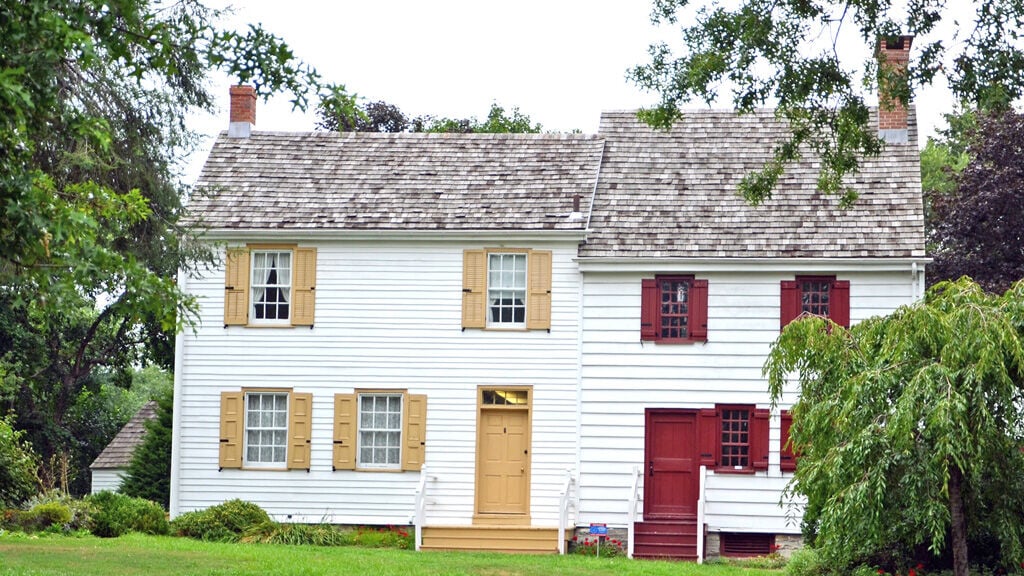
The John Abbott II house in Hamilton.,

